





 Portuguese
  English
  Spanish
  5 min of reading
  0 comments


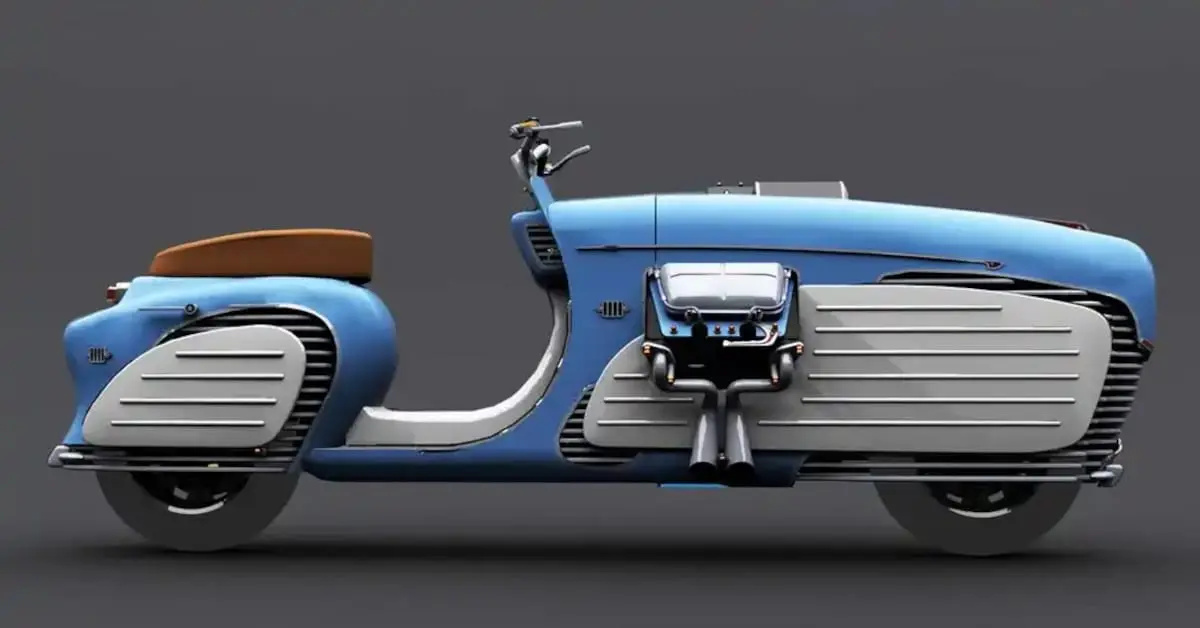
The Innovative Russian Dieselpunk Scooter, Which Combines the Charm of Retro Design from Russia with the Power of the Soviet 1,200 cc V4 Engine, Extracted from the Classic ZAZ 968. A Scooter with a Car Engine That Unites Unique Style and Performance
The Dieselpunk is a handcrafted scooter created in Russia that draws attention for combining retro style, heavy mechanics, and a 1970s Soviet V4 car engine. With a post-apocalyptic look and unusual engineering, the project went viral on social media for its brutalist design and the use of a 1,200 cc engine, taken from an old ZAZ 968 — a popular model from the automotive industry of the former USSR.
The project was developed by Sergey Kotov, an artist and mechanic dedicated to extreme vehicle customization. His creation was named “Dieselpunk,” referencing the visual style inspired by industrial machines and retro-futuristic aesthetics. Next, understand why this car-engine scooter has become a phenomenon among two-wheel enthusiasts and alternative design lovers.
Dieselpunk Russian Scooter: Power and Style from the Cold War
The Dieselpunk scooter is the opposite of what one expects from an urban and compact vehicle. Instead of a small electric motor or a combustion single-cylinder, it houses a Soviet air-cooled V4 engine, with 1,197 cc and about 40 horsepower — the same engine used in the compact ZAZ 968 V4, manufactured in the 1970s.
-
Honda performs miracles in fuel consumption with a hatch that marks 13.2 km/l in the city and 15 km/l on the highway, leaving Polo, HB20, 208, and Onix behind and becoming a reference among compact cars without resorting to turbo or hybrid systems.

-
Six diseases that seem common but can prevent the renewal of the driver’s license for the elderly throughout Brazil and surprise experienced drivers — could any of them affect you without showing clear signs?

-
With 122 hp, fuel consumption of up to 17.7 km/l, and a trunk capacity of 440 liters, this hybrid SUV impresses even though it costs up to R$ 47,000 more than the Yaris — meet the Toyota Corolla Cross.

-
600 km with three Chinese plug-in SUVs, same mode and air conditioning on: Jaecoo 7, BYD Song Plus, and Haval H6 hit the road, and the pump reveals who was truly the most economical.


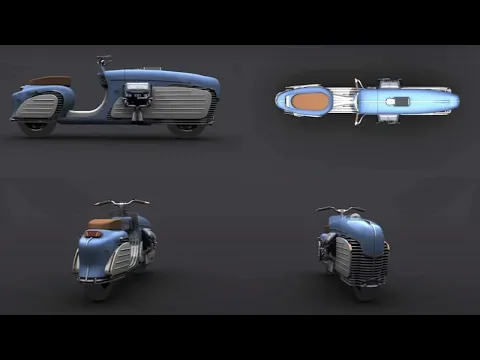

The raw power is channeled to the rear wheel through a four-speed manual transmission and a shaft-drive system, an unusual mechanical solution in scooters.
The weight of the engine required robust adaptations in the chassis, which was custom designed to ensure balance and handling. According to the creator, the goal was to build something that combined form and function with a strong historical and cultural load.
ZAZ 968 V4: The Soviet Car That Gave Rise to the Scooter
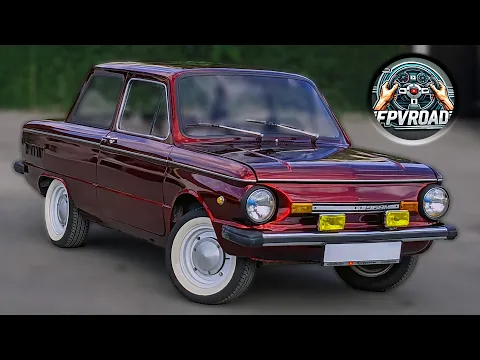
Manufactured by ZAZ (Zaporozhets) between 1971 and 1980, the ZAZ 968 was known for its affordable price and simple mechanics. Its rear-mounted air-cooled V4 engine was one of the few of its kind produced on a large scale in the former Soviet Union. With 1,197 cc, the engine was designed to be reliable, easy to maintain, and operate in various weather conditions.
The adaptation of this engine in a scooter required technical skill and deep mechanical knowledge. The propulsion system, although modest by automotive standards, delivers enough torque to turn the “Dieselpunk” into a true medium-sized motorcycle. The result is a car-engine scooter that impresses in both performance and appearance.
Retro Scooter from Russia with Brutalist and Industrial Aesthetic
The style of the retro scooter from Russia created by Kotov follows the principles of the Dieselpunk movement: raw appearance, exposed metallic finishes, and inspiration from war machines and industrial equipment from the 20th century. There are no plastic fairings, shiny chrome, or polished details — everything is made from brushed steel, bolted, or welded in plain sight.
The “Dieselpunk” project draws attention for its raw and industrial look, with exposed metal structure and finishes that refer to the aesthetics of Soviet machines from the 20th century. The V4 engine, sourced from a ZAZ 968 car, was mounted on a handcrafted frame that values the visible mechanics. One of the highlights is the custom exhaust system, described by sources as a custom downpipe, designed to fit the new positioning of the engine and reinforce the sound and visual identity of the model.
A Scooter with a Car Engine That Became a Phenomenon on the Net
The Dieselpunk project gained international notoriety after being shared on forums like Reddit, specialized portals like RideApart and Motociclismo Online, as well as YouTube videos with thousands of views.
The public’s fascination is due both to the unusual aesthetics and to the boldness of the idea: transforming an old automotive engine into a functional scooter, mixing art, engineering, and culture. It is a modern reinterpretation of “do it yourself,” where discarded parts gain new life in projects with their own identity.
Moreover, the construction of the scooter reinforces current trends like upcycling (repurposing with added value), nostalgia for the Cold War years, and the growing interest in customized vehicles that break commercial standards.
How the Soviet V4 Engine Was Adapted to the Two-Wheel Structure
Integrating a Soviet V4 engine into a scooter frame required creative solutions. Air cooling, for instance, depends on natural ventilation generated by movement, which limited the use of closed fairings.
The original transmission system from the car was retained, including the hand-operated clutch and the four-speed manual gearbox.
The shaft drive was adapted to work in a custom rear swing arm. The electrical system also needed to be redesigned, with the installation of modern battery and wiring to support the assembly.
Due to the considerably greater weight of the V4 engine taken from the ZAZ 968 compared to conventional scooter engines, the scooter’s structure was reinforced to ensure the necessary stability and safety during riding, ensuring that the chassis supports the heavier and more robust mechanical assembly.
The result is a functional machine, with performance similar to that of a medium-displacement naked motorcycle. There are speculations that the top speed exceeds 120 km/h.
Dieselpunk Russian Scooter Is a Symbol of Culture, Art, and Extreme Mechanics
The success of the Dieselpunk scooter goes beyond aesthetics or performance. It represents a rare form of cultural expression in today’s world, where handcrafted customization retrieves historical elements and transforms them into functional art. The choice of the ZAZ 968 V4, for instance, is not just technical — it’s symbolic, as it references the collective memory of an entire generation in Russia and former Soviet republics.
The Dieselpunk movement, though less known than steampunk, has gained ground among fans of industrial design, retro mechanics, and alternative fiction. In vehicle customization, this aesthetic represents resistance to modern consumption standards and a valuation of manual labor.
Projects like this also reinforce the importance of conscious repurposing. Instead of scrap, the Soviet automotive engine becomes the beating heart of a unique retro scooter — with historical, artistic, and functional value.
The “Dieselpunk” is more than just a mechanical eccentricity — it is a symbol of human capacity to transform the past into innovation. Uniting a Soviet V4 engine with a handcrafted body, this project demonstrates how culture, memory, and creativity can generate unique, functional, and expressive vehicles.
Whether for its brutalist aesthetics, the robust sound of the V4, or the narrative embedded in every weld, the Russian Dieselpunk scooter has already secured its place among the most iconic projects in the custom universe. A tribute to creative engineering that inspires mechanics, designers, and enthusiasts worldwide.









-

-

-

-

-

32 pessoas reagiram a isso.