





 Portuguese
  English
  Spanish
  4 min of reading
  1 comment


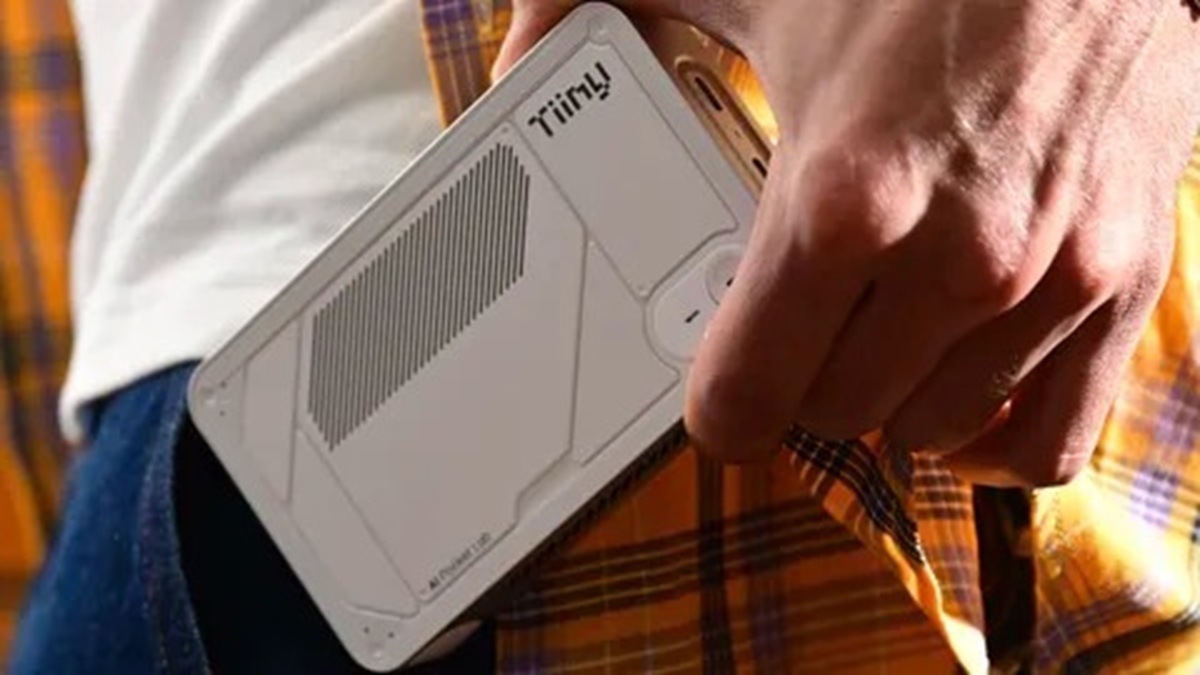

American Startup Tiiny AI Presents the AI Pocket Lab, a Portable AI Supercomputer Measuring 14.2 × 8 × 2.53 cm, 80 GB of RAM, and Capable of Running Language Models with Up to 120 Billion Parameters Locally, Without Internet, Achieving 190 Trillion Operations Per Second
An American startup has introduced a compact AI supercomputer capable of running local language models with up to 120 billion parameters. The device, called AI Pocket Lab, measures 14.2 × 8 × 2.53 cm and is designed to fit in your pocket.
AI Supercomputer Runs Complex Models Locally
The AI supercomputer was developed by the startup Tiiny AI and is designed to run advanced artificial intelligence models directly on the device. According to the creators, it is capable of operating systems with “PhD-level intelligence,” performing abstract reasoning, strategic planning, and autonomous problem-solving.
Named AI Pocket Lab, the device can locally execute a large language model with 120 billion parameters. This type of system typically requires data center infrastructure to operate, but the device eliminates the need for internet connectivity.
-
How the terraforming of Mars can transform the planet: artificial aerosols can increase the temperature by up to 35°C in 15 years, creating conditions for liquid water.

-
Scientists drilled nearly 8,000 meters into the ocean floor above the fault that caused the 2011 tsunami in Japan and discovered that a layer of clay 130 million years old was responsible for making the wave much worse than any model had predicted.

-
Thousands of years after causing the largest eruption of the Holocene, one of the world’s largest supervolcanoes is rebuilding itself beneath the sea south of Japan, receiving new magma and alarming scientists with its transformation.

-
China has activated a magnet 700,000 times more powerful than the Earth’s magnetic field that operates for over 200 consecutive hours while consuming little energy, and now the world wants to know what Beijing plans to do with this technology in 2026.

This capability allows for advanced local coding, document analysis and enhancement, and multi-step reasoning. Processing occurs entirely on the device itself, without relying on external servers or cloud computing.
Compact Hardware Concentrates Large Memory Volume
Despite its small size, the AI supercomputer features an unusual hardware configuration for portable devices. It is built around a 12-core ARM processor, an architecture common in smartphones, tablets, and laptops.
The device measures just 14.2 × 8 × 2.53 centimeters but includes 80 GB of LPDDR5X RAM. In comparison, most current laptops have between 8 GB and 32 GB of RAM, highlighting the device’s high memory capacity.
Of the total available memory, 48 GB is reserved exclusively for the neural processing unit, known as NPU. This type of chip is optimized for artificial intelligence-related computations and has already been incorporated by manufacturers like Intel and AMD.
These specialized processors enable handling of intensive AI workloads and meet the 40 trillion operations per second limit set by Microsoft for running AI features on Windows 11.
Computational Power Allows It to Be Classed as an AI Supercomputer
The device is considered an AI supercomputer due to its ability to execute workloads typically associated with much larger systems. In particular, it can perform local inference on language models with over 100 billion parameters.
In conventional environments, such processing typically requires systems with multiple GPUs and data center infrastructure. In the AI Pocket Lab, these tasks are executed directly on the device’s compact hardware.
Among the models that the device can run are GPT-OSS 120B, large-scale Phi models, and large-parameter Llama family models. This capability expands access to advanced artificial intelligence tools in environments where remote server connections are unavailable.
The development of the device also aligns with a growing trend towards edge computing for artificial intelligence. This model seeks to reduce energy limitations and the environmental impact associated with distributed processing in large data centers.
Power of 190 TOPS Combines CPU and Neural Unit
Even though it is extremely compact, the AI supercomputer offers significant computational power. The system delivers around 190 trillion operations per second, resulting from the combination of its CPU and neural processing unit.
This level of performance positions the device as part of a miniaturization process of advanced computing systems. The project also follows a similar trend to the recent announcement of Nvidia’s mini PC Project Digits, although with significantly smaller dimensions.
To concentrate such processing capacity in a compact chassis, the Tiiny AI team utilized various optimization techniques. Among them is TurboSparse, a technology that allows running large language models more quickly on hardware with limited resources.
In traditional models, all parameters are used in each processing step. In the TurboSparse system, only the parameters needed for each step are activated, reducing the volume of calculations required.
Optimization Technologies Reduce Energy Consumption
Another technology integrated into the AI supercomputer is PowerInfer, responsible for managing workloads between CPU, GPU, and NPU. The system uses heterogeneous scheduling to distribute tasks among the most suitable processors for each type of calculation.
This mechanism boosts the overall efficiency of the device and reduces energy consumption. PowerInfer also includes intelligent power management, automatically adjusting the maximum processing usage according to need.
According to the developers, this approach also eliminates some unnecessary calculations during the processing of language models. As a result, the system can maintain high performance even in a device with reduced dimensions.
AI Supercomputer Enhances Privacy and Use Offline
The ability to execute advanced language models directly on a portable device brings implications beyond miniaturization.
One of the noted effects is the reduction in reliance on large data centers.
Another consequence relates to privacy. Since processing occurs locally, the data used does not need to be sent to external servers or processed in the cloud by third parties.
This characteristic also enables the use of artificial intelligence in environments without connectivity. Examples cited include remote research stations, ships, and aircraft that operate outside internet network reach.
In this way, the portable AI supercomputer expands the possibilities for applying advanced language models in situations where traditional cloud computing infrastructure is unavailable.










O texto enfatiza, diversas vezes, que o aparelho funciona sem acesso à internet e, no entanto, não elucida o modo como os dados são colocados e/ou removidos do HD.