





 Portuguese
  English
  Spanish
  5 min of reading
  0 comments


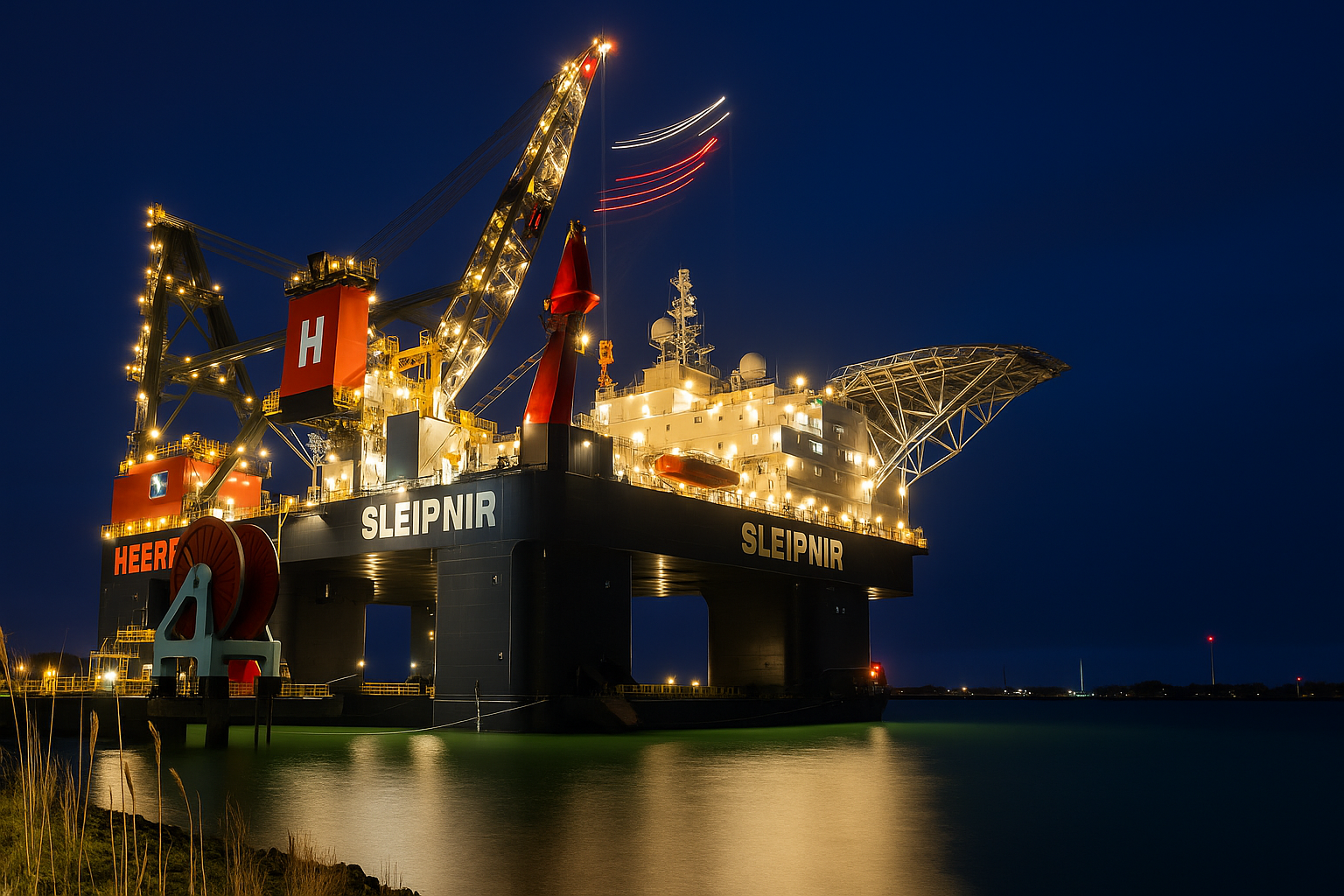
Meet the SSCV Sleipnir, the Giant Crane with 40-Meter Arms and Power Equivalent to 1,500 Men, Used in the Assembly of Warships and Offshore Mega Structures.
In a world where marine structures are increasingly colossal — oil rigs, warships, and offshore wind turbines — there is a machine that stands out for its size and superhuman capabilities: the SSCV Sleipnir, a true giant floating crane. Capable of lifting up to 20,000 tons at once, it has 40-meter-long arms, each with power comparable to that of 1,500 men.
Designed to perform the most complex tasks in offshore engineering, this crane ship is a key piece in the construction of offshore platforms and the installation of components for warships, underwater structures, and floating power plants. More than just a crane, the Sleipnir is a masterpiece of modern naval engineering, combining technology, power, and sustainability.
In this article, we will explore all about this titan of the seas — its operation, applications, curiosities, and impact on the naval and defense sectors.
-
Mr. Mário reveals the technique of the caipira papaya: he cuts the fruit in half, discards the seeds from the tip, and plants the ones from the back to increase the chance of a productive female tree.

-
Few remember, but the submarine that disappeared in 1968 with 52 crew members was found after 51 years at the bottom of the sea at more than 2,000 meters, intriguing the entire world.
-
With 1,200 tons suspended, the Japan mega-structure in a grid shape with a floating sphere from Fuji TV features two 25-story towers connected by elevated walkways, titanium panels, and impresses the world with its ability to reduce wind impact.

-
The village where two rivers run side by side without mixing in Santarém and Alter do Chão reveals some of the most beautiful freshwater beaches on the planet.


What is the Giant Crane SSCV Sleipnir?
The SSCV Sleipnir (Semi-Submersible Crane Vessel) is a semi-submersible ship equipped with two of the largest offshore cranes in the world. Designed and operated by Heerema Marine Contractors, the ship was named after Sleipnir, the eight-legged mythical horse of the Norse god Odin — a perfect metaphor for its stability and power.
Officially launched in 2019, the Sleipnir was designed to meet the heaviest demands of the global offshore industry, particularly in:
- Construction and decommissioning of oil and gas platforms;
- Installation of offshore wind turbine bases;
- Assembly of military naval structures, such as hulls and communication towers of warships;
- Transport and positioning of floating industrial modules.
Technical Characteristics of the Giant Crane
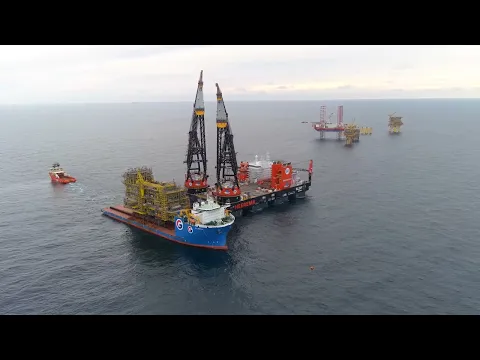

The dimensions and capacities of the Sleipnir impress even the most experienced engineers:
| Characteristic | Specification |
|---|---|
| Total Length | 220 meters |
| Width | 102 meters |
| Gross Weight | 119,000 tons |
| Lifting Capacity (Total) | 20,000 tons (2x 10,000 t) |
| Arm Reach | 40 meters |
| Crew | Up to 400 people |
| Propulsion | Hybrid system with LNG |
| Stabilization | Semi-submersible with 12 thrusters |
The two main cranes work in sync, capable of lifting steel modules dozens of meters high and weighing thousands of tons, ensuring precise positioning even in rough seas.
How Does a Semi-Submersible Giant Offshore Crane Work?
Unlike a land crane, the semi-submersible offshore crane needs to operate with extreme stability in ocean environments, where waves, wind, and currents make any cargo movement a logistical challenge.
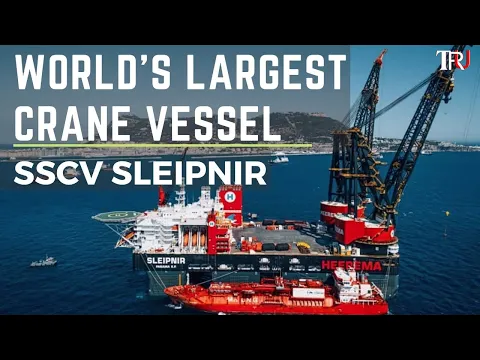
The Sleipnir uses a ballast system with submerged tanks that allow it to sink part of the hull, reducing sway and keeping the platform level even in open sea. This is essential for installing parts with millimeter precision — whether in a drilling tower or in a military ship hull.
Applications in the Construction of Warships
Although the Sleipnir is widely known for its operations in the oil and gas sector, its use in naval construction has been growing in recent years.
Why?
- Modern warships have large pre-fabricated modules;
- The hull, deck, and superstructures are assembled separately and then integrated;
- Conventional cranes cannot support the weight or height of these structures;
- The Sleipnir can install entire blocks at sea or at coastal shipyards, saving weeks of operation.
Shipyards in Europe and Asia have already used the Sleipnir to position radars, command towers, missile silos, and heavy superstructures on warships and ocean patrol vessels.
Sustainability and Energy Efficiency
The Sleipnir is the first floating crane in the world powered by LNG (liquefied natural gas), which drastically reduces its pollutant emissions:
- 25% reduction in CO₂ emissions compared to diesel ships;
- 85% reduction in nitrogen oxides (NOx);
- Practically zero sulfur emissions (SOx).
Additionally, the ship is equipped with heat recovery systems, energy regeneration systems, and intelligent consumption management, making it a model of sustainable engineering in the heavy sector.
Comparison with Other Cranes in the World
Although there are other large-scale maritime cranes, the Sleipnir is currently the most powerful in the world, surpassing competitors such as:
| Cranes Ship | Lifting Capacity | Year of Construction | Operator |
|---|---|---|---|
| SSCV Sleipnir | 20,000 tons | 2019 | Heerema Marine Contractors |
| SSCV Thialf | 14,200 tons | 1985 (refurbished) | Heerema |
| Pioneering Spirit | 15,000 tons (lift) | 2016 | Allseas |
| Saipem 7000 | 14,000 tons | 1987 | Saipem |
Curiosities About the Sleipnir
- The ship can operate at depths of up to 40 meters without traditional anchoring.
- It has already participated in the removal of decommissioned oil platforms, with over 10,000 tons of material per operation.
- Its control system is automated by artificial intelligence for real-time load adjustment.
- It made headlines in 2022 by lifting a 10,000-ton drilling tower from a military ship in South Korea, one of the largest ever installed.
Geopolitical Impact and Military Use
The Sleipnir’s ability to operate with ultralheavy military loads attracts interest from navies and governments around the world. Although it is a civilian equipment, its rental for strategic naval operations has become frequent in countries such as:
- United States
- United Kingdom
- South Korea
- India
These countries use the Sleipnir in large-scale shipyards, where its precision and power accelerate the production of warships and aircraft carriers.
Operational Challenges and Safety
Working with loads of this magnitude demands a strict safety protocol:
- 3D simulations before each operation;
- Real-time weather monitoring;
- Teams of specialized engineers and operators on board;
- Redundant stabilization and cargo locking systems.
A failure could result in catastrophic accidents, which is why the automation and precision level of the Sleipnir is among the most advanced in the world.
The Future of Offshore Construction with Mega Cranes
As the demand for larger naval structures grows — whether for military, energy, or scientific purposes — giant cranes like the Sleipnir become indispensable. The new generations of offshore wind turbines, for example, require the assembly of towers over 250 meters tall, something that only equipment like this can safely install.
Furthermore, with the advancement of what is called “naval modularization,” where ships are built in blocks and assembled at sea, the role of these floating cranes will become even more strategic.
The SSCV Sleipnir is much more than a giant crane. It represents the strength of modern naval engineering, the pursuit of energy efficiency, and the versatility of a machine that operates in both commercial operations and the construction of warships. With 40-meter arms and power equivalent to 1,500 men, it stands as a symbol of power, precision, and sustainability on the seas of the 21st century.






Seja o primeiro a reagir!