





 Portuguese
  English
  Spanish
  4 min of reading
  4 comments


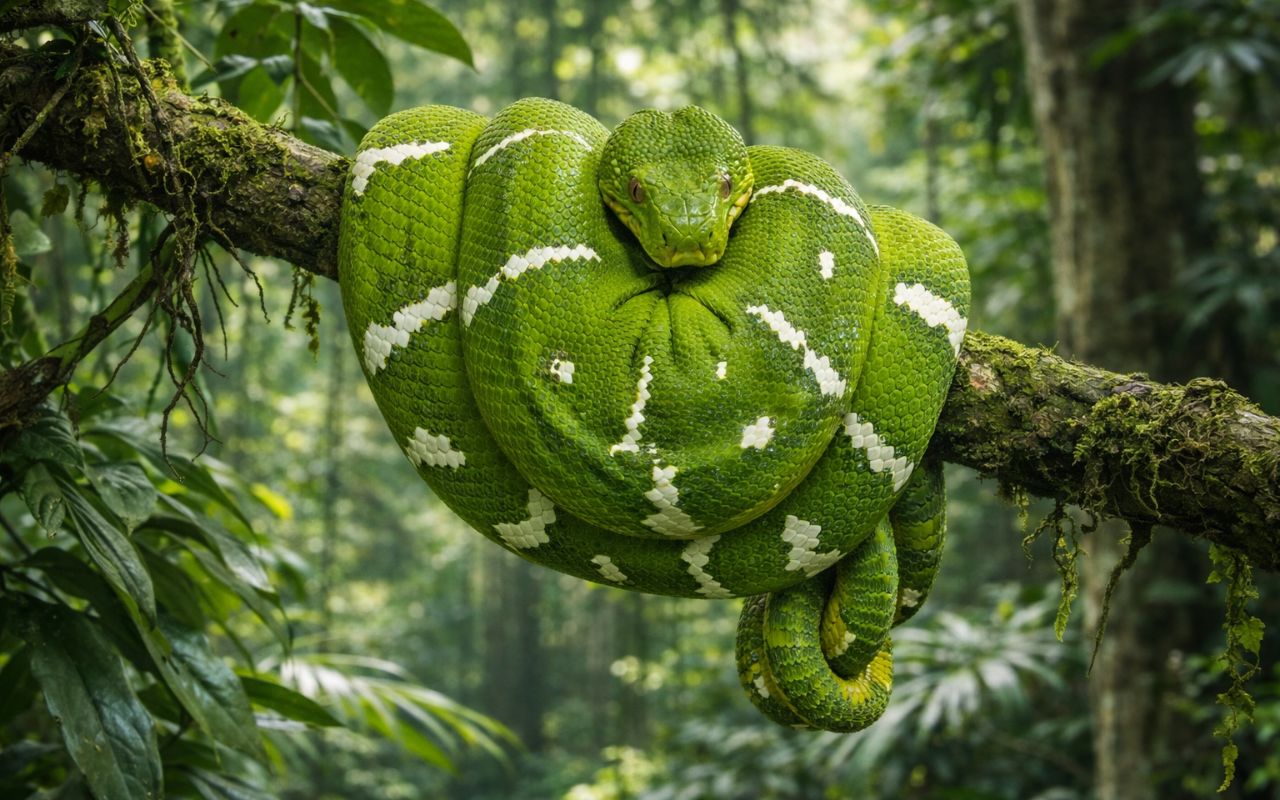


Discover The Curiosities Of The Parrot Snake (Corallus batesii)! Learn About The Behavior, Vibrant Colors, And Nocturnal Habits Of This Fascinating Snake That Lives At The Top Of The Amazon.
The parrot snake, scientifically known as Corallus batesii, is one of the most impressive species of South American fauna. Biologists emphasize the importance of knowing this snake that, despite being imposing, is essential for the balance of the Amazon.
A resident of the heights, it stands out for spending most of its time hanging from branches up to 15 meters high, using its vibrant coloration to camouflage itself among the tropical foliage.
Unlike many of its relatives, the parrot snake is an excellent climber. It chooses the treetops in the Amazon Basin—covering countries like Brazil, Peru, and Colombia—to live and hunt.
-
He started running at 66 years old, broke records at 82, and is now a subject of study for having a metabolic age comparable to that of a 20-year-old, in a case that is intriguing scientists and inspiring the world.

-
Oldest tree on the planet reappears after 130 years of searches: Wattieza, 385 million years old, was 10 meters tall and had no leaves or seeds; Gilboa fossils in New York solved the mystery in 2007.
-
A 48-square-meter house assembled in hours with 4,000 bricks made of recycled plastic that does not absorb moisture, has natural thermal insulation, and costs less than 90,000 reais in a complete kit.

-
Luciano Hang revealed that Havan’s air fleet has already accumulated more than 20,000 landings, 10,000 flight hours, and 6 million kilometers traveled, and he says that without the planes, the company would never have grown so quickly.

This survival strategy allows it to avoid terrestrial predators while monitoring its prey from above, coming down to the ground typically only under the cover of night or in search of water during dry periods.
Where Does The Parrot Snake Live And How Does It Behave?
The parrot snake is an endemic species of wooded areas with high humidity. Although its main home is the Amazon Rainforest, the Animal Diversity Web (ADW) notes that it can also be spotted in savanna areas and drier forests of South America.
Its routine is marked by diurnal rest in the heights. Unlike most snakes that crawl on the ground, the Corallus batesii prefers to coil up on elevated branches.

During the day, it remains practically motionless, but at dusk, its behavior changes. As it is nocturnal, it takes advantage of the darkness to descend or move between trunks in search of food.
The Hunting Technique And The Impressive Size
Many wonder if the parrot snake poses a danger to humans. The good news is that it is not venomous, meaning it has no poison. However, that does not make it any less efficient as a hunter.
Check out the main characteristics of attack and size:
- Size: Can reach up to 2 meters in length.
- Vision: Its vertical pupils are adapted to regulate light and see clearly in the dark.
- Strategy: It coils around its prey and applies enough pressure to hinder the animal’s breathing.
- Menu: Primarily feeds on small mammals like opossums, rodents, and bats, as well as birds.
Why Is It Called The Parrot Snake?
The common name is not by chance. The color combination of the Corallus batesii directly reminds one of the colors of the Brazilian flag and the talking bird.
According to the Butantan Institute, the snake’s body is predominantly green with white dorsal spots, while its belly displays an intense yellow.

This exuberant aesthetic, however, goes beyond beauty: it is an essential survival tool called camouflage.
In the treetops, the green and white mimic the sunlight passing through the leaves, making the snake nearly invisible to birds of prey.
The Amazing Color Change Of The Youngsters
One of the most curious facts about the parrot snake is that it is not born green. The life cycle of this snake presents a fascinating visual transformation:
Young Stage: The youngsters have an orange or reddish coloration. This occurs because, being small, they inhabit lower and thinner branches, where the earthy tone helps to hide them among the twigs.
Transition: As they grow and gain strength to climb to the tops of the trees, the color gradually changes.
Adult Stage: Once established in the heights, it assumes the definitive emerald green tone to blend in with the dense foliage.
Preservation And Scientific Importance
The preservation of the parrot snake is vital for controlling rodent and bat populations in the forests.
Institutions such as the Butantan Institute and the Museum of Zoology at the University of Michigan highlight that understanding these peculiar habits is the first step to protecting South American biodiversity against animal trafficking and deforestation.

Nature shows us, through this snake, how evolution creates perfect mechanisms of adaptation.
Whether by color, by the way it hunts, or by its habit of living in heights, the Corallus batesii continues to be one of the most valuable jewels of our fauna.
With information from the website National Geographic







This is a picture of an Emerald Tree Boa also a south American snake found in the Amazon. This is not a parrot snake.
muy bueno lo que publican sobre la fauna silvestre me encanta mucho el tema
Excelente aprender de las distintas especies de serpientes que hay, impresionante esa especie.