





 Portuguese
  English
  Spanish
  6 min of reading
  0 comments


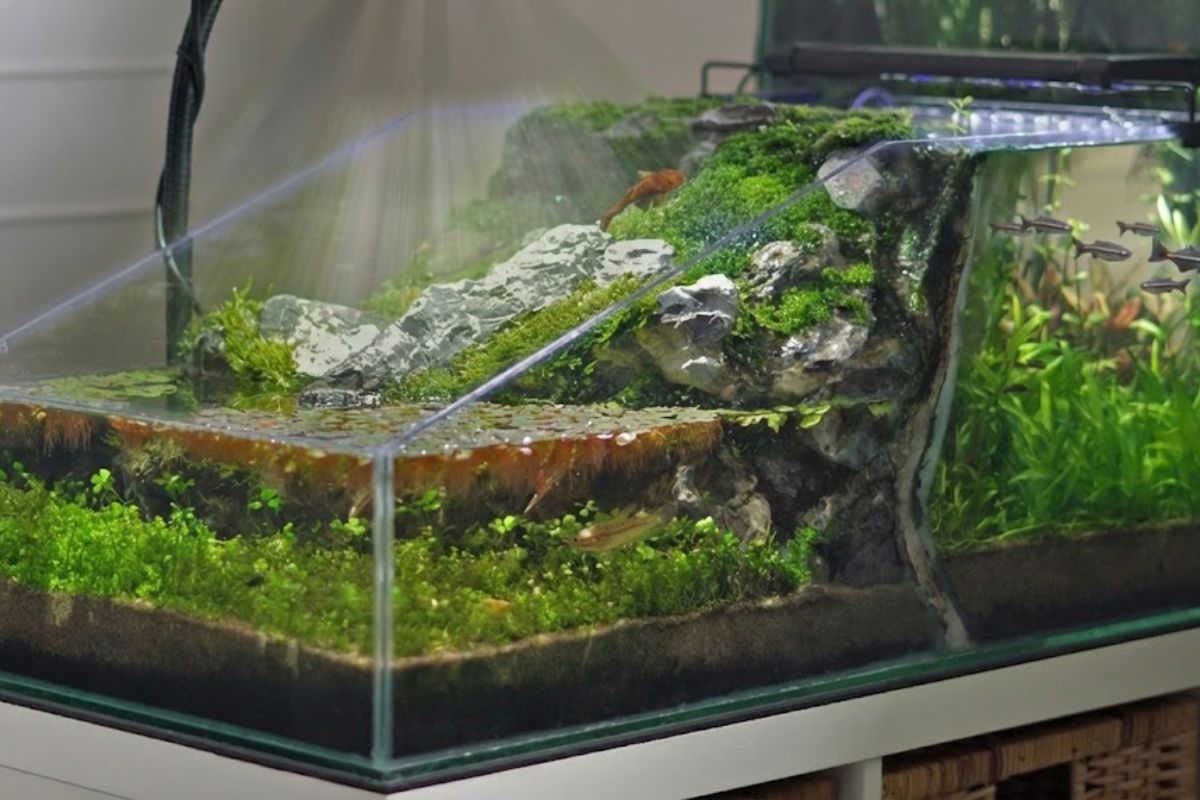
Functional Waterfall in Home Aquarium Reveals Shrimps, Catfish and Microfauna Climbing Against the Current, Connects Two Levels of Water and Exposes Limits of a Closed Recirculating System Inside the House
At first, the idea arises from a detail: when adding shrimps to an existing aquarium, the creator notices the constant attraction to the current and decides to design a habitat dedicated to animals that swim against the flow. The proposal turns into a functional waterfall at home, with two interconnected and visible water levels from the hallway, exploring behavior and adaptation on a controlled scale.
Once the system is filled, observation becomes the method: each ascent turns into data. Shrimps reach the top in a few minutes, nocturnal catfish look for the “upstream” path, and microfauna occupies the dense plant areas. At the same time, the project exposes practical limits of the closed recirculating aquarium, such as leaks, increasing hardness and the need for occasional maintenance.
Project and Materials: Reused Glass, Rock and Level Containment

The starting point is an empty space and a cube organizer obtained for free, chosen for its visibility at the end of the hallway.
-
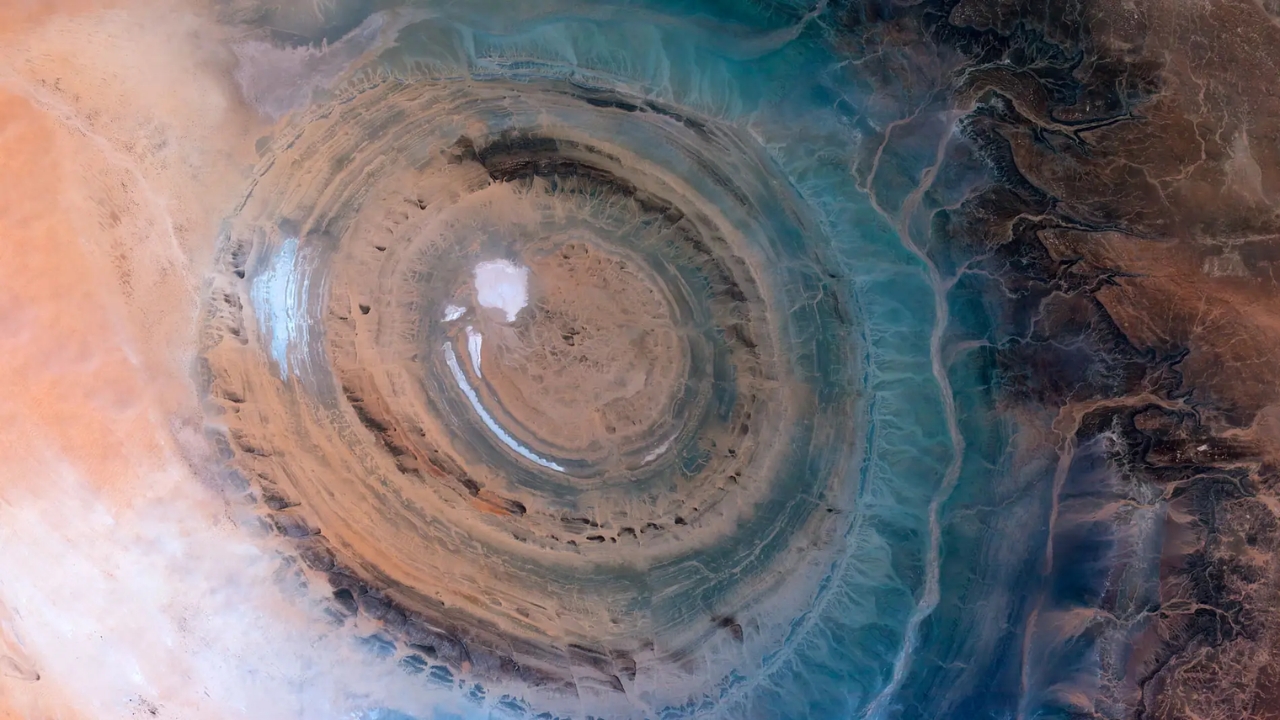
For decades, a 50-kilometer ring structure in the middle of the Sahara has puzzled scientists: visible from space, it reveals layers of millions of years and turns the desert in Africa into a geological mystery.
-
With an unusual prize, Japan transforms office chairs into a resistance race on the streets, the ISU-1 Grand Prix grows, fills events, and pays 90 kilograms of rice.

-
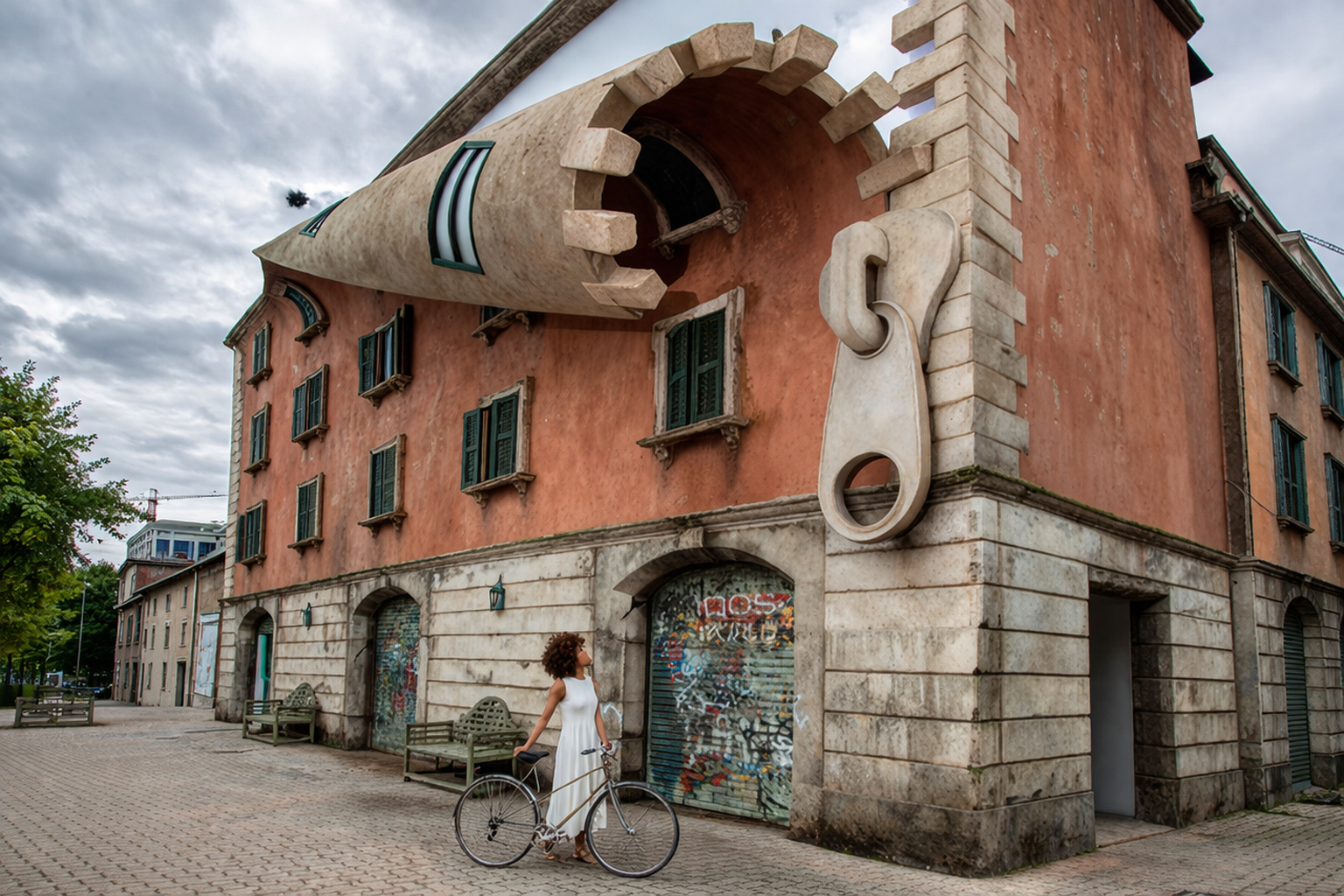
With a façade that resembles a giant zipper, the building in Milan creates a sense of strangeness, featuring lighting that transforms engineering and attracts the attention of residents and tourists.
-
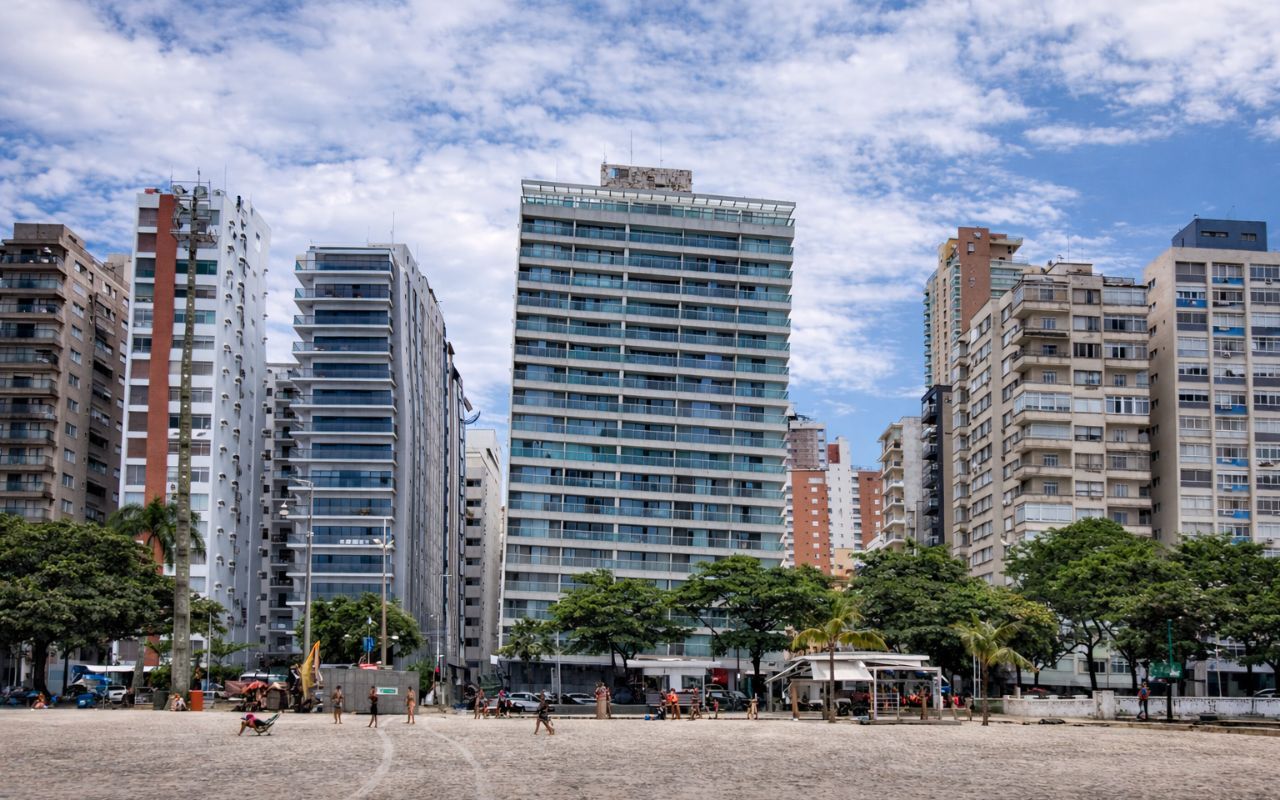
The Brazilian city has 319 crooked buildings built on sandy soil without proper deep foundations, houses the largest beach garden in the world, with over 5 km, and is still considered the birthplace of surfing — meet Santos, in São Paulo.

To avoid creating excessive volume at the entrance, the creator reuses old panels, including a glass with an irregular edge trimmed by marking and pressure, forming an unconventional-shaped box to accommodate two levels in the same set.
The definition of the height change requires a retaining wall.
In an aquascaping supply store, he selects large stones, prioritizing shapes already molded by erosion.
The assembly becomes a three-dimensional puzzle: stacking, disassembling, recalculating angles, and deciding which rock will be the centerpiece of the functional waterfall, without overloading the glass.
Sculpture and Assembly: Expanding Foam, Epoxy and Micrometric Adjustments

To reduce weight and enable height, the structure is not only made of stone.
The creator builds a scaffold with expanding foam, applying layers every few hours until the point where the intermediate pool aligns with the desired waterline.
The remaining foam distributes pressure and allows fine corrections so that the water falls only where the upper edge has been leveled.
The final fixing uses epoxy resin, mixed and applied with limited time before hardening.
Cracks and gaps are filled, and less aesthetic parts are hidden with rock fragments.
Side cavities become technical areas to hide components; a tube with a sponge at the end reduces risks to the animals; a pump can be placed under the sand to move water between sides; and the heater is positioned near the aquarium’s flow.
Water Test: Leaks, Silicone and Risk of Overflow
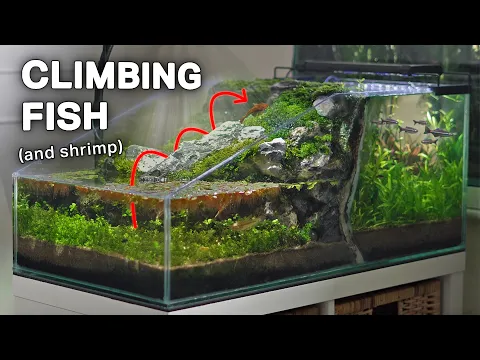

As it fills, the functional waterfall ceases to be a model and becomes a hydraulic system.
The first problem arises where the foam had voids: leaks on both sides.
Even with partial retention, a weak point at the base could become critical if the pump fails because the weight of the water on one side would push the volume until levels equalized, risking overflow onto the floor.
The correction follows a practical sequence: drain, dry, apply silicone from behind, spread mixture to cover holes and reinforce seams.
The finish is not the focus; the priority is stability.
When the water begins to flow through the intended channels, with an intermediate puddle and lateral branches, the creator declares the system “alive” and begins the biological phase of the aquarium.
Biological Colonization: Sand, Garden Soil and Mature Water with Good Bacteria
To support plants, the substrate is made from common garden soil, hydrated until it turns into uniform mud, covered with a thick layer of sand.
The inoculation comes from direct siphoning of a stabilized aquarium in the window, introducing mature water with good bacteria.
From there, balance begins to be silently contested: nutrients, biofilm, and algae compete, while moss may be inserted in wet areas to filter waste.
The creator plants various groupings in the back and combines carpets and floating plants at the front, integrating stones for camouflage.
In this scenario, the microfauna spreads through the dense habitat, with small organisms occupying surfaces and leaves.
The functional waterfall comes to operate not only as a water passage but as an ecological corridor within the aquarium.
Observing the Animals: Seven Shrimps, Snails and Catfish in Continuous Mountaineering
The introduction of animals is controlled: there are seven shrimps of different colors to trace individual behavior in the aquarium.
At first, the activity resembles community herding, with a search for edible biofilm already formed.
Then comes the unexpected: a shrimp appears at the top of the cliff after a few minutes out of sight, highlighting its ability to climb against the flow and also the need for barriers and safe routes.
The snails enter disoriented, move slowly, clean the glass, and over time participate in algae control. On the other side, the microfauna occupies every crevice.
With the vegetation of the upper basin closing coverage, limpets scraping algae and even smaller crustaceans appear everywhere.
In this environment, the arrival of fish changes the map: a gourami lives in the “forest” in miniature, and then harmless yet daring catfish start to taste surfaces, using suction mouths and body spines.
At night, when the catfish become more active, the main scene appears: they try to switch sides, approach the wall, follow the instinct to swim “upstream,” and conquer the vertical stretch to the summit.
The reward is an area with new friends and food.
The functional waterfall becomes a migration route within the aquarium, repeated by shrimps and catfish, and observable in cycles.
Limits of the Closed Recirculating Aquarium: Increasing Hardness, Minerals and Occasional Maintenance
Biological stability does not eliminate physical limits.
In a recirculating aquarium, the water passes repeatedly through the same circuit, unlike a natural waterfall with continuous renewal.
With a large volume of limestone for that water, minerals dissolve and hardness tends to increase over time, creating restrictions for more sensitive species.
Moreover, the silent war against algae depends on consumption by animals and nutrient absorption by plants.
When vegetation advances, the tendency is to reduce available nutrients, but this does not occur linearly.
The system can function for long periods without direct intervention, but it requires occasional external help, including partial drainage, algae removal from leaves, plant propagation, and replenishing fresh water to keep it stable.
Two Connected Ecosystems, with Visible Data and Technical Responsibility
By connecting two areas with different levels, the functional waterfall transforms a home aquarium into an observable experiment: flow, plants, microfauna, shrimps and catfish adjust, explore routes and build balance without constant command.
The same arrangement makes it clear that, in a closed circuit, leaks, level equalization, and water chemistry are not details, but conditions for safety and survival.
If you plan to assemble something similar, the most realistic step is to start small, test sealing and flow for days before scaling up, and record behavioral changes and water quality to understand your own limits.
Would you have the courage to maintain a functional waterfall in a recirculating aquarium inside your home, or would the maintenance risk make you hesitate?






-

-

-

-

27 pessoas reagiram a isso.