





 English
  Francês
  Alemão
  Italiano
  Japonês
  Norueguês
  Portuguese
  Spanish
  3 min of reading
  0 comments


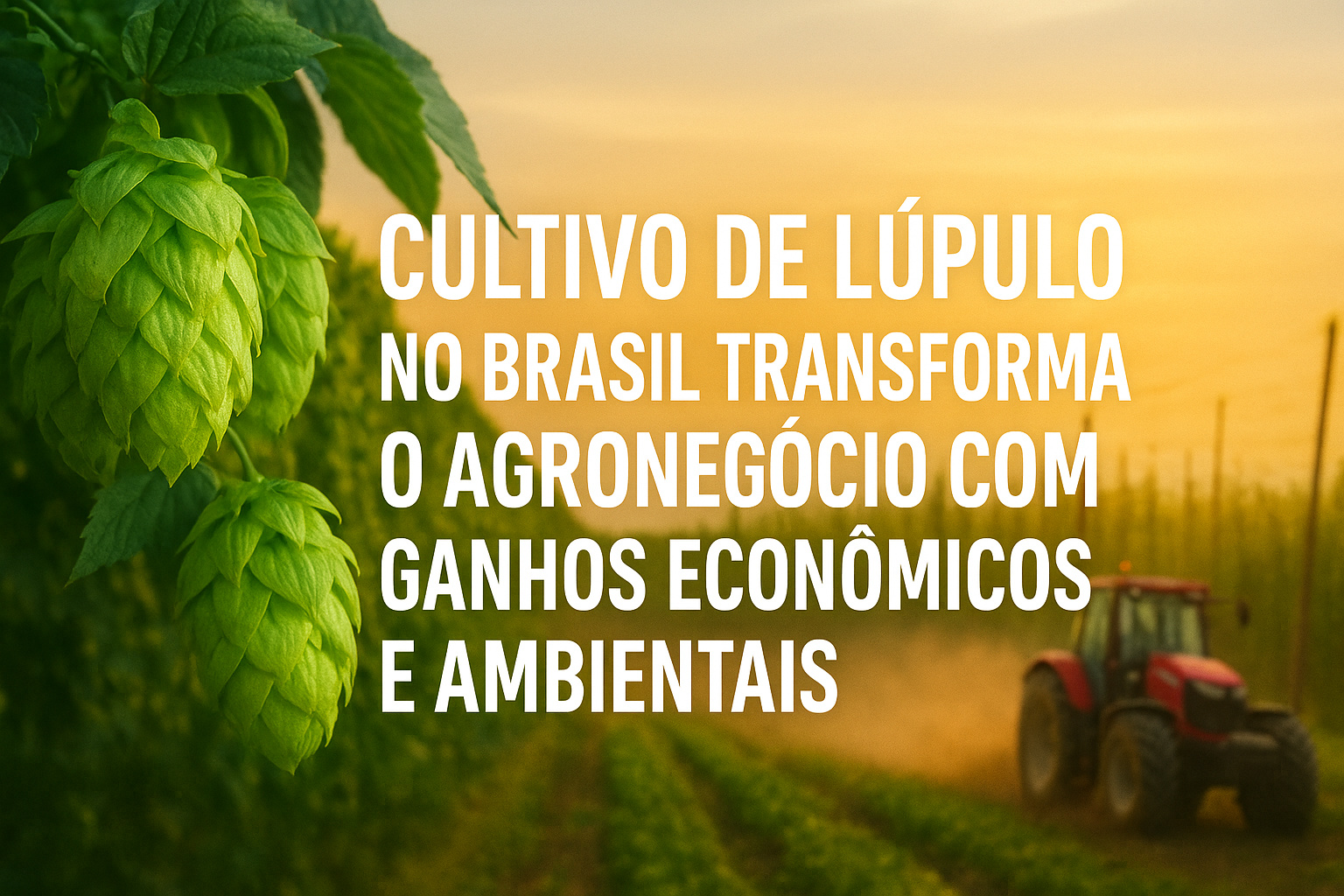
The Cultivation of Hops in Brazil Grows and Shows Gains in Agribusiness, with Positive Impact on Income, Sustainability, and Social Inclusion.
Tropicalized Hops Boost Brazilian Agribusiness
The cultivation of hops in Brazil is becoming one of the most promising surprises of the national agribusiness.
A groundbreaking study analyzed ten reference farms in the states of Alagoas, Goiás, and São Paulo. The research revealed that the cultivation of hops in Brazil generates economic, social, and environmental benefits.
The result is surprising, given that the plant was considered unviable in tropical regions.
-
While Russia dominates the global wheat market, Brazil emerges as an unexpected competitor in the Cerrado, offering grain available in July and August when stocks in the Northern Hemisphere are at their lowest point of the year.
-
China returned almost 20 Brazilian ships with soybeans, but now everything could change: the country that buys 80% of the grain is considering relaxing regulations after impurities held up shipments of thousands of tons and caused million-dollar losses.
-
The drought of the cerrado was considered an enemy of wheat, but Brazilian scientists turned the lack of rain into a competitive advantage by creating a grain with quality that is already attracting the attention of international mills around the world.
-
THE OWNER of Brazil: a farmer who came from laundries, created an ’empire’ and today runs a company valued at R$ 42 billion after tripling its value in less than a year and receiving a billion-dollar investment from the USA.


The survey was conducted by researchers from Unesp in Botucatu (SP). They used the Ambitec-Agro tool to measure the impact of cultivation across 27 criteria and 148 indicators. The analysis assessed everything from technological efficiency to income generation and governance.
The results are encouraging. In total, 19 criteria demonstrated positive performance. The study confirms the potential of Brazilian hops to drive sustainability and innovation in agribusiness.
Sustainability in Three Dimensions: Economy, Society, and Environment
According to Viviany Viriato, a PhD student at Unesp and one of the authors of the study, the economic gains were the most valued, highlighting increased rural income, productive diversification, and appreciation of properties.
“Social advances were also notable, such as formalization of work, inclusion of women and youth, and greater availability of training, in addition to positive environmental effects linked to the recovery of degraded areas and increased biodiversity,” said the researcher.
Thus, the cultivation of hops proves to be an alternative that goes beyond profit. It brings concrete benefits to rural communities, creates jobs, and also restores previously degraded ecosystems.
Innovation and Sustainability Side by Side
Although some challenges persist—such as the increase in electricity consumption and water demand—producers are adopting innovative solutions to reduce impacts.
Among the most notable initiatives are the use of solar panels, fertigation systems, and green fertilization, which improves soil fertility and helps sequester carbon.
Furthermore, many farmers have implemented integrated pest management practices, waste recycling, and technical training for workers, strengthening the environmental and social governance of their properties.
These strategies have allowed for the compensation of negative impacts and increased productive efficiency, making Brazilian hops increasingly competitive and sustainable.
Social and Economic Impacts: A New Scenario for the Countryside
On the social aspect, the study points to significant advances. Hops production formalizes jobs, improves working conditions, and expands the participation of women and youth in agribusiness.
On the economic front, producers observe appreciation of land and create new income opportunities.
Even with high initial investments, the sector projects accelerated growth in the medium term. Domestic demand and the prestige of national hops among craft and industrial breweries drive this expansion.
Brazil: From Importer to Potential Exporter
Currently, Brazil is the third-largest beer producer in the world, but still heavily depends on hop imports.
In 2023, approximately 180 tons were produced over 53 hectares, a small number given the demand of over 15 billion liters of beer per year.
The good news is that the number of Brazilian hop producers is growing rapidly. There are already 152 registered, according to data from the International Hop Growers Convention (HGC).
The expansion is most intense in the South and Southeast regions, driven by support from Aprolúpulo and a national technical chamber.
The Future of Brazilian Hops in Agribusiness
The results of the study confirm that the cultivation of hops in Brazil is viable, strategic, and sustainable.
The tropicalization of the plant reduces external dependence, strengthens small and medium producers, diversifies national agriculture, and paves the way for future exports.
The sector already recognizes tropicalized hops as a new green frontier of Brazilian agribusiness. Thus, cultivation combines productivity, environmental responsibility, and social inclusion. The model consolidates a more balanced and innovative growth.








Seja o primeiro a reagir!