





 Português
  Inglês
  Espanhol
  3 min de leitura
  1 comentário





New Technique Promises to Transform Diamond Production by Dispensing with Extreme Pressures and Accelerating Growth Under Normal Conditions
In the quest for innovation, researchers have discovered a completely new way to accelerate diamond production, creating these gems from scratch under common ambient conditions, all in just 15 minutes. This radical change not only facilitates the process but also paves the way for new applications that could impact sectors such as mining and the tech industry.
To achieve this result, the team led by a physical chemist from the Basic Science Institute of South Korea reinvented the traditional process, eliminating the need for a seed gem and the extremely high pressures and temperatures previously considered indispensable in diamond production.
Instead, they used a mixture of metals and silicon in a specially designed crucible that allows for rapid adjustments of internal conditions, simulating part of the natural dynamics that form diamonds deep within the Earth.
-
A gigantic freshwater reservoir appears beneath the Great Salt Lake, between 3 and 4 kilometers deep, surprising scientists with an unexpected flow towards the interior of the lake.

-
At over 8,800 meters above sea level, the summit of Mount Everest is made up of rocks that originated at the bottom of an ocean about 500 million years ago and were pushed to the highest point on Earth by the collision of tectonic plates.

-
Japan targets a remote island in the Pacific measuring only 1.51 square kilometers, located 1,900 kilometers from Tokyo, to store nuclear waste for up to 100,000 years, raising alarms at sea.

-
A 1,900-year-old papyrus found in the Judean Desert reveals a crime of the Roman Empire involving fraud, forgery, and a detailed court hearing.


Production in 15 Minutes
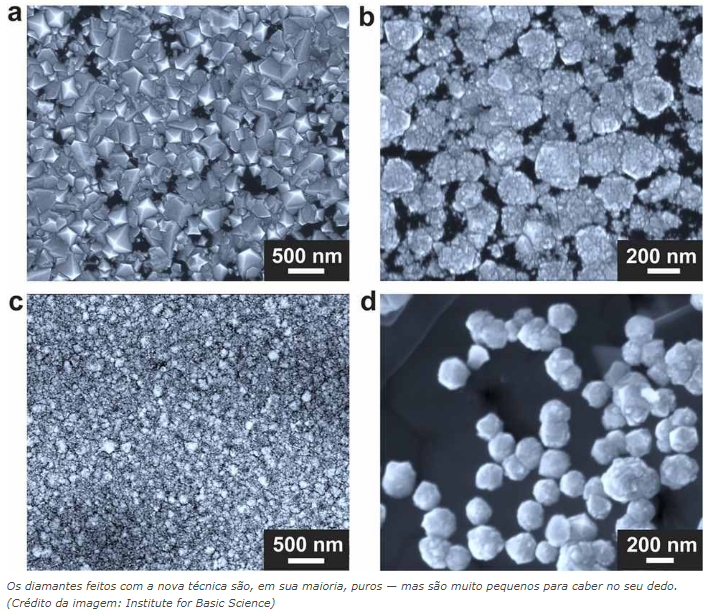
While conventional diamond production methods require alarming pressures and temperatures, this new approach has managed to create diamond films in a very short time, albeit at microscopic dimensions.
Although these diamonds are too small to become jewelry, their potential for industrial applications, such as in drilling or polishing tools, is enormous. After all, the ability to scale this technique and adapt it to the needs of different sectors could change the way we understand the mining of valuable resources.
Despite current limitations, scientists are optimistic. Soon, new technical advances may make diamond production even more accessible and versatile, opening a new chapter in the history of these precious stones. Only time will tell how far this innovation will take us.
How Is Laboratory Diamond Made?
In technical terms, the current method of diamond production involves a crucible chamber of approximately 9 liters (2.4 gallons), where elements like gallium, nickel, iron, and a small amount of silicon are carefully heated and combined to catalyze the formation of gems.
The process takes place under standard atmospheric pressure, eliminating the need for massive and expensive equipment, which significantly reduces synthesis time and energy consumption, as well as allowing for quick adjustments in the composition of internal gases to optimize crystal growth.
These innovations not only make diamond production faster and more controlled but could also impact the mining sector by reducing reliance on traditional and costly methods.
Although the dimensions of the diamonds obtained are still too small for use in jewelry, their physical and chemical properties remain intact, suggesting that, in the future, their application in drilling, cutting, and polishing tools – areas where the strength and hardness of diamond are essential – could become a new technological standard.









Boa