





 Português
  Inglês
  Espanhol
  5 min de leitura
  0 comentários


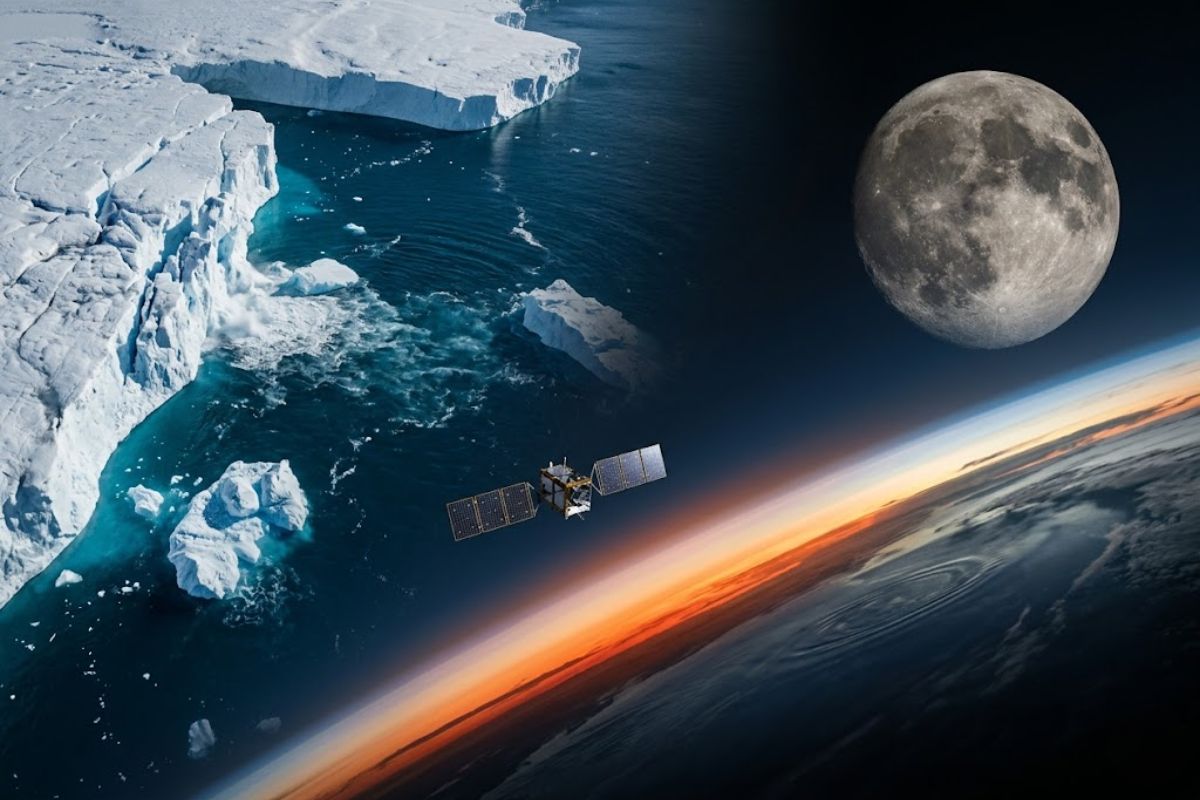
Research in the Journal of Geophysical Research: Solid Earth indicates that the Earth has been slowing down its rotation by milliseconds per day, with acceleration of the pace since 2000, an effect linked to the Moon and the redistribution of mass caused by melting ice, elevating oceans and changing the balance of the planet during this period.
The Earth is literally becoming a little more “slow” in the spin that defines the duration of each day. A study published in the Journal of Geophysical Research: Solid Earth points out that days are getting longer by milliseconds, and that the speed of this change is noteworthy when compared to what is observed over millions of years.
The phenomenon does not alter anyone’s routine from one day to the next, but it affects a sensitive point of science and technology: how humanity measures, synchronizes, and projects time. And the explanation is not due to a single reason, but rather to forces that combine, from the Moon to the melting of ice that redistributes mass on the planet.
What does it mean that “days are longer” in practice
When it is stated that days are longer, it does not mean that the Earth has “gained hours,” but rather that the time for a complete rotation is increasing by very small fractions, on the scale of milliseconds. It is an invisible change for wristwatches, but real for scientific measurements and systems that depend on precision.
-
44 minutes on the cosmic scale: mysterious object in the Milky Way emits simultaneous radio and X-ray signals and raises an intriguing question about what is really happening in deep space.
-
Omoda & Jaecoo and AiMOGA Robotics advance in industrial artificial intelligence with a strategic debut in Thailand and a focus on advanced automation.

-
In a scenario of rising fuel prices, Omoda & Jaecoo enhance value for consumers with a range of up to 1,200 km, energy efficiency, and a new concept of worry-free mobility.

-
Cement battery inspired by chemistry used since Ancient Rome resurfaces as a rechargeable thermal solution and enters the competition for the future of industrial heat.

The Earth has never been a perfect and motionless mechanism. The duration of the day varies because the planet is a living system, with a dynamic interior, a changing surface, and a moving atmosphere. Even without noticing, the Earth adjusts its rhythm as external and internal forces gradually alter how mass is distributed and how the spin responds to that.
Why the Moon is in this story and does not leave the radar

The Moon directly influences the Earth through gravity. This “pull” is linked to effects that, over time, tend to slow down the planet’s rotation. At the same time, the dynamics between the Earth and the Moon also involve changes in the distance between the two bodies, a detail that helps to understand why this topic always comes up when discussing rotation and tides.
The central point is that the Earth and the Moon function as a coupled system, where energy and movement are redistributed. Therefore, when the study highlights the Moon’s action as part of the picture, the message is clear: it is not an isolated event, but rather a continuous process, with small impacts in the short term, but significant when measured over decades and compared to the geological record.
How the melting of ice changes the “balance” of the Earth
The study also relates the recent pace of the Earth’s deceleration, especially since 2000, to a factor that has gained strength with climate change: the redistribution of mass caused by melting ice, especially in polar regions. When large volumes of ice cease to be concentrated on land and begin to integrate into the oceans, the planet reorganizes its weight.
This mechanism can be understood as a sequence: melting ice, rising sea levels, and redistribution of mass. When the “weight” of the planet changes location, the spin responds. The expected result, according to the explanation provided, is a slightly slower rotation and, therefore, slightly longer days, even if this is measured in milliseconds.
What the study saw when looking back millions of years
To support the idea that the recent pace is noteworthy, the researchers referred to evidence that helps reconstruct environmental variations over geological time. The cited work analyzed fossils of benthic foraminifera, microscopic marine organisms used to record environmental changes over long periods.
According to the lead author, Mostafa Kiani Shahvandi, the speed of change is the most prominent point. He states that only once, about 2 million years ago, was the rate of variation in the length of the day almost comparable, but that nothing was as rapid as what was observed between 2000 and 2020. This comparison is not meant to dramatize, but rather to contextualize: the Earth has varied before, but the current pace deviates from the recent pattern on very long scales.
Why an “imperceptible” change matters for science and technology
Even when the Earth changes the length of the day by milliseconds, this enters the map of those who depend on well-defined time.
Reference systems, synchronization, and high-precision measurements need to take into account that the planet is not a fixed clock. The more technology demands precision, the more the variation of natural time becomes a practical matter.
There is also a larger scientific aspect: understanding why the Earth decelerates, when it accelerates, or when it changes pace helps connect pieces that seem distant, such as oceans, ice, sea level, tides, and the dynamics of the planet.
The study draws attention to a convergence: the Moon continues to play its role, and climate change begins to weigh more heavily, altering the distribution of mass that influences rotation.
The Earth is not “stopping,” nor does this transform daily life immediately, but the study suggests that the planet is adjusting its spin at an unusual pace, especially since 2000, combining the constant influence of the Moon with the redistribution of mass linked to melting ice and rising sea levels.
When the planet’s time changes, even if by milliseconds, the question shifts from “if” this matters to “where” it will appear first.
With information from the portal NDMAIS.
In the comments, tell us what you find most convincing in this explanation: the force of the Moon, the melting of ice and the redistribution of mass, or the sum of both factors? And if you could ask the researchers something about the Earth and the planet’s “clock,” what would your most direct question be?







Seja o primeiro a reagir!