Portuguese
  Spanish



Research indicates that the walls of Pompeii hold marks of a war machine used in the siege of Sulla before the eruption of Vesuvius
After more than 1,900 years since the destruction of Pompeii by Vesuvius, a study from February indicates that marks on the city’s walls record a war machine used in the siege of Lucius Cornelius Sulla, almost a century before the eruption.
Unusual marks in Pompeii
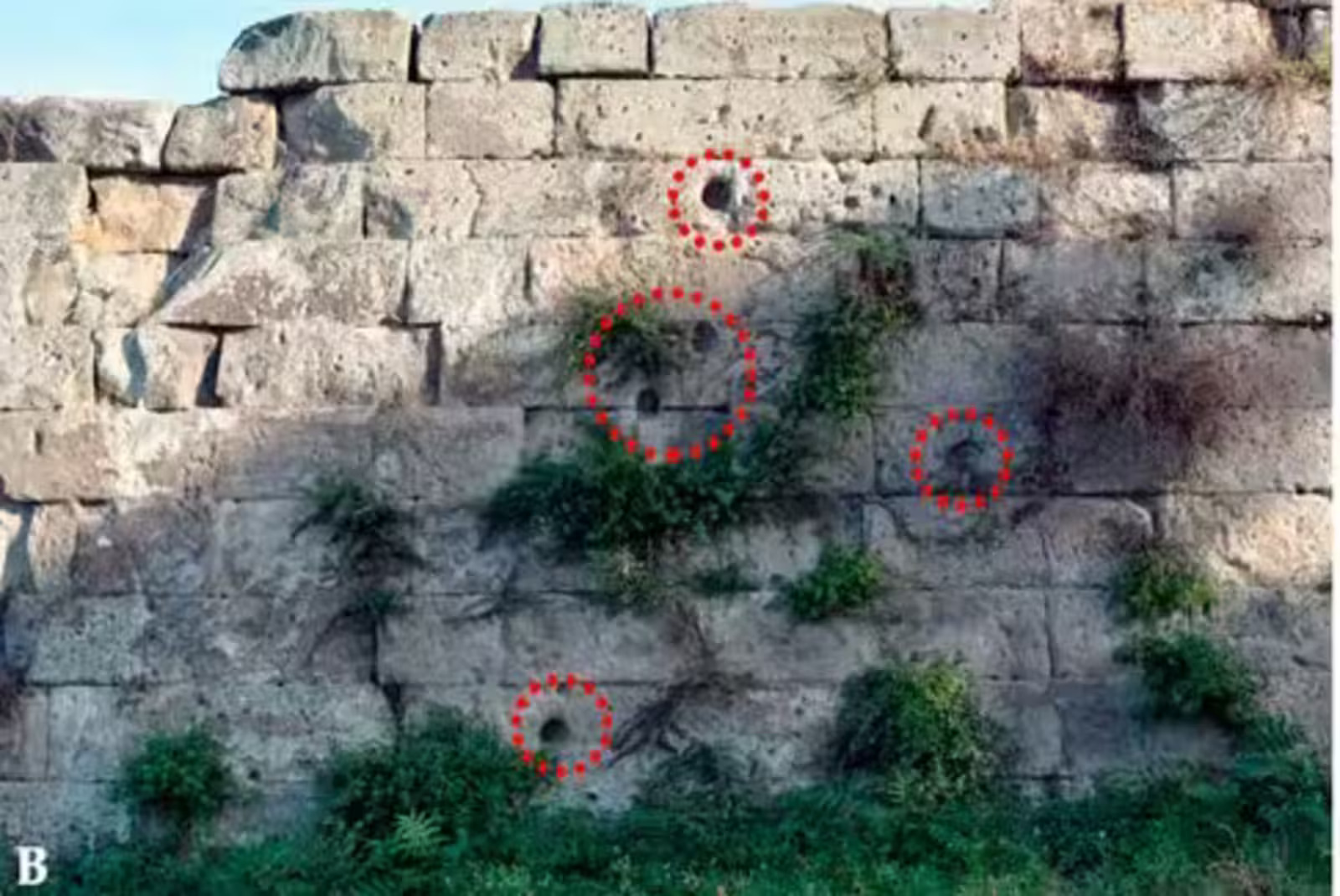
Italian researchers claim to have discovered signs of a weapon on the walls north of Pompeii. The study was published in the journal Heritage and describes battle damage different from the known craters.
According to the research, the holes do not resemble the large circular impacts produced by stones thrown by Roman catapults.
-
Pennsylvania Mine Creates Ice in Summer Heat and Melts in Winter, Turning a Mountain Crevice into a Reverse Natural Refrigerator

-
China Accelerates Global Expansion of Robotics: From Smart Vacuums to Industrial and Humanoid Machines, Millions Exported to Over 150 Markets
-
Polar Air Mass to Hit Brazil: Temperatures to Plummet in Nine States, Near Freezing in the South with Frost Risk Until Monday
-
Chinese “dark factories” produce electric cars 24/7 with minimal human intervention, as Zeekr assembles 800 units daily, raising concerns in Brazil.





They are smaller and appear distributed in a fan shape along the walls.
Previously treated as ancient wear or generic conflict marks, this damage has begun to be interpreted.
The new study argues that they were caused by a weapon capable of firing multiple projectiles in rapid succession.
3D models reconstruct firings
To examine the traces, the researchers turned to ballistics, a field that studies the movement, behavior, and chemistry of projectile firing. From this field, the preserved holes in Pompeii were analyzed.
Using laser scanning and photogrammetry, the scientists created high-resolution 3D models of the marks.
The procedure allowed for estimating depth, width, and the possible shape of the projectiles and impacts found on the walls.
The results indicated shots coming from a non-portable machine and at high speed. This reconstruction reinforced the interpretation that the marks were not caused by simpler weaponry.
Comparison with Roman pieces
To support the hypothesis, the data from the walls of Pompeii were compared with engineering designs from the 3rd century BC. These records describe machines similar to the ancient weapon indicated in the study.
The researchers also considered museum collections and remaining projectiles from other Roman sites.
Many of these materials, especially those related to scorpion-type catapults, matched the dimensions observed in the 3D models.
“The unequivocally radial configuration of the nearby impacts observed in Pompeii (…) makes it reasonable to hypothesize the use of an automatic scorpion intended to target archers“, the authors describe.
Siege of Sulla and ashes
According to the research, the damage to the walls was caused during the siege of Lucius Cornelius Sulla on the city, almost a century before Vesuvius erupted and buried Pompeii.
The study indicates that the volcanic ashes released over the city after the military action may have preserved the traces of the polybolos firings for nearly two thousand years, maintaining these marks to this day.
Thus, the very catastrophe that destroyed Pompeii may have helped to preserve signs of a previous confrontation.
The finding expands what the archaeological sites of the city still reveal about the ancient world and its military history.
With information from Revista Galileu.