Portuguese
  Spanish


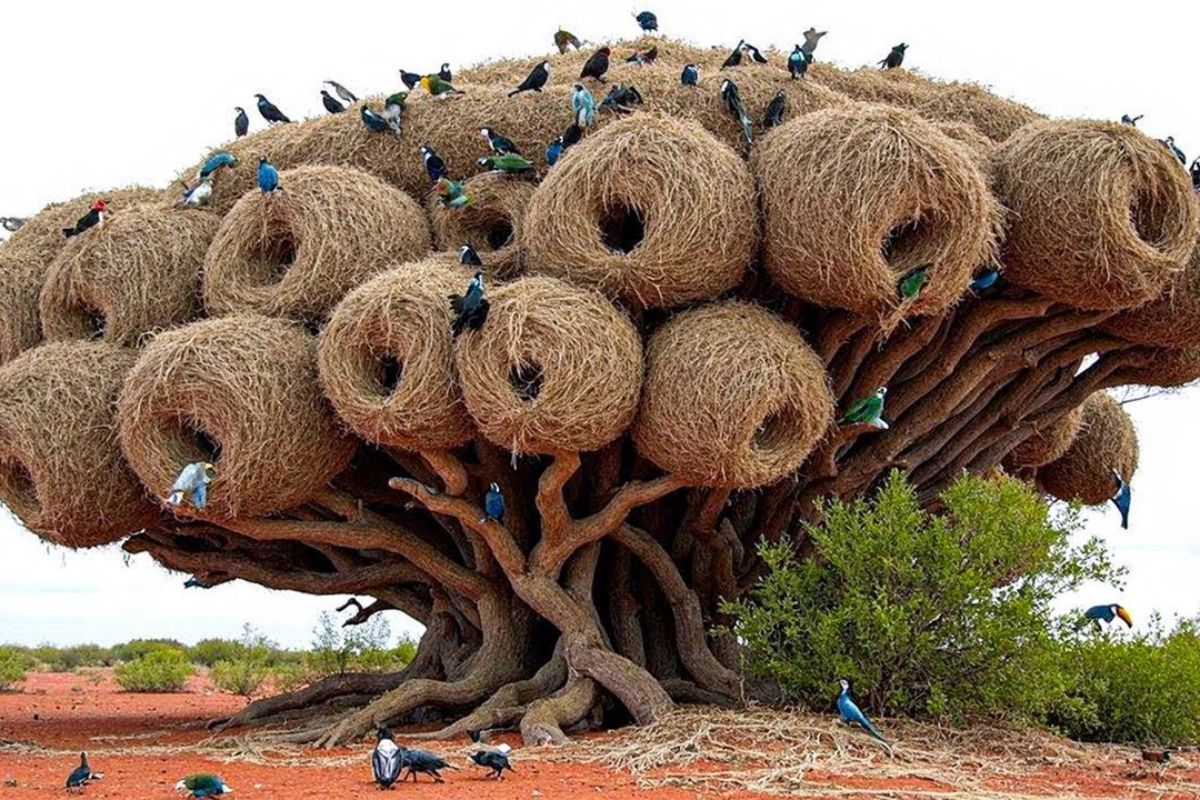


The Architect Birds Transform Twigs, Mud And Webs Into Nests That Would Challenge Human Engineers, From Braided Bags To Nests Weighing Tons
Since humans started to observe nature more closely, one thing became clear: the true architects of the planet may not be engineers, but architect birds. In forests, deserts, caves, and lakes, there are birds that build nests so complex, sturdy, and efficient that they seem like advanced engineering projects, made with calculation and intent, but born purely from instinct and patience.
They make over 3,000 loops with grass fibers, dig tunnels in cliffs, mold clay into conical towers, and raise giant nests that can weigh up to 3 tons, all while using just their beaks, feet, and an impressive capacity for adaptation. Common among these architect birds is that they build to protect their chicks, deceive predators, regulate temperature, and even cooperate in large aerial condominiums.
Architect Birds: Engineering, Instinct And Survival Strategy
When we talk about architect birds, it’s not an exaggeration. These birds can control temperature, conceal entrances, take advantage of branch shapes, wind flow, and the presence of predators to choose the perfect location and the ideal type of structure.
-
In Andradina, in the interior of SP, a tannery transformed tilapia skin that slaughterhouses used to throw away into exotic leather for bags, shoes, and even wedding dresses, producing about 2,000 pieces per month and exporting to seven countries, proving that fish waste has become high-value fashion.

-
The industrial waste that even recyclers didn’t want has gained value in the interior of Bahia: two entrepreneurs invested R$ 2.8 million to transform 350 tons per year of foam, rubber, and plastic into boards that can replace wood and MDF.

-
What is a red flashlight used for, after all? See why it is so commonly used at night.

-
He has never read a line of code, but he already knows how to work: the French company UMA presented in Paris the Northstar, its first AI-powered humanoid robot designed for factories and warehouses, capable of copying tasks just by observing an employee in action.




Some species build alone, while others work in colonies with dozens or hundreds of nests side by side, forming true cities of clay, grass, or wood.
There are nests that use saliva as biological cement, floating nests anchored in aquatic plants, nests dug into cliffs like apartments on a rock face, and nests inherited over generations, renovated and expanded year after year. Up close, it becomes hard to argue that architecture is “only human.”
Weaver Bird: The Weaver That Makes More Than 3,000 Loops Per Nest

The weaver bird is one of the most impressive architect birds in South Asia. During the monsoon season, the male turns into a true building machine, alone, hanging from high and thorny branches, almost always over water to keep away rats and snakes.
With strips of grass and palm fibers measuring 20 to 60 centimeters, he weaves more than 3,000 loops to form a hanging nest shaped like a half, which at first looks like a helmet and then gains a long entrance tunnel.
The most curious detail is that the nest also serves as a showcase: the male sings, sways his body, and displays his work to the females. If they disapprove, he simply destroys everything and starts over, even repeating this cycle up to 20 times in a single season.
Some of these nests form colonies with dozens of units, all tilted against the wind from the monsoons to withstand storms.
Instead of fireflies stuck for illumination, as the legend said, what exists is mud and droppings reinforcing the structure, pure natural calculation of resistance.
Montezuma Oropendola: Hanging Bags And Protection With Wasps

In Central America, the Montezuma oropendola creates a spectacle of its own. The females build stitched bag-shaped nests, hanging high up in the canopy, using fibers and vines that can form structures ranging from 60 centimeters to nearly 2 meters in length. Each nest is a deep capsule, made to withstand wind, rain, and climbing predators.
On the same tree, there can be dozens or even more than 170 hanging bags, as if someone decorated the forest with living lanterns.
The local legend said that they built near beehives by chance, but it is now known that there is a partnership: the wasps help keep away parasites and cowbirds, while the birds fend off other intruders from the hives.
While the female cares for the nest and the eggs, the male hangs upside down, spreads his yellow tail like a fan, and emits deep bubbling vocalizations, in a kind of timed show to impress the females. The choreography occurs right below the nests they built.
Social Weaver: Nest Cities In The Kalahari Desert

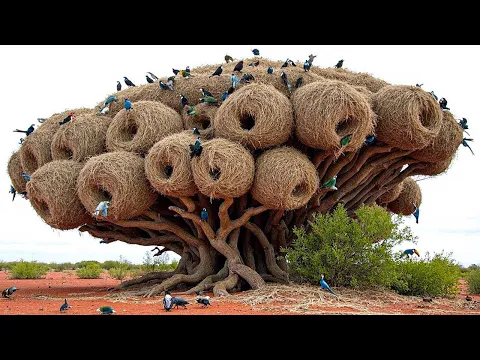
In the dry regions of the Kalahari, the social weaver takes the concept of architect birds to another level. Instead of building one nest, he builds an entire condominium.
With twigs and grass, hundreds of birds collaborate in the construction of a single community nest that can grow over 3 meters wide and weigh almost 1 ton.
Inside, the structure is a maze of tunnels and individual chambers, which can house from 10 to 500 birds, with dozens of internal compartments.
The design is so efficient that it keeps the internal temperature stable between 21 and 24 degrees, even when the desert is scorching during the day and near zero at night. It’s a natural air-conditioning system, without electricity, bricks, or concrete.
These super nests can last over a century, being inherited, expanded, remodeled, and shared with other species, such as hawks, finches, vultures, and even geckos.
It’s architecture, a condominium, and an ecosystem all at once, born from the routine of architect birds that never took engineering classes.
Cave Swallow: Nest Of Saliva That Became Luxury Soup

The cave swallow lives in cliffs and dark caves in Southeast Asia. In there, there are no branches or leaves, only smooth stone.
The solution found was to transform saliva into a building material. These architect birds produce a thick saliva that hardens upon contact with air, like biological cement.
In about 35 days, each individual builds a bowl-shaped nest attached to the rock, about 8 centimeters wide.
It weighs only a few grams but is strong enough to support eggs, chicks, and adults. In large caves, thousands of white nests form a panel of semicircles stuck to the stone.
For centuries, humans climbed bamboo scaffolding to collect these nests, turning them into the famous bird’s nest soup, surrounded by legends of youth and vigor.
The reddish color of some nests, once considered “magical,” actually comes from the acidic action of guano.
Over-exploitation nearly led the species to collapse in some areas until protected areas allowed populations to recover.
Oven Bird: A Clay Oven Camouflaged On The Forest Floor

The oven bird takes a different path from many architect birds that build high.
It prefers the forest floor, among dry leaves, roots, and shade, where it raises a small dome of grass, twigs, fur, and pieces of bark that resembles a clay oven.
The female clears an area, organizes the materials, and builds a rounded structure with a hidden lateral entrance, usually pointing downwards.
This detail, combined with the natural camouflage among leaves and branches, makes it difficult for snakes and small mammals looking for nests to spot them from above. If a predator comes too close, the female pretends to be injured to lure it away from the chicks.
In some regions, the oven bird’s nest is seen as a sign of good luck. Some communities avoid destroying these structures for fear of causing drought, transforming the “clay house” into a silent amulet within the forest.
Cliff Swallows: Nest Cities Of Clay With Thousands Of Capsules

The cliff swallow trades trees and soil for columns, overpasses, rocks, and bridges. It collects small balls of clay from rivers and puddles, shaping capsules that look like gourds stuck to walls.
Each nest measures about 20 centimeters wide, with a narrow neck at the entrance and a comfortable chamber inside.
The great spectacle is collective. These swallows often build in colonies with hundreds or even thousands of nests, so close that they form real cities of compacted clay on cliffs or human structures.
Couples work together to collect clay, line it with grass and feathers, and feed the chicks.
Among these architect birds, not all are so cooperative. Some females take advantage of others’ work and lay eggs in neighbors’ nests, in a type of brood parasitism that shifts the weight of raising the young onto another couple.
American Jabiru: Palaces In The Swamps
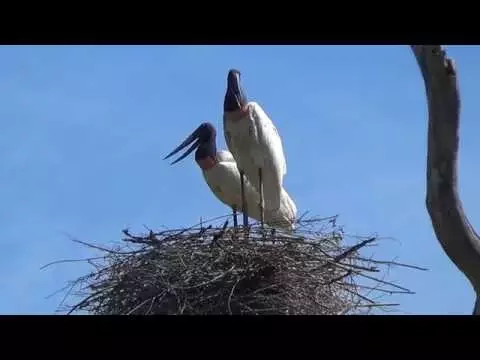
In the swamp environment, the American jabiru combines height, water, and sturdy branches to create luxury platforms.
The couples build wide nests, up to 1.5 meters in diameter, supported high in trees over flooded areas, where land predators have difficulty reaching.
In just a few days, they set up a base of branches and reinforce it with leaves, sometimes sealed with guano for extra sturdiness.
In the so-called rookeries, several of these “balconies” cluster over the water, forming an aerial landscape of aligned nests.
The chicks are born small but grow quickly. For almost two months, the nest becomes an intense nursery, with constant comings and goings of adults bringing fish caught in shallow waters. It’s a project designed for wide visibility, access to food, and a natural barrier against invaders.
Suspension Tit: Mansions Of Fiber With Fake Entrances
The suspension tit shows that architect birds also master the trick of deception. It builds pear-shaped hanging nests using soft fibers, wool, and spider silk, which function like extremely thin but highly resistant threads.
On the outside, the nest looks like a single pouch. Inside, there are tricks: a false entrance that leads to nowhere and a real entrance hidden behind a flexible flap, also reinforced with silk. Those who look from the outside get confused, while the parents enter and exit discreetly.
Some nests even have two chambers, one real and another decoy, all to confuse predators. Females often prefer larger and better-insulated nests, which forces the male to perfect the design each time.
Flamingo: Clay Towers With Natural Air Conditioning

In the shallow lakes where they live, flamingos raise small conical clay towers up to 45 centimeters high, shaped with their feet and beaks. At the top, they create a rounded cavity where a single egg is deposited.
The height isn’t aesthetic. It protects the egg from sudden floods and helps keep the temperature regulated, as the moist mud evaporates and cools the surrounding surface.
In large colonies, these structures align almost like a board of small clay chimneys, each occupied by a couple.
After the chick hatches, it stays on the “mount” for a few days before descending to join a group of young, while the parents continue feeding it with a nutritious liquid produced in their crop.
Woodpecker: Cavity Digger Turned Ecosystem Engineer
Among architect birds, the woodpecker is the master of excavation. Instead of building outward, it digs inward, using its beak as a chisel and a skull specially adapted to withstand repeated impacts.
It chooses trees with the most decayed interiors and yet firm bark, which eases the excavation while maintaining the trunk’s strength.
The entrance is narrow and discreet, leading to a deep cavity lined with wood chips. Inside, white eggs shine in the dark, protected by layers of wood and height.
Over time, when these nests are abandoned, they become shelters for owls, bats, insects, and other birds, turning the woodpecker into a true habitat engineer, creating spaces that other species couldn’t create on their own.
Masked Weaver: The Masqueraded Producer To Impress Females
The masked weaver takes the idea of love resumes seriously. During the breeding season, the male can build up to 25 nests in one season, all hanging from branches and made with grass, reeds, and long leaves.
It starts by tying a single leaf to a branch, then weaving until it forms an oval structure with a lower entrance, sometimes with a small tunnel.
Each nest is an attempt to convince a female that he is a good partner and a competent builder.
If she enters, examines, and approves, the nest is finished with soft lining. If she disapproves, the male himself destroys the structure and starts from scratch, in a trial-and-error cycle that perfects the technique over the years.
Hammercop: Giant Domes That Can Hold The Weight Of A Human
The hammercop, known in some places as “hammer-headed”, is one of the most exaggerated architect birds in scale.
Its nests are huge domes made of twigs, grass, clay, and anything useful it finds, including pieces of cloth or plastic.
These structures can reach up to 2 meters in width and height, weighing from 25 to 50 kilograms. Inside, there is a narrow tunnel leading to a central chamber lined with clay, like a secret fortified room within the ball of twigs.
The construction takes weeks, with hundreds or thousands of trips carrying materials in its beak. The result is so sturdy that an adult can sit on top of the nest without collapsing it, and it’s not rare for other species, such as owls, ducks, and even snakes, to use the structure when the hammercop is absent.
European Bee-Eater: Deep Tunnels Dug Into Walls
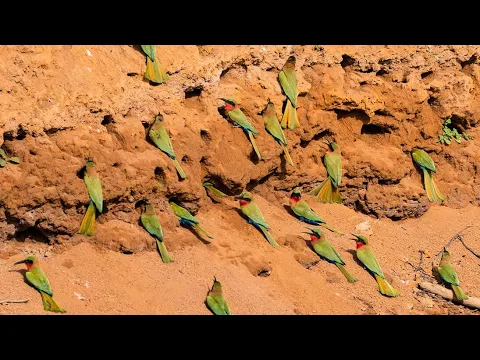
The European bee-eater trades trees and branches for mud walls, sandy cliffs, and steep riverbanks, where it digs horizontal tunnels up to 1 meter long. At the end of the tunnel, it opens a rounded chamber that becomes a protected nursery.
Couples work together, excavating with their beaks and feet, removing earth until they create a safe corridor, well out of reach of many predators.
In large cliffs, hundreds or thousands of tunnels can appear side by side, like a façade full of small round doors, each leading to a couple’s nest.
In addition to protecting eggs and chicks, these tunnels create an extra barrier for invasive species and help organize the colony.
In some cases, young from previous years return to help feed the new chicks, reinforcing teamwork.
Red-Necked Grebe: Floating Nest Anchored In Vegetation

The red-necked grebe is one of the most ingenious architect birds when it comes to water.
It builds floating nests, intertwining reeds, twigs, and aquatic plants above the surface, but anchoring everything in submerged vegetation.
The result is a stable sort of raft that gently follows the movement of the waves without coming loose or sinking.
The couple alternates in building, incubating the eggs, and defending the territory, while the structure remains somewhat hidden among the plants.
When the chicks are born, they can already swim, but prefer to ride on their parents’ backs, who transform their own bodies into an extension of the floating nest, safely carrying the young over the water.
Bald Eagle: Monumental Nests Weighing Up To 3 Tons

At the top of the list of architect birds in scale is the bald eagle. Their nests are true monuments built in trees 18 to 60 meters high, near rivers and lakes, where there is an abundance of fish.
A typical nest starts large, about 1.80 meters in diameter, but the pair returns year after year, adding new layers of twigs, moss, grass, and other materials.
Over time, these structures can reach more than 2.70 meters in width, 6 meters in depth, and almost 3 tons in weight, nestled in gigantic branches capable of supporting such a load.
These nests become territorial landmarks, used for decades and even over half a century. Each new layer is memory, extra protection, and structural reinforcement, transforming a simple pile of twigs into a true aerial castle that guards generations of chicks.
Looking at all these stories, it’s hard to say that architecture is a human exclusivity. The architect birds show that planning, innovation, and adaptation also exist in nature, quietly, in mud, in fibers, in saliva, long before any concrete building.
Which of these architect birds surprised you the most: those that build cities, those that use saliva as cement, or those that raise nests weighing tons?