





 Portuguese
  English
  Spanish
  4 min of reading
  0 comments


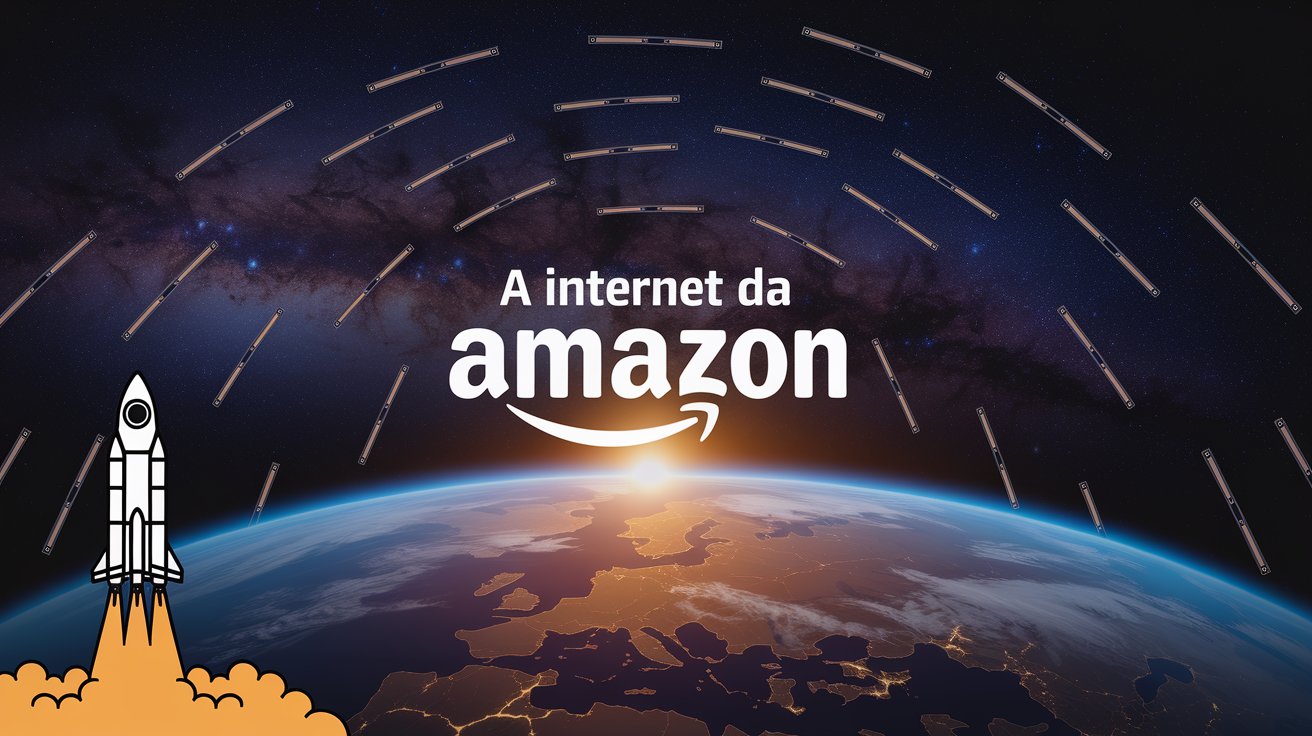
Technology Giant Surprises by Announcing a Bold and Space Initiative That Promises to Transform How the Entire World Connects to the Internet.
Constellation of over 3,000 satellites aims to bring high-speed connectivity to any point on the planet, including areas without traditional coverage
The race for dominance in satellite internet has gained a new and powerful competitor.
Following the success of Starlink from Elon Musk’s SpaceX, Amazon is preparing to launch its own space constellation, promising to deliver high-speed connectivity to any location in the world — including remote areas where traditional internet does not reach.
-
The Caspian Sea intrigues scientists as it is neither officially a sea nor a lake: the largest lake on the planet holds a hybrid crust, submerged cities, mud volcanoes, and billions of barrels of oil hidden at the bottom.

-
Why did the sky turn blood red in the west of Australia and it wasn’t sunset? Discover what is behind the change that took over the horizon for miles.

-
The most feared warplane of the United States is over 70 years old, carries 32 tons of explosives, flies 14,000 kilometers nonstop, and has just been sent to the United Kingdom amid escalating tensions with Iran.

-
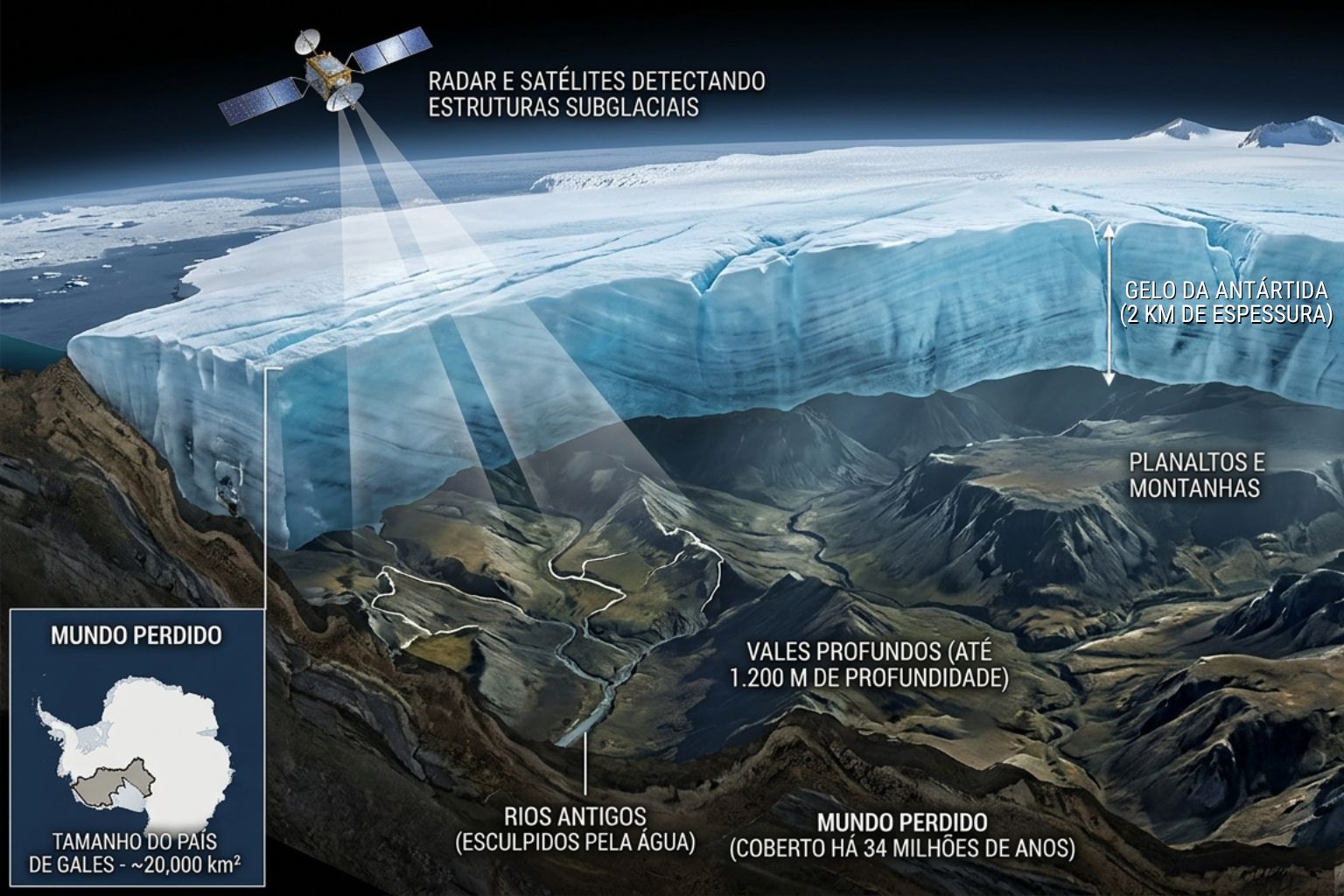
Satellites and radars revealed, beneath 2 kilometers of ice in Antarctica, a lost world the size of Wales, with rivers, valleys 1,200 meters deep, and plateaus sculpted by water, frozen for 34 million years, when the continent had temperate forests and was part of a supercontinent that included South America.

The ambitious project of the e-commerce giant, dubbed Project Kuiper, plans to install over 3,200 satellites in low Earth orbit (LEO), creating a global coverage mesh to provide fast, stable, and low-latency internet.
The first major step will take place on April 9, 2025, when Amazon will launch the first 27 satellites of the KA-01 mission into orbit from Cape Canaveral Space Force Station in Florida, United States.
The launch will be conducted using the Atlas V rocket from the United Launch Alliance (ULA).
Technological Advances and Reduced Visual Impact
According to Amazon itself, the new satellites are technologically superior to the prototypes tested in October 2023, featuring innovations such as next-generation processors, phased array antennas, more efficient solar panels, and optical links for communication between satellites.
Considering the scientific community, the company’s engineers also aimed to reduce light pollution in the night sky by applying a dielectric mirror film coating that reflects less sunlight.
This measure addresses criticisms directed at Starlink, whose satellites interfere with astronomical observation.
Another highlight is the active propulsion system, which allows individual control of each satellite, from launch to final positioning and operation in orbit, enhancing safety and precision in the constellation formation.
Three Types of Antenna for Three User Profiles
Amazon’s internet will be accessible through customer terminals that function as receiving antennas.
The company will offer three different models, each targeted at a specific type of user.
The most compact model, weighing about 500 grams, is designed to serve residential users, small businesses, and mobile applications such as boats and moving vehicles.
This terminal promises speeds of up to 100 Mbps.
The intermediate version, weighing around 5 kg, offers a higher speed, reaching 400 Mbps.
Finally, the most robust and powerful terminal, in a rectangular shape, will be aimed at businesses and governmental agencies, with the capability to deliver up to 1 Gbps speed.
Low Orbit Satellites Ensure Lower Latency
One of the main advantages of Project Kuiper is the strategic positioning of the satellites.
They will be positioned at only 450 km from the Earth’s surface, a distance that ensures lower latency and higher response speeds — one of the main differentiators of satellite internet compared to traditional networks or geostationary satellites.
Moreover, Amazon is investing in a robust terrestrial infrastructure, with gateway antennas spread across different points of the globe, capable of sending and receiving data from the satellites and retransmitting it to the users.
The operations center of the system is located in Redmond, Washington state, United States.
The Name Comes from Space, and the Ambition is Galactic
The name of the project was not chosen randomly.
Kuiper is a reference to the Kuiper Belt, a region of the Solar System located beyond Neptune’s orbit, rich in icy bodies and comets.
This choice reinforces the spatial and visionary nature of the initiative.
Since the project’s foundation in 2019, Amazon has reinforced its commitment to global digital inclusion.
The proposal is to offer a viable alternative for connection in areas where conventional operators do not operate, such as rural areas, forests, deserts, conflict zones, and isolated communities.
How Much Will Amazon’s New Internet Cost?
Although Amazon has not yet officially disclosed the service prices, the expectation is that prices will be more affordable than those of competitors, especially Starlink.
According to information available on the project’s page, the company intends to adopt the same low-cost philosophy applied to other brand products, such as Echo devices and Kindle readers.
The estimated price of the most basic customer terminal will be around US$ 400 (about R$ 2,276 at current exchange rates).
The monthly fee for the service will vary depending on the chosen speed plan.
The idea is for tests with corporate clients and selected users to begin later this year, according to the schedule released by Amazon.
Commercial operations on a large scale are expected to commence by the end of 2025, initially in specific regions.
In Brazil, the company already holds ANATEL authorization to offer satellite internet, granted in 2022. However, the start date for operations in the country has not yet been disclosed.
The Clash of Giants: Amazon vs Starlink
With Project Kuiper, Amazon officially enters a market dominated by Elon Musk, whose Starlink already operates over 5,000 satellites and has millions of users in dozens of countries.
However, experts suggest that competition could be beneficial for consumers, driving down prices and leading to constant improvements in service quality.
Another differentiator for Amazon is the potential for integration with its other services, such as AWS (cloud), smart devices, and Internet of Things (IoT) solutions, which could boost adoption in sectors such as agriculture, logistics, defense, and education.
Would you like to have internet that works even in the middle of the forest or at sea?
Comment on where you would use Amazon’s connection and whether it can truly surpass Elon Musk’s Starlink!




Seja o primeiro a reagir!