





 Portuguese
  English
  Spanish
  4 min of reading
  0 comments


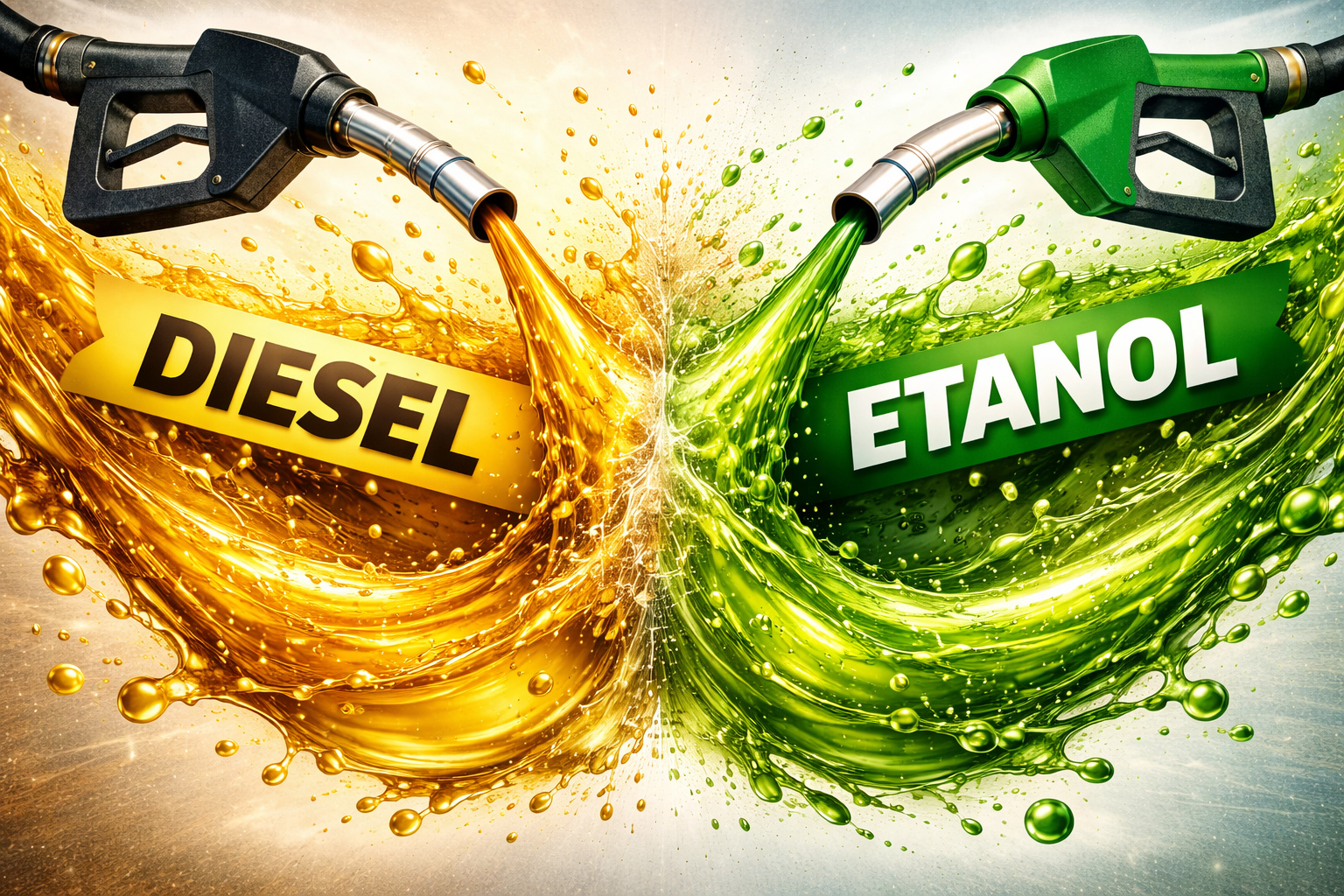
Technology Developed in the Country Promises to Reduce Diesel Consumption, Maintain Engine Power, and Cut Emissions in Trucks, Buses, and Agricultural Machinery
The Brazilian is already accustomed to the flex engine, which allows choosing between gasoline and ethanol at the pump. Now, this logic begins to enter a previously untouched territory: the diesel engine. A new technology under development in Brazil allows diesel engines to operate with a mixture of diesel and ethanol, maintaining high torque and reducing the use of fossil fuel.
The innovation has been tested by companies and national research centers, focusing on heavy vehicles such as trucks, buses, and agricultural machinery — precisely where diesel is dominant.
What Changes in Real Life for Those Who Use Diesel Engines
In practice, the proposal is simple and powerful: substitute part of the diesel with ethanol, a renewable fuel produced on a large scale in Brazil. In some tests, the substitution can reach up to 70% of diesel under certain operating conditions.
-
The gigantic steel shell built to contain Chernobyl for a century has been pierced by a drone, exposing a critical system and creating a hole that could cost over 500 million euros to repair.

-
Brazilian Navy reaches a new level by taking over an airport with a 1,600-meter runway used by 1,800 military personnel and autonomous attack drone testing.

-
With a 1.0 engine producing 75 hp and costing less than R$ 70,000, Fiat’s car returns to the podium as the cheapest in the country; a temporary promotion for the 2026 Like version reduces the price of the Fiat Mobi.
-
The Himalayas continue to grow to this day, with tectonic plates advancing 5 cm per year, mountains rising up to 10 mm annually, and the 2015 earthquake that killed 9,000 people may have increased the risk of an even larger seismic mega-event.


For those who make a living from transport or agriculture, this means:
- less dependence on fossil diesel,
- potential reduction of emissions,
- maintenance of the power and torque typical of the diesel engine.
In other words, the engine remains “diesel” in behavior but starts to use a significant share of ethanol.
Will It Use Less Fuel?
It may use less diesel, as part of it is replaced by ethanol, especially in constant use.
Will It Pollute Less?
Yes. The use of ethanol can reduce CO₂ emissions and pollutants from diesel.
Will It Lose Power?
No. The torque of the diesel engine is maintained, as the diesel continues to initiate combustion.
Will It Require More Maintenance?
It may require more technical attention, but it does not mean more frequent maintenance in daily use.
Is It Suitable for Trucks? Tractors? Buses?
Yes. The technology is designed specifically for trucks, buses, and agricultural machinery.

Does Diesel Step Aside? No — It Remains the Heart of the Engine
This is a key point for those who enjoy diesel engines: diesel does not disappear. It continues to be used as the fuel responsible for initiating combustion.
According to specialists involved in the development of the technology, the system works on a model called dual-fuel. In this system, a small amount of diesel is injected directly into the chamber to initiate combustion. Ethanol enters afterward and is ignited by the heat generated.
Simply put, diesel acts as a “liquid spark plug”, ensuring stable ignition, low-speed power, and reliability.
Why This Matters So Much to Transport and Agribusiness
The initial focus of the technology is on heavy vehicles, where diesel is still practically irreplaceable. Trucks, tractors, and harvesters require high torque and continuous operation — something that electric engines or Otto cycle engines still cannot fully deliver.
By allowing these engines to use ethanol:
- fuel costs can become more predictable,
- the country reduces CO₂ emissions,
- domestic ethanol gains a new market,
- transport and agriculture become less exposed to diesel volatility.
It is no coincidence that the development involves companies like Bosch, in partnership with Brazilian universities and institutes.

The Challenge Behind the Technology: Mixing Two Very Different Fuels
Diesel and ethanol are fuels with completely distinct properties. Ethanol has low flammability in compression engines, and it is also more corrosive and less lubricating.
Therefore, the adaptation requires:
- two independent injection systems,
- reprogrammed electronic control unit,
- components compatible with ethanol,
- sensors to control load, temperature, and mixture ratio.
Researchers from Mackenzie Presbyterian University and Mauá Institute of Technology explain that the engineering is complex but technically feasible, provided the electronic control is precise.
Less Pollution, but Without Miraculous Promises
From an environmental standpoint, the gain is significant. Considering the entire fuel cycle, the use of ethanol can reduce CO₂ emissions by up to 70% compared to pure diesel. Additionally, ethanol contains no sulfur and helps reduce particulate emissions.
Still, the developers themselves make it clear: it is not a magic solution. The system needs to be durable, reliable, and economically viable to advance beyond the testing phase.
Is It Near Future or Still an Experiment?
For now, the technology is in testing and validation phase, aimed at specific applications.
The fact that Brazil is leading this development is no coincidence: the country combines a large diesel fleet with massive ethanol production, creating a unique scenario for this type of innovation.







-

-

-

5 pessoas reagiram a isso.