





 Portuguese
  English
  Spanish
  4 min of reading
  2 comments


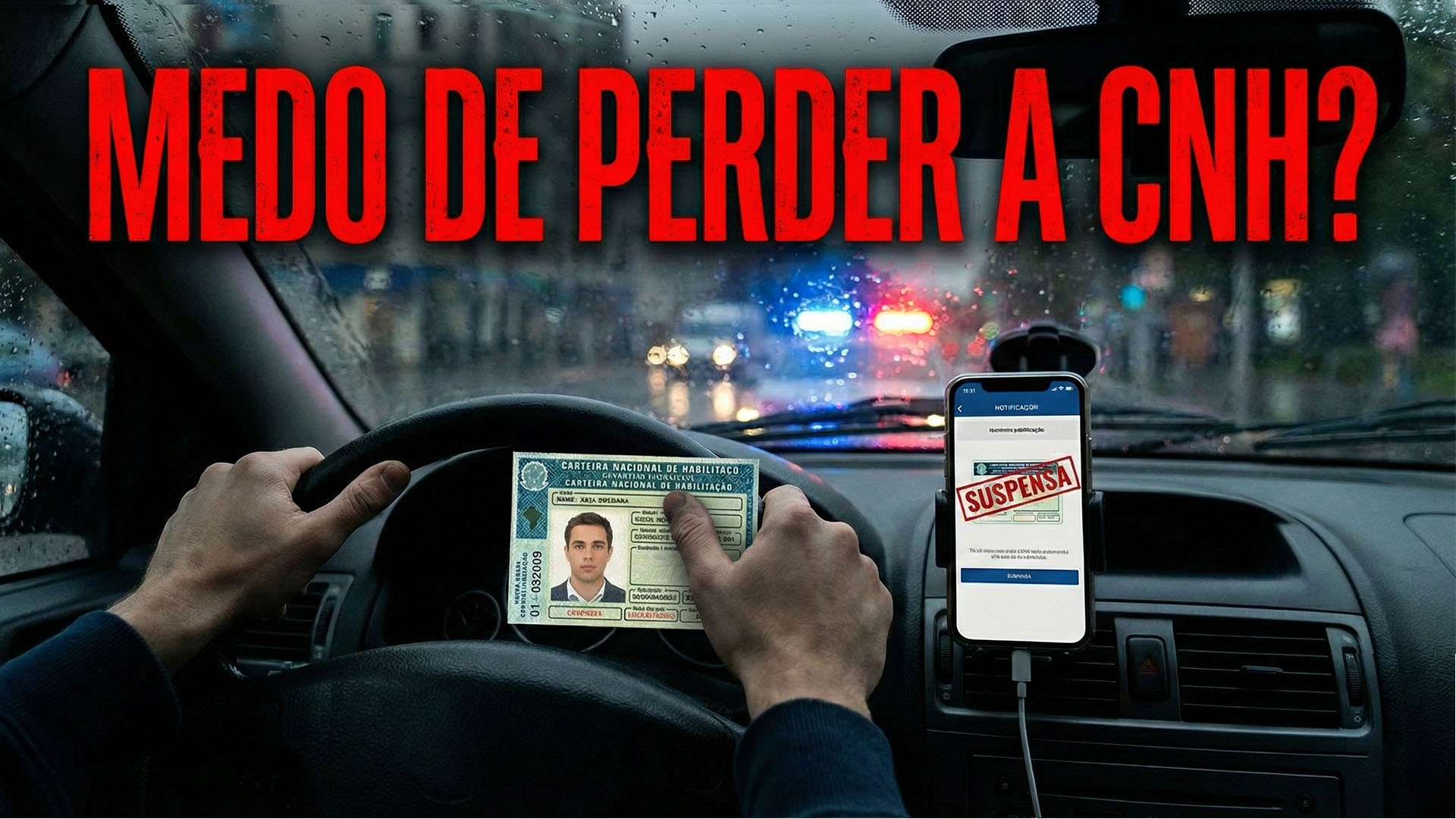


The Bill 3412/23 Advances in the Chamber and Proposes to Reduce One-Third of the Accumulated Points on the Licensing for Drivers Who Remain Six Months Without Fines, Creating a New Reward Mechanism in Brazilian Traffic.
A new legislative proposal may bring immediate relief to thousands of Brazilian drivers who live under the risk of having their National Driver’s License (CNH) suspended. This is the Bill 3412/23, authored by Deputy Antonio Carlos Rodrigues (PL-SP), which aims to alter the punitive logic of the Brazilian Traffic Code (CTB) by introducing a direct benefit for those who improve their behavior.
According to the text presented in the Chamber of Deputies, the measure establishes that the driver who remains six months without committing new infractions will be entitled to a reduction of one-third of the points already recorded in their record. The main objective is to encourage education and defensive driving, offering a second chance for those who demonstrate a change in behavior before reaching the legal limit of points.
Currently, the project is following legislative procedures and has already been approved by the Committee on Transportation and Traffic. The proposal argues that merely punishing is not enough to re-educate; it is also necessary to create mechanisms that value the citizen who decides to continuously respect traffic laws.
-
The Senate approves a bill that criminalizes misogyny, hatred, or aversion towards women, and includes the crime in the Racism Law with a penalty of up to 5 years.
-
Chamber Approves Bill That Allows Pepper Spray for Women Over 16 and Imposes Strict Rules for Purchase, Possession, and Use as Self-Defense

-
Chamber Approves Law to Combat Leucaena, Fast-Growing Plant That Dominates Land and Threatens Native Species in Various Regions of the Country

-
Asset Division: Know What Cannot Be Divided in Case of Divorce


If approved and sanctioned, the law will benefit not only amateur drivers but mainly professionals who depend on the CNH to work, such as truck drivers and app drivers, for whom the suspension of the document represents an immediate loss of income.
Understand the Mathematics of the Proposed Point Reduction
The mechanics of the benefit suggested by Bill 3412/23 is simple but powerful. Imagine a driver who has accumulated 15 points on their license due to minor or medium infractions. By the proposed rule, if this driver keeps their record “clean,” meaning without any new citations, for a period of six consecutive months, they will have a deduction of 5 points (one-third of 15), leaving only 10 active points.
This reduction moves the driver away from the suspension limit, functioning as an “extra breath.” It is important to emphasize that the benefit is not automatic for everyone; it requires the proof of good behavior during the evaluation semester. If the driver commits any infraction during this period, they lose the right to the discount, and the points continue to accumulate normally.
Traffic experts point out that this measure could reduce the administrative burden on traffic authorities and focus severe punishment on those who are habitual offenders, showing no interest in adapting their driving to safety standards.
The Current Point System and the Danger of Suspension


To understand the impact of this change, it is essential to recall the current rules established by Law 14.071/20, which recently reformed the CTB. Today, the suspension of the right to drive occurs within a scaled system that varies according to the severity of the fines.
The points limit over a 12-month period works as follows:
- 40 points: For those who have not committed any serious infractions.
- 30 points: For those who have committed only one serious infraction.
- 20 points: For those who have committed two or more serious infractions.
For Professional Drivers (who have the EAR observation on their license), the rule is more flexible, maintaining the cap of 40 points regardless of the nature of the infractions. However, even with higher limits, the accumulation of minor infractions (medium and serious) can quickly lead to the temporary loss of the license, something that the new project aims to mitigate.
The Difference Between Bill 3412/23 and the Positive Register (RNPC)
It is crucial not to confuse the new point reduction proposal with the already existing National Positive Register of Drivers (RNPC). The RNPC, known as the “Positive Register,” is already in effect and offers tax and tariff benefits for good drivers, but it does not directly interfere with the point count for suspension.
While the Positive Register focuses on discounts for CNH renewal, benefits at car rental companies, and even discounts on state taxes (depending on each state’s participation), Bill 3412/23 operates within the administrative sphere of penalties.
Both initiatives can be seen as complementary: the RNPC rewards those who never err, while the new project offers an opportunity for recovery for those who made mistakes but have decided to correct their behavior. Both measures reinforce the trend of using the “carrot” (incentive) instead of just the “stick” (fine) in the management of national traffic.
Next Steps in the National Congress
Like any legislative change, the path to final validation requires rigorous steps. After analysis in thematic committees of the Chamber of Deputies, such as the Constitution and Justice and Citizenship Committee (CCJC), the text must be voted on in plenary or, if processed conclusively, proceed directly to the Federal Senate.
In the Senate, the project will undergo further review. If the senators make any changes to the text, it goes back to the Chamber; if approved without changes, it moves on to presidential sanction.
During this process, civil society and traffic authorities may pressure for adjustments, ensuring that the “amnesty” of points does not encourage impunity, but rather a real awareness of the dangers behind the wheel.
And you, what do you think of this proposal? Do you believe that forgiving points for those who spend six months without fines is a fair incentive for traffic education, or do you think this will make it easier for reckless drivers? Leave your opinion in the comments.










Realmente pode benefíciar Realmente quem precisa de sua cnh para trabalhar
O correto para os maus condutores é perder a habilitação…