





 Portuguese
  English
  Spanish
  6 min of reading
  3 comments


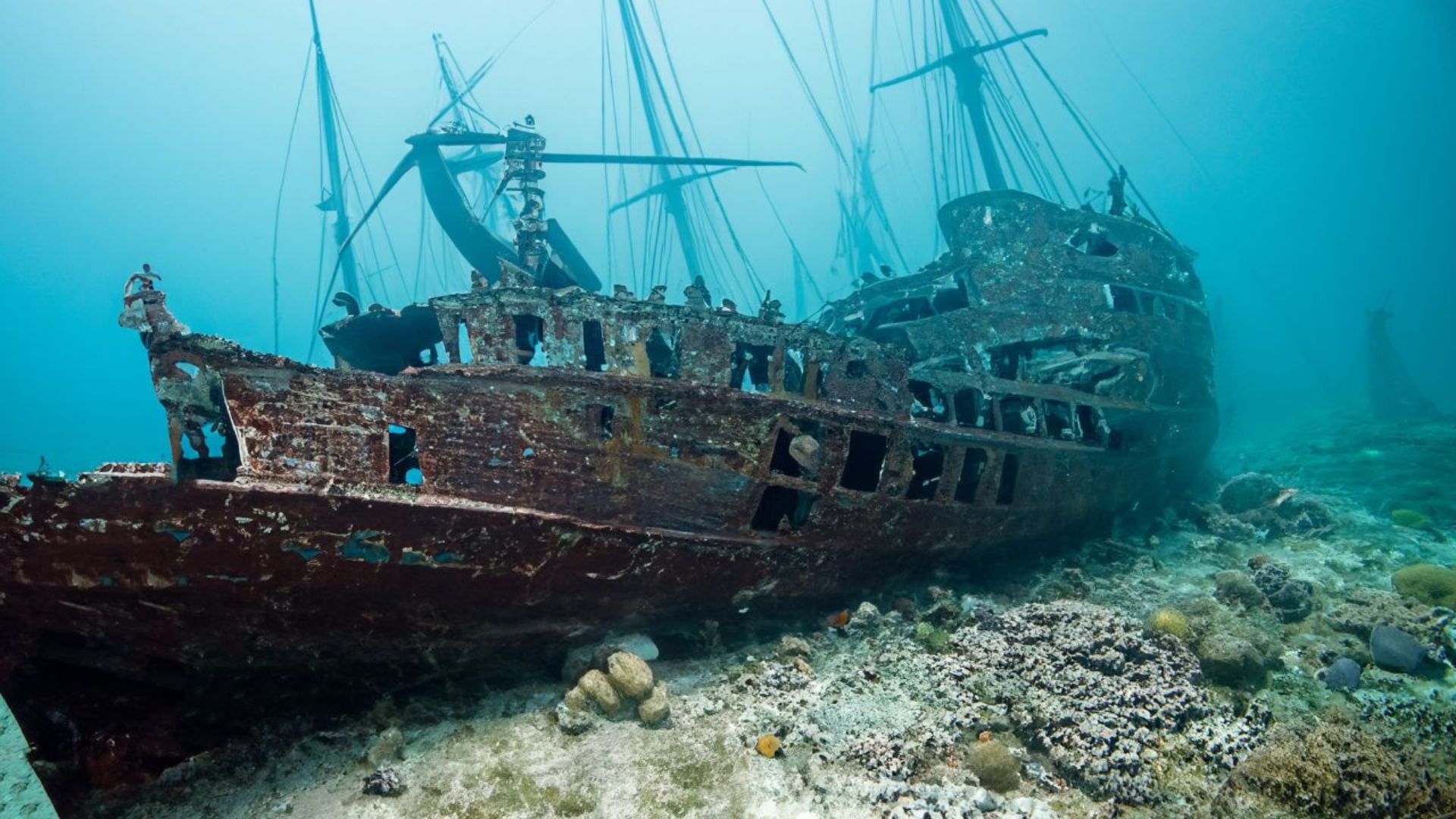


A Rare Find in Deep Waters Reveals a Preserved Renaissance Ship and Fuels New Technologies for Underwater Exploration, Drawing Attention for the Combination of History, Science, and Environmental Impact.
The identification of the wreck Camarat 4, a 16th-century merchant ship located about 2,567 meters deep off Ramatuelle on the south coast of France, has solidified the record for the deepest shipwreck ever documented in waters under French jurisdiction and has redefined the boundaries of modern underwater archaeology.
Discovered in March 2025 by a French Navy drone during a seabed control mission, the vessel, approximately 30 meters long by 7 wide, surprises both by its state of preservation and by the combination of cutting-edge technology, with ROVs equipped with 4K cameras, 3D mapping, and advanced digital models.
Preservation at Extreme Depth
The Camarat 4 rests in a deep area of the Mediterranean, near Cap Camarat, in the Gulf of Saint-Tropez, in an environment considered virtually inaccessible for archaeology until recently.
-
He started running at 66 years old, broke records at 82, and is now a subject of study for having a metabolic age comparable to that of a 20-year-old, in a case that is intriguing scientists and inspiring the world.

-
Oldest tree on the planet reappears after 130 years of searches: Wattieza, 385 million years old, was 10 meters tall and had no leaves or seeds; Gilboa fossils in New York solved the mystery in 2007.

-
A 48-square-meter house assembled in hours with 4,000 bricks made of recycled plastic that does not absorb moisture, has natural thermal insulation, and costs less than 90,000 reais in a complete kit.

-
Luciano Hang revealed that Havan’s air fleet has already accumulated more than 20,000 landings, 10,000 flight hours, and 6 million kilometers traveled, and he says that without the planes, the company would never have grown so quickly.


The depth of 2,567 meters, eight times the approximate height of the Eiffel Tower, places the site above only deep-water war wrecks, such as the U.S. destroyer USS Samuel B. Roberts, but sets a record in French territory.
Environmental conditions help explain the unusual preservation.

Cold water, low oxygen levels, the absence of sunlight, and a limited presence of wood-eating organisms drastically reduced structural wear.
Additionally, the depth discouraged any looting attempts, unlike what occurs with shipwrecks located a few dozen meters deep.
Experts describe the assemblage as a kind of “time capsule” of the Renaissance, where the hull, cargo, and armaments remain arranged very close to their original configuration.
Renaissance Cargo and Clues to Mediterranean Trade
The visible cargo on the surface of the site helps reconstruct the role of the ship in 16th-century trade routes between northern Italy and other regions of the Mediterranean.
Images captured by submerged vehicles show about 200 jars of glazed pottery and approximately 100 plates, mostly attributed to workshops in the Liguria region of northwestern Italy.
The jars have a globular shape, pinched spouts, and ribbon handles.
Many are decorated with the monogram “IHS”, while others exhibit floral and geometric motifs, indicating both the utilitarian function and symbolic value of the pieces.
The yellow-toned plates, also linked to Ligurian production, reinforce the hypothesis of a structured trade in fine ceramics along routes between the Italian peninsula, southern France, and potential destinations in the Maghreb or the Levant.
Among the ceramic pieces, bars of iron wrapped in plant fibers stand out, a type of packaging that reduces oxidation during transport and demonstrates technical concern for strategic goods.
For researchers, this type of metallic cargo recalls, in its economic importance at the time, the role played today by high-value inputs, such as electronic components.
The assemblage also includes six cannons, a complete anchor, large cauldrons, and other utensils that help reconstruct daily life aboard and the measures taken to defend against piracy on long-distance routes in the 16th century.

Military Mission and Start of Scientific Investigation
The discovery occurred on March 4, 2025, during the military oceanographic mission Calliope 25.1, dedicated to mapping seabeds.
An autonomous deep-water drone identified an anomaly consistent with a vessel about 30 meters long and 7 wide, in an area with no cartographic records of similar structures.
In light of the initial images, the Navy contacted the DRASSM, the department responsible for underwater archaeology.
A second campaign utilized a remotely operated vehicle capable of working up to 4,000 meters deep, which provided high-definition videos of the vessel and cargo.
Based on the typology of the ceramics and the visible architecture, the team classified the ship as a large Renaissance merchant ship, active around the mid-16th century.
4K Technology, 3D Mapping, and Digital Twins
As human divers cannot operate safely at these depths, the entire investigation relies on underwater robotics.
The ROVs employed in the Camarat 4 campaign operate with 4K cameras, 3D mapping sensors, and high-precision robotic arms, capable of manipulating objects without disrupting the archaeological context.
This combination allows for the documentation of every centimeter of the site with a level of detail close to that of an in-person inspection.

Based on this material, the DRASSM and partner institutions are working on the generation of a 3D digital twin, reproducing the position of the hull, ceramic pieces, armaments, and other structural elements.
The goal is to allow repeated analyses of the site without the need for new trips to the seabed, as well as to prepare for future campaigns of restricted excavation and virtual exhibitions.
Researchers in heritage conservation indicate that digital models of this type tend to integrate artificial intelligence tools to assess risks, simulate degradation scenarios, and virtually test preservation strategies.
Sources linked to the project say that the high-resolution documentation generated in the initial campaigns will serve as a basis for this approach, in cooperation with marine technology centers.
Modern Trash in the Same Bed as 500-Year-Old Artifacts
Among jars, plates, and iron bars, the images recorded by the ROVs also revealed drink cans, plastic packaging, bottles, and remnants of fishing nets, resting in the same bed where 500-year-old artifacts lie.
The presence of these materials has been confirmed in different campaigns and has been cited as evidence of the ability of modern waste to reach even abyssal environments.

The contrast between the preserved wreck and the recent trash has gained prominence in presentations related to the United Nations Ocean Conference, held in June 2025 in Nice.
Long-Term Research and Virtual Access to the Ship
Official plans foresee a multi-year research effort on the site, prioritizing complete photogrammetric documentation, typological analyses of pottery, and studies focused on the exact origin of the vessel and its route.
There are no plans for large-scale removal of artifacts.
The strategy is to keep the wreck in situ and conduct only targeted collections when strictly necessary for laboratory analyses.
French museums and international partners are discussing formats for virtual exhibitions and immersive experiences based on the digital twin of the ship, with potential to bring images of Camarat 4 to classrooms and cultural spaces.
At the same time, the site is incorporated into environmental education initiatives, as an example of coexistence between rare historical heritage and human-origin pollution.
As archaeologists seek answers about the route, the port of departure, and the causes of the wreck, Camarat 4 consolidates itself as a natural laboratory to discuss Renaissance trade, technological innovation, and human impact on the deep sea.
In a scenario where drones, 4K cameras, 3D models, and artificial intelligence are advancing rapidly, to what extent can discoveries like this transform the way modern societies relate to hidden heritage thousands of meters deep?








A gente nem consegue ler de tanta publicidade na página. Primeiro e último artigo que leio nessa página.
Coloca mais anúncio que tá pouco aí nois cê anúncio e não notícia
Esses patifes, valorizam o dinheiro em primeiro lugar. Querem priorizar o comercial, em detrimento dos leitores.