





 Portuguese
  English
  Spanish
 4 min of reading
  13 comments


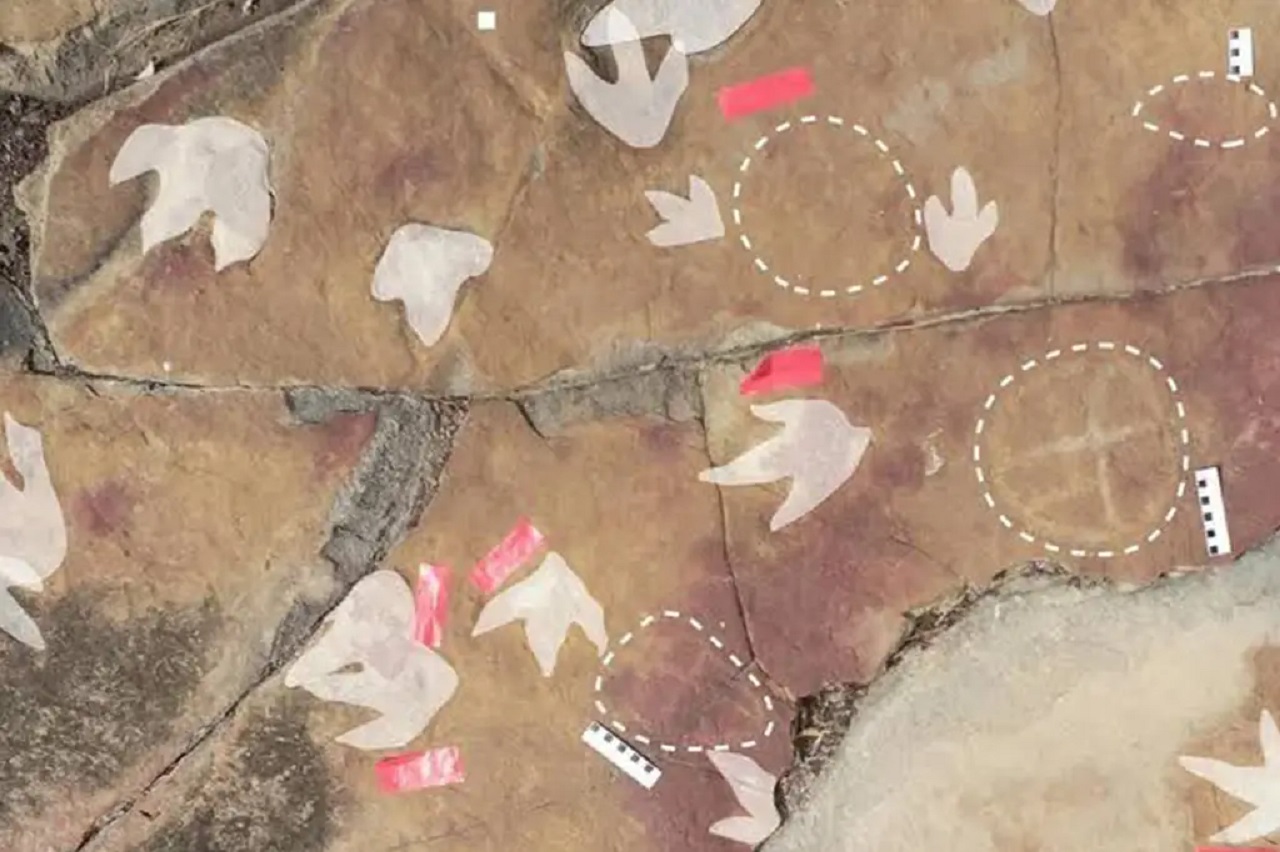


Rock Art Interacts With Dinosaur Tracks at Prehistoric Site and Reveals Millennial Cultural Connection in the Northeast Backlands – Check Out the Details of One of the Most Important Archaeological Discoveries in Paraíba in the World.
An archaeological discovery in Paraíba has just been internationally recognized as one of the most relevant in the world in 2024. The revelation was made by the renowned scientific journal Archaeology Magazine, which highlighted the Brazilian find in its annual list of the top ten global archaeological discoveries. The study, originally published in Scientific Reports, identified a rare interaction between prehistoric rock art and fossilized dinosaur footprints, revealing a unique form of symbolic expression between humans and paleontological records.
The research was led by Leonardo Troiano from the National Institute of Historic and Artistic Heritage (Iphan), in collaboration with paleontologist Aline Ghilardi, a professor at the Federal University of Rio Grande do Norte (UFRN). The site of the find is the Serrote do Letreiro Archaeological Site, in the interior of Paraíba, which now gains status as an international scientific landmark. Another archaeological finding: Honey from 3,000 years ago is found in an Egyptian tomb and is still fit for consumption.
Archaeological Discovery in Paraíba Connects Stone Age Humans With Dinosaur Tracks
What makes this archaeological discovery so unique is the clear evidence that humans who inhabited the region over 9,000 years ago recognized and engaged symbolically with fossilized footprints left by carnivorous dinosaurs that lived in the area about 140 million years ago.
-
Finland, the happiest country in the world, wants to hire 140,000 technology professionals and is eyeing Brazilians: visas are issued in just two weeks and salaries with a 37-hour workweek are surprising.

-
Mr. Mário reveals the technique of the caipira papaya: he cuts the fruit in half, discards the seeds from the tip, and plants the ones from the back to increase the chance of a productive female tree.

-
Few remember, but the submarine that disappeared in 1968 with 52 crew members was found after 51 years at the bottom of the sea at more than 2,000 meters, intriguing the entire world.

-
With 1,200 tons suspended, the Japan mega-structure in a grid shape with a floating sphere from Fuji TV features two 25-story towers connected by elevated walkways, titanium panels, and impresses the world with its ability to reduce wind impact.


At Serrote do Letreiro, researchers mapped more than 50 petroglyphs — figures carved into rocks — that were drawn over or alongside fossilized dinosaur trails. The petroglyphs have shapes similar to the footprints, suggesting that the region’s inhabitants reproduced the marks for symbolic or ritualistic purposes.
According to the study, this is the first time a direct and intentional association between rock art and paleontological records has been documented, transforming the region into a true millennial palimpsest — a concept that refers to the reuse of a surface for different messages over time.
Recent Discovery Reveals That Homo Sapiens Recognized Dinosaur Tracks
The rock where the recent discovery was made has been known since the 1980s, when archaeologist and Italian priest Giuseppe Leonardi identified the site as potentially significant. However, it was only in recent years, with the advancement of mapping technologies, that a thorough analysis of the petroglyphs was conducted.
The new investigations showed that the Homo sapiens, at least 10,000 years ago, recognized the shapes of dinosaur footprints and incorporated them into their cultural practices. Some petroglyphs have the exact same shape as the fossilized trails, demonstrating that the inhabitants understood they were ancient vestiges and attributed some meaning to them.
Even though the original symbolic meanings cannot be completely deciphered, the overlap of rock drawings over fossilized footprints is sufficient to demonstrate an intentional connection between two distant geological eras — the Cretaceous and the Holocene.
Archaeological Discovery Unites Paleontology and Archaeology at the Same Site
The archaeological discovery in Paraíba is also unprecedented for bringing together two distinct disciplines: archaeology, which studies human artifacts, and paleontology, which analyzes fossils of extinct living beings. At Serrote do Letreiro, both areas overlap in a concrete way, which is extremely rare in scientific sites.
Most of the fossilized footprints belong to theropod dinosaurs, a group of carnivores that lived millions of years ago. Rock art, in turn, dates from a period between 9,000 and 3,000 years ago, spanning from the end of the Stone Age to the early periods of copper use in Brazil.
“It is an overlap that shows a dialogue between humans and the deep past of the Earth,” states researcher Leonardo Troiano. “These people not only noticed the footprints. They interacted with them symbolically, incorporating these traces into their visual language.”
Serrote do Letreiro Gains International Recognition as Brazilian Archaeological Heritage
The inclusion of the Paraíba site on the list of Archaeology Magazine puts Brazil at the center of global archaeology. The magazine is considered one of the most respected scientific publications in the field and selects only discoveries with global relevance. In addition to the archaeological discovery in Paraíba, the list includes findings in Egypt, Greece, Turkey, Italy, and Mexico.
For paleontologist Aline Ghilardi, the repercussions of the recent discovery also reinforce the importance of preserving Brazil’s archaeological and paleontological sites. “These evidences are outdoors, exposed to erosion, vandalism, and ignorance. We need to value and protect these places,” she stated in an interview with the press.
The research team is now seeking institutional support to ensure the protection of Serrote do Letreiro as national and international heritage. The hope is that the recognition will help stimulate scientific tourism, environmental education, and interest in multidisciplinary research in the northeastern semi-arid region.
Brazil Now Integrates the Global Circuit of Archaeological Discoveries
The recognition of the archaeological discovery in Paraíba also marks a shift in the international landscape, where Brazil is sometimes underrepresented. Sites like the Serra da Capivara in Piauí have already revealed evidence of ancient human occupations, but this new discovery goes further: it shows that the first Brazilians were also interpreters of the geological landscape.
This symbolic interaction between humans and dinosaur tracks is a unique contribution to understanding how ancient societies viewed and recontextualized the vestiges of deep history. Instead of ignoring or erasing the marks left by dinosaurs, these human groups transformed them into art and culture.








Parabens pela descoberta assim consigo retroagir no tempo e maravilhoso..
Sousa na Paraíba !
Interessante, e bacana ver que háa pessoas inteligentes e cultas neste Brasil que lêem e comentam sobre este tipo de reportagem