





 Portuguese
  English
  Spanish
  4 min of reading
  0 comments


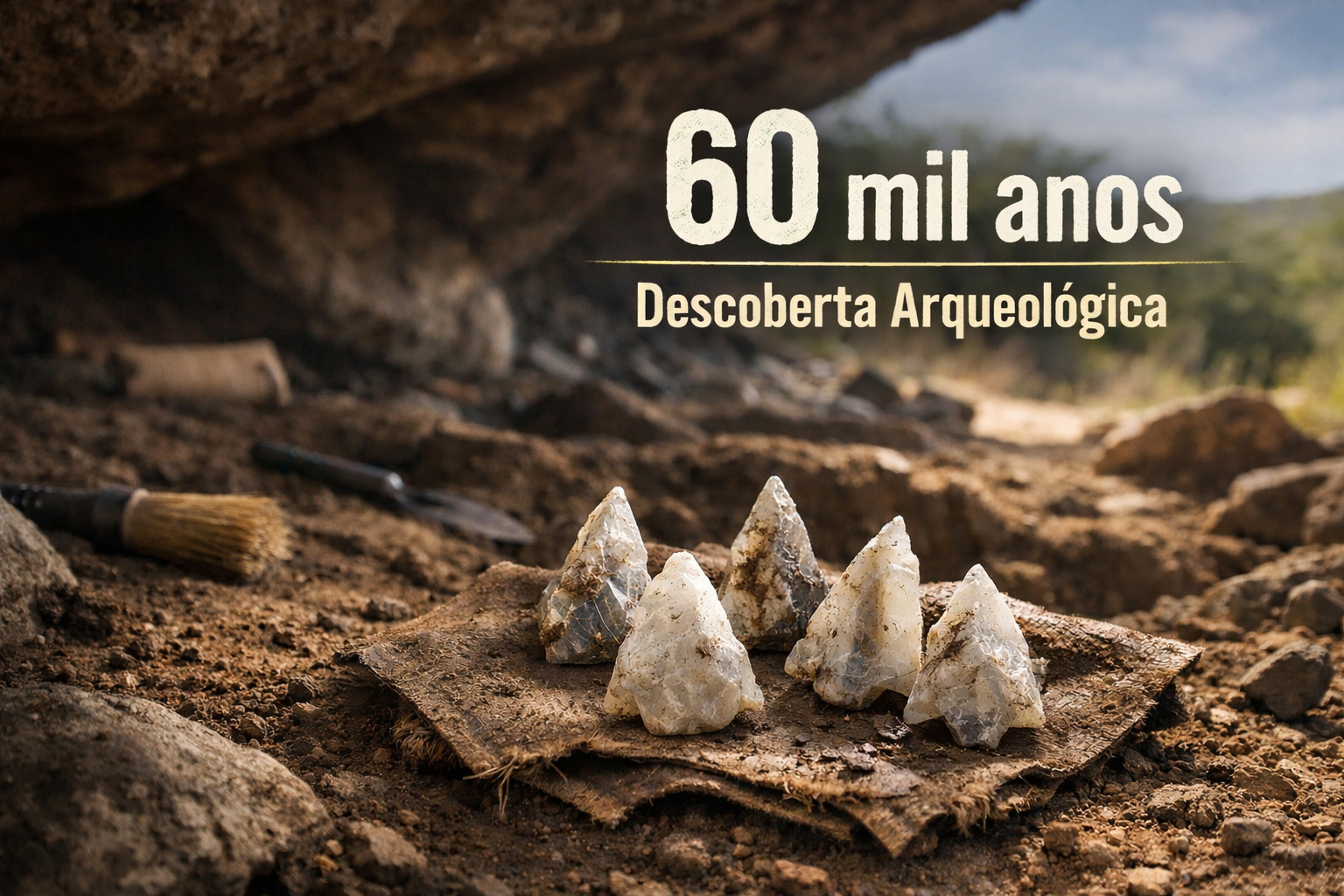
Discovery of Poisoned Arrows with 60 Thousand Years Reveals Science and Strategy of the First Human Civilizations.
Archaeological Discovery Changes What Was Known About Early Civilizations
An archaeological discovery made in South Africa revealed that humans used poisoned arrows about 60 thousand years ago, long before the emergence of the first known civilizations. The research, conducted by archaeologists and published in the journal Science Advances in January 2026, shows that sophisticated hunting techniques were already part of the human repertoire in the Late Pleistocene.
The find occurred at the Umhlatuzana Rock Shelter site in KwaZulu-Natal province, and helps explain how science, planning, and strategy were already shaping the behavior of early Homo sapiens.
Poisoned Arrows Indicate Science and Strategy Before the Holocene
The researchers identified 216 quartz arrowheads buried at the site, all dated to approximately 60 thousand years ago. Among them, ten contained preserved microscopic residues. Of these, five contained toxic plant substances, confirming the intentional use of poisoned arrows as a hunting technology.
-
With a cost per shot close to zero, the DragonFire laser could change naval warfare in 2027 and provide British ships with nearly unlimited defense against drones.

-
A British startup creates tires that generate electricity in electric vehicles when passing over potholes, speed bumps, and cracks.

-
Scientists have created robots made with living cells that have their own nervous system, swim on their own, explore the environment, and self-organize without any genetic engineering, and now they want to do the same with human cells.

-
Students create a solar-powered ambulance that operates without a plug, without fuel, and still keeps medical equipment running in remote areas.


Until now, archaeology associated the use of poisons in weapons with a much more recent period. The oldest known records date back to about seven thousand years ago, with traces found in Kruger Cave, also in South Africa. Therefore, this discovery pushes the origin of this practice back by thousands of years.
Applied Science in Hunting Among Early Homo Sapiens
Chemical analyses identified the alkaloids buphanidine and epibuphanisine in the residues of the arrows. These substances are associated with the plant Boophone disticha, known for its high toxicity. Even today, communities in Southern Africa use this plant as poison for hunting weapons, reinforcing the continuity of traditional knowledge over time.
Moreover, the compounds directly affect the nervous system, potentially causing seizures and respiratory failure. Thus, the use of this poison increased hunting efficiency, even when the animal did not die immediately after being hit.
Archaeology Reveals Abstract Thinking and Complex Planning
According to the study’s authors, the use of poisoned arrows requires a sequence of coordinated actions. First, the hunter needs to identify plants with toxic properties. Next, they must correctly extract the compounds and apply them in such a way that the poison remains active on the weapon for long periods.
“Although the Middle Pleistocene hunters of the Umhlatuzana Rock Shelter did not possess formal chemical knowledge, our study demonstrates that they had a system of knowledge or procedural knowledge that allowed them to effectively identify, extract, and apply toxic plant exudates,” the study explains.
This behavior, therefore, points to abstract thinking, causal reasoning, and advanced planning—fundamental elements of science even before the emergence of the first organized civilizations.
Poisoned Arrows Required Deep Ecological Knowledge
In addition to empirical chemical mastery, hunters needed to understand the behavior of their prey. The study highlights that the poison did not act immediately but weakened the animal over time, favoring what is known as persistence hunting.
“They also must have had the necessary knowledge about ecology and prey behavior (ethology) to know that if hit by a shot, the delayed effect of the poison would weaken the prey after some time,” the researchers detail.
Meanwhile, since the poison acts chemically rather than through physical force, hunters needed to anticipate outcomes, plan movements, and coordinate long-term actions.
The Plant Used in the Poison Reinforces the Sophistication of the Technique
Boophone disticha belongs to the Amaryllidaceae family and is native to Southern Africa. Although there is no direct botanical evidence that the plant was exactly around the rock shelter 60 thousand years ago, it still occurs less than eight kilometers from the archaeological site.
This fact reinforces the hypothesis that human groups had a good understanding of the territory they inhabited. Furthermore, it demonstrates that survival-related science was part of the routine of these populations long before the Holocene.
Discovery Redefines the Role of Science in Early Civilizations
The find clarifies the use of advanced hunting techniques long before the Holocene, a period that began about 11,700 years ago and is associated with the emergence of agriculture and the first complex civilizations. Thus, archaeology shows that science, strategy, and innovation were already present in human life in much earlier times.
According to Live Science, the study represents one of the clearest pieces of evidence that the use of poisons was part of an ancient technological tradition. As a result, the discovery of poisoned arrows redefines the understanding of the level of sophistication achieved by the first human civilizations.








Seja o primeiro a reagir!