





 Portuguese
  English
  Spanish
  9 min of reading
  0 comments


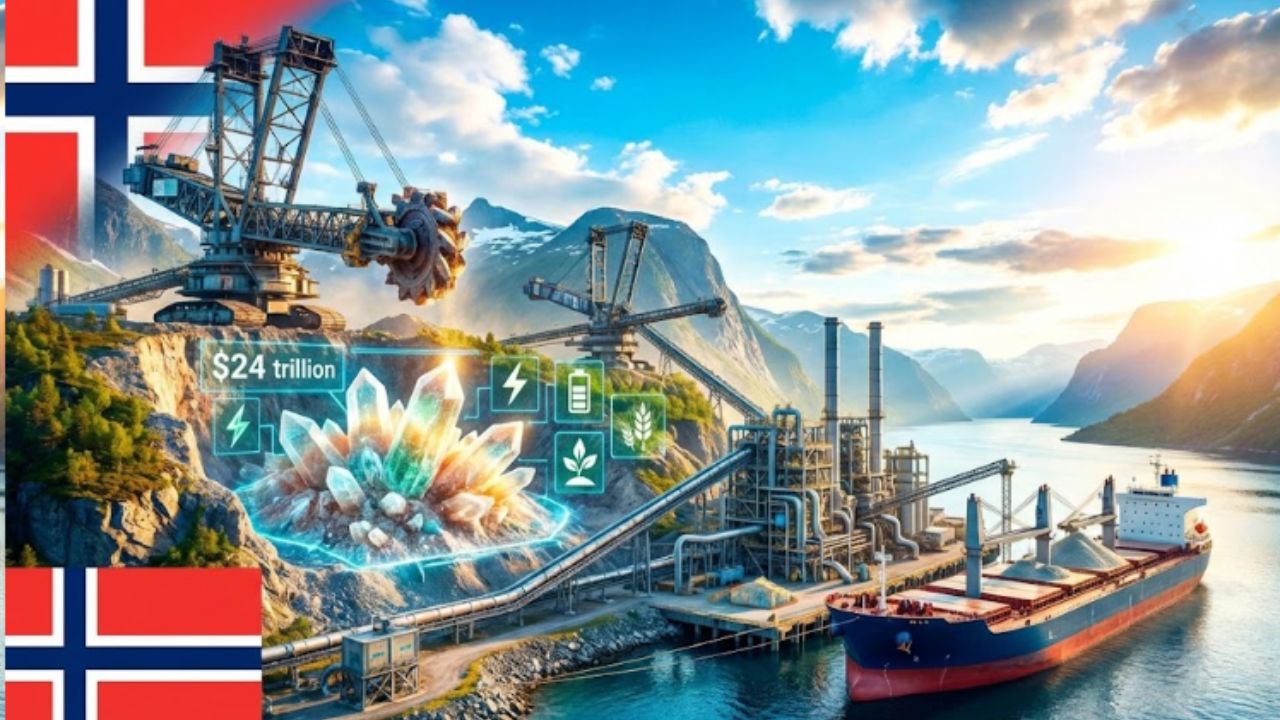
Discovery In Norway Of The Largest Phosphate Deposit In The World Exposes How Norway Uses Phosphate And Sovereign Fund To Become An Energy Power
The Discovery In Norway Of The Largest Phosphate Deposit In The World comes amid a global fertilizer crisis, where a single mineral connects food on the table, electric batteries, and geopolitics. Buried beneath mountains in the southwest of the country, this mineral treasure could provide phosphorus for agriculture and for LFP batteries used in solar panels and electric cars for decades.
At the same time, the Discovery In Norway Of The Largest Phosphate Deposit In The World appears precisely when Europe realizes the risk of depending on a few suppliers. When China closed phosphate exports in 2021, prices exploded, farmers were left in despair, and the green industry felt the impact. The question is whether this new deposit will be capable of breaking the monopoly, ensuring strategic security for Europe, and preventing further global fertilizer crises.
Largest Phosphate Deposit In The World: The Hidden Treasure In Norway
Buried in the mountains of Rogaland in the southwest of the country, the Discovery In Norway Of The Largest Phosphate Deposit In The World was identified by the company Norge Mining and announced in 2018. Estimates speak of up to 70 billion tons of phosphate rock, in addition to significant reserves of titanium and vanadium, two strategic minerals for the green and technology industry.
-
The institute that trained the greatest aerospace engineers in Brazil has just opened its first campus outside São Paulo after 75 years: ITA Ceará will have R$ 445 million, new courses in energy and systems, and classes are expected to start in 2027.
-
Luciano Hang, owner of Havan, goes to Juiz de Fora after the tragedy in February, brings R$ 1 million, hands out R$ 2,000 cards, and donates up to R$ 15,000 to victims in the region.

-
The Brazilian passport allows legal residence in dozens of countries without the need for a prior visa, and most Brazilians are unaware that they can apply for residency directly upon arriving in nations in South America, Africa, and even Europe.

-
Petrobras sends a message to Brazilian truck drivers after fuel collapse and reveals plan to have 100% domestic diesel.
If confirmed, these numbers put Norway on another level. This largest phosphate deposit in the world could completely change the geopolitical balance of fertilizer supply, taking part of the spotlight away from countries like China, Morocco, Egypt, and Russia.
Today, phosphate is traded at around 345 dollars per metric ton. On a scale, this largest phosphate deposit in the world could be worth about 24 trillion dollars. It is literally a case of turning stone into gold. But this windfall comes at a cost: technical challenges, environmental risks, and political pressures that could compromise everything.
How Phosphorus Became The Base of Agriculture And The Energy Transition
Phosphorus was the first known chemical element whose discoverer has a name and surname. In 1669, the German Hennig Brand heated urine attempting to find the philosopher’s stone. He didn’t find gold, but discovered something that glowed in the dark: phosphorus, the “carrier of light.”
In the 19th century, Justus von Liebig demonstrated that phosphorus, nitrogen, and potassium were the real culprits behind plant fertility, not just decaying organic matter. Shortly after, phosphate-rich steel production waste showed how heavy industry could feed the fields.
The practical result is that, after World War II, mineral-derived phosphorus became a key player in modern agriculture. Today:
- More than 200 million tons of phosphate are extracted each year.
- Consumption is around 45 million tons annually.
- About 90% of the extracted phosphate is turned into fertilizer.
Outside the fields, phosphate appears in chemical products, animal feed, detergents, and LFP batteries used in solar panels and electric cars. Controlling the largest phosphate deposit in the world means influencing food, energy, and technology at the same time.
Dangerous Dependence And The Shock That Opened Space For Norway
Before the Discovery In Norway Of The Largest Phosphate Deposit In The World, the global board was practically dominated by a few actors. The simplified structure is as follows:
- China
- Produces about 110 million tons of phosphate per year.
- Has estimated reserves of 3.7 billion tons.
- Morocco
- Produces nearly 30 million tons annually.
- Has about 50 billion tons of reserves, until then the largest in the world.
Together, China and Morocco dominate global supply, followed by the United States and Russia. In 2021, when China blocked phosphate exports, the decision acted like an earthquake in the markets.
- Before the war in Ukraine, Russia accounted for about 12% of global phosphate exports.
- With Belarus, allies combined accounted for nearly 20% of global fertilizer exports.
- Sanctions and restrictions led to breaks in supply chains and a brutal rise in prices.
The European Union, which depends almost entirely on imports, was left completely exposed. It is in this vulnerability scenario that the largest phosphate deposit in the world in Norway gains strategic relevance for all of Europe.
Rogaland And The Package Of Phosphate, Titanium, And Vanadium

The Rogaland deposit is not “just” the largest phosphate deposit in the world. It comes with:
- Large volumes of phosphate rock.
- Reserves of titanium, used in prosthetics, airplanes, and high-strength industrial applications.
- Presence of vanadium, important in metal alloys and energy technologies.
This package turns the Discovery In Norway Of The Largest Phosphate Deposit In The World into a complete asset for the green industry.
For Brazil, there is a sensitive point: the titanium from Rogaland directly competes with Brazilian titanium, as the country is currently one of the main suppliers and has the largest reserve in the world in Minas Gerais. If Norway enters this market aggressively, the competition for space in the global chain of strategic minerals will become fiercer.
The Environmental Cost Of The Largest Phosphate Deposit In The World
Exploiting the largest phosphate deposit in the world in a country like Norway is not just an engineering matter. It is an environmental test.
Norway has a tradition of maritime exploration and deep-sea oil extraction, but mining phosphate, titanium, and vanadium on a large scale in mountainous and fjord areas is a different challenge. The fjords, deep valleys where the sea enters between rock walls, create iconic landscapes. There are over a thousand fjords in the country, some listed as World Heritage by UNESCO.
Any mining accident in these regions would have a huge environmental and political cost.
Moreover, phosphate mining produces phosphogypsum, a waste that can contain radioactive elements such as uranium, thorium, and radium. In the United States, mountains of phosphogypsum can reach hundreds of meters in height. In 2021, a deposit in Piney Point, Florida, suffered a leak, dumping millions of gallons of contaminated water into Tampa Bay, causing algal blooms and fish kills.
This type of disaster is a direct warning: the largest phosphate deposit in the world cannot repeat mining models that treat waste as a secondary problem.
Law, Diplomacy, And The Fear Of Local Communities
The Discovery In Norway Of The Largest Phosphate Deposit In The World also brought the issue to the forefront of European diplomacy.
Although not part of the European Union, Norway is part of the European Economic Area and is a strategic ally of Brussels. The European Union has already expressed concern about the impacts of large mining projects offshore and in sensitive areas. In 2023, it sent a formal note to the Norwegian government on the matter.
While experts study closed systems to prevent particles and metals from spreading in the sea, those who feel the risk closest are the local communities.
In the village of Ulefoss, around two thousand people live near the area where the largest phosphate deposit in the world was found. The responsible company promises an “invisible mine”, underground, and claims it will return the waste to the extraction site to avoid gigantic waste piles.
Even so, residents are divided:
- Some see mining as a chance for jobs and income.
- Others fear geological instability, ground deformation, and irreversible damage to nature, as happened in Kiruna, Sweden, where the city had to be relocated.
- Environmentalists, academics, and European politicians question whether it is worth risking a preserved region to explore the largest phosphate deposit in the world in the name of trillion-dollar profits and independence from China.
The opposition is growing and turning Rogaland into a laboratory for how to reconcile food security, energy transition, and environmental protection.
How The Largest Phosphate Deposit In The World Fits Into The European Battery Plan
Even with so much controversy, Norway decided to move forward. The project in Rogaland, which explores the largest phosphate deposit in the world, is expected to begin operations in 2028 with a sustainability and innovation narrative.
The plan includes:
- Use of renewable energy on a large scale.
- Underground mining instead of large open pits.
- Total electrification of the process, reducing direct emissions.
- Integration with a circular economy for batteries and fertilizers.
The Discovery In Norway Of The Largest Phosphate Deposit In The World connects directly to the European strategy for critical minerals. Phosphate is included in the Critical Raw Materials list of the European Union and is regarded as a risk item. In 2024, the EU and Norway signed a strategic partnership for sustainable raw materials and battery value chains, covering:
- Extraction of raw materials.
- Design and manufacturing of cells.
- Recycling and disposal in circular economy models.
If the exploration is successful, this largest phosphate deposit in the world could supply Europe’s and good part of the planet’s demand for a century, providing:
- More security for European farmers.
- Less vulnerability to shocks coming from China, Morocco, and Russia.
- More stability for fertilizer, energy, and clean technology industries.
The Norwegian Manual: From Oil To Phosphate
Norway has already experienced something similar to this Discovery Of The Largest Phosphate Deposit In The World, only with oil. In the late 1960s, the Ekofisk field in the North Sea ushered in the era of Norwegian oil.
Instead of transforming the state-owned company into a short-term tool, the country opted for a more stable institutional design:
- Created Statoil, now Equinor, as a commercial company that competes with private groups.
- Kept the state as the majority shareholder, participating in profits, but without using the company as a permanent political cash box.
- Allowed the company to develop governance and multinational market logic, with strategic government support.
The result was the creation of a robust sovereign fund, fed by oil income, to also benefit future generations.
- Norway has about 5.5 million inhabitants.
- Each citizen, in theory, has more than 300 thousand dollars in participation in this fund.
- The Oil Fund totals approximately 1.8 trillion dollars, making it the largest in the world.
Now, the hope is that the country applies the same logic to the largest phosphate deposit in the world, turning the mineral into long-term security and not into crisis or instability.
Brazil, Devaluation And The Hidden Lesson In Norwegian Phosphate
When we look at the largest phosphate deposit in the world in Norway, it is almost inevitable to compare it with Brazil. Here, the recurring sentiment is that the state fails to protect collective assets and the purchasing power of the population.
While Norway discusses a sovereign fund and governance, the Brazilian sees the real losing strength. In the mentioned context, the dollar went from 4.91 reais to 5.45 reais, representing an 11% devaluation in a short time.
That’s why so many people try to protect part of their wealth in dollars, attempting to adopt, on an individual scale, the same long-term logic that Norway applies on a national scale. Instead of waiting for the government to create a robust sovereign fund, individuals try to set up their “mini sovereign fund” in a strong currency.
Partnerships with platforms like Nomad fit precisely into this context:
- Open a dollar account.
- Convert reais with commercial exchange rates.
- Use an international card while traveling without relying on cash.
The big lesson is that Norway thinks in decades, while those living in unstable economies need to protect themselves month by month.
Geological Luck Or Consequence Of Good Governance?
The Discovery In Norway Of The Largest Phosphate Deposit In The World is not just a stroke of luck. It adds to a history that includes:
- Transforming oil into sovereign fund and not into economic collapse.
- Leading the adoption of electric vehicles, with around 88% of the cars sold in 2024 already electric.
- Inaugurating, in 2025, the world’s first commercial CO₂ storage, burying captured carbon dioxide from factories and power plants.
- Investing in carbon capture and purchasing credits to mitigate energy production impacts.
In other words, even while exploring fossil resources, the country tries to align natural wealth with sustainability and long-term vision. If the same logic is applied to the largest phosphate deposit in the world, Rogaland could become a reference in responsible mining on a global scale.
And If The Largest Phosphate Deposit In The World Were In Brazil?
In the end, the Discovery In Norway Of The Largest Phosphate Deposit In The World raises an inevitable question for those on this side of the Atlantic:
If a reserve of this size were discovered in Brazil, what do you think would happen to this wealth?
Would it become a robust sovereign fund, a guarantee of future investment in education, technology, and energy transition? Would it lead to crisis, scandal, and short-term political disputes? Or would it end up as just another missed opportunity in a resource-rich country but poor in planning?
Tell us in the comments: if the largest phosphate deposit in the world were in Brazilian territory, what do you think would be the fate of this treasure?









-

-

-

9 pessoas reagiram a isso.