





 Portuguese
  English
  Spanish
  3 min of reading
  3 comments


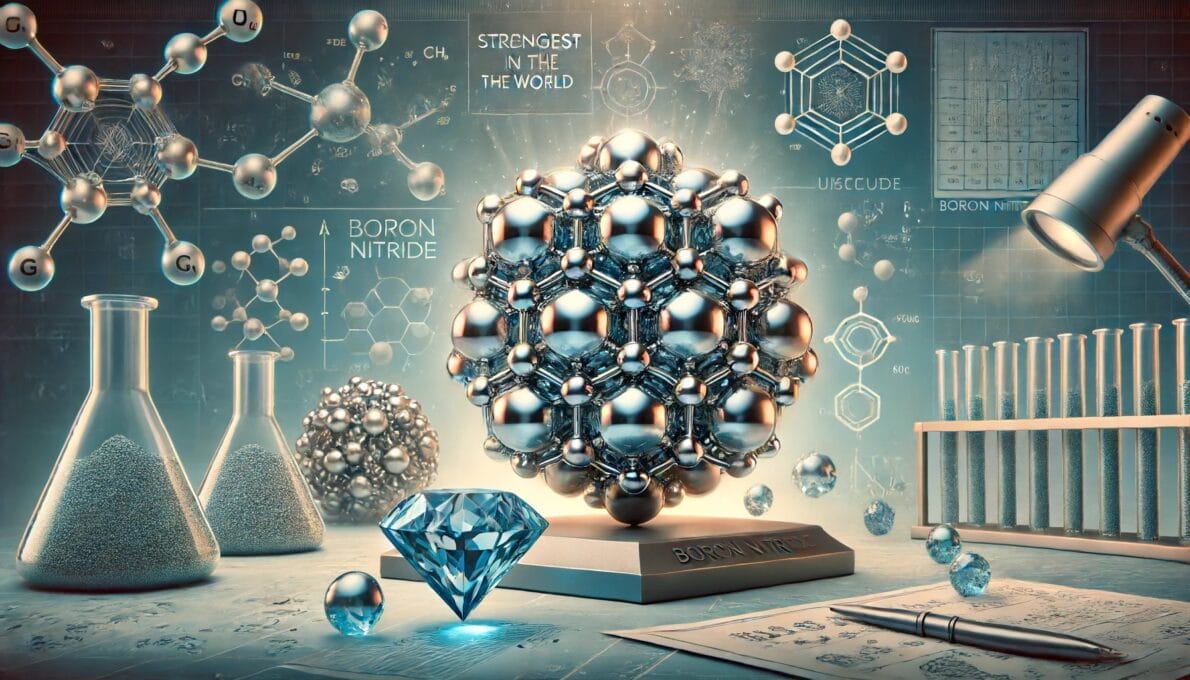


Meet Boron Nitride (h-BN), the Strongest Material in the World, Surpassing Graphene by 10 Times. This Innovative Material Is Even Stronger Than Diamond, Offering New Possibilities for Industrial and Technological Applications.
Graphene is widely known as one of the strongest materials in the world. However, it has a close relative called hexagonal boron nitride (h-BN), which is even stronger than diamond. While graphene is famous for its exceptional properties, hexagonal boron nitride stands out for its superior strength, opening new possibilities for industrial and technological applications. Discover more about this incredible material that is redefining the limits of strength and durability.
Find Out Where the Strongest Material in the World Is Used
With the ability to withstand up to 10 times more than graphene, hexagonal boron nitride is also a two-dimensional material, with only one atomic layer in thickness, and was used by the cosmetics industry in the 1940s. It was abandoned due to its high cost, but resurfaced in the 1990s when technology made its production cheaper.


Currently, it is used in almost all cosmetics, due to its ability to absorb excess facial oil and evenly disperse pigments, and as a protective layer in electronics, due to its insulating ability against electricity and its resistance to temperatures up to 1000 ºC.
-
Seen from space, a colossal volcano nearly 5,000 meters high in Russia has released 1,600 km of smoke over the Pacific, forming “devil’s horns” of lava and revealing the brutal force of the Ring of Fire.

-
Expedition 501: Scientists drill into the ocean floor and discover a giant reserve of fresh water hidden beneath the sea, extracting nearly 50,000 liters and revealing an invisible system that could reshape the map of water scarcity.

-
Archaeologists find an intact tomb over 2,500 years old, with more than 100 preserved objects, weapons, jewelry, and human remains never touched.

-
Volcanic lava transforms into threads as fine as human hair that travel over 30 kilometers by wind and fall like cutting rain on roofs and backyards in Hawaii and Iceland.


However, until then, scientists had never understood the reason for the extreme mechanical strength of hexagonal boron nitride, as this property, technically called toughness, is much greater than in materials with similar structures.
Yingchao Yang and other scientists from Singapore and the U.S. have now finally conducted an experiment that repeated over 1,000 hours, revealing the secrets of the strongest material that surpasses diamond.
How Were Tests Conducted with the Strongest Material in the World?
When Yang examined the strongest material surpassing diamond as it was subjected to stress, he observed that any breaks in the material branched like forks in a road, rather than traveling straight through the material, meaning that fractures in boron nitride are less likely to grow when more stress is applied.
According to Huajian Gao, whose team discovered the principle governing metal strength and recently helped create a nanotechnological version of reinforced concrete, the experiments show that boron nitride is the strongest material in the world.
What makes this work so exciting is that it reveals an intrinsic hardening mechanism in this material, which should be brittle, as it is only one atom thick. This is unexpected, as there is often a trade-off between strength and brittleness in nanomaterials.
The team claims that this new understanding of the unique properties of the strongest material in the world could pave the way for the design of new flexible materials for electronics.
Differences Between Boron Nitride and Graphene
Similar in structure, both boron nitride and graphene are arranged in interconnected hexagons. However, the hexagons in graphene consist solely of carbon atoms, while each hexagon in h-BN consists of three nitrogen atoms and three boron atoms.
This difference in composition is what causes a moving crack in the strongest material surpassing diamond to branch, and this tendency to branch means that more energy is required for a crack to advance. In comparison, graphene breaks more easily because fractures travel directly through the material, like a zipper.
Researchers claim that the strength of boron nitride could make it the ideal option for making tear-resistant flexible electronics, such as wearable medical devices and foldable cell phones. It can also be added to strengthen composites made from other two-dimensional materials, which tend to be brittle.









Impressionante e tem a espessura de 1 átomo, os seres humanos se não fossem as guerras e a eminente possibilidade de uma guerra nuclear e mais mudanças climáticas, teria em seu futuro próximo e adiante, possibilidades que as mentes mais brilhante sequer imaginariam na ficção científica.
Sou um estudante de Astrofísica,Astronomia e Física Quântica e com a idade avançada e problemas nos olhos com problemas
Uaio nitreto de boro eu já conhecia a muitos anos mais só agora escobriram isso kkkkkk
Tenho outras descobertas
Fantastico