





 Portuguese
  English
  Spanish
  2 min of reading
  0 comments


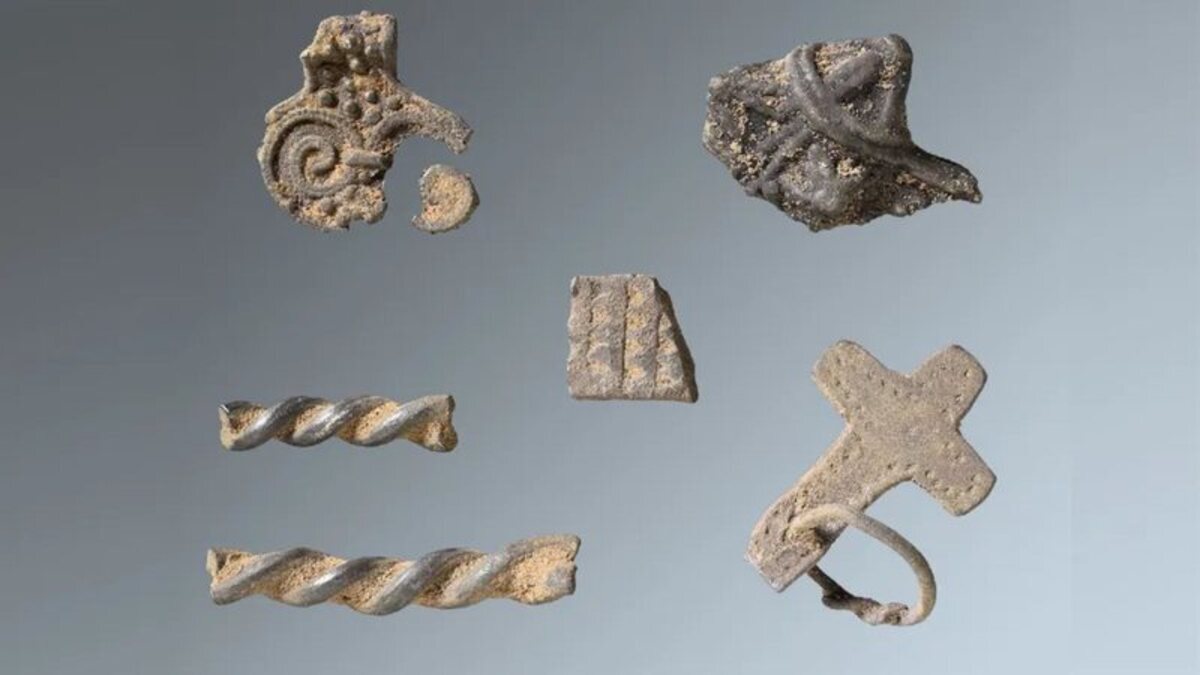
Viking Treasure With Coins, Silver And Mysterious Pendant Discovered In Germany May Reveal Signs Of The Arrival Of Christianity In The Region
An impressive collection of Viking Age artifacts was found in northern Germany. The discovery took place near Haithabu, an ancient port city that was one of the most important trading centers of the time.
The find was made by Arjen Spießwinkel, a volunteer from a group of metal detectors in Schleswig-Holstein.
The treasure includes around 200 artifacts, among them Arab coins, silver ingots, fragments of silver used as currency — known as hacksilver — and a mysterious pendant. The centerpiece of the discovery may represent either a Christian cross or an unfinished Thor’s hammer.
-
The gigantic steel shell built to contain Chernobyl for a century has been pierced by a drone, exposing a critical system and creating a hole that could cost over 500 million euros to repair.

-
Brazilian Navy reaches a new level by taking over an airport with a 1,600-meter runway used by 1,800 military personnel and autonomous attack drone testing.

-
The Himalayas continue to grow to this day, with tectonic plates advancing 5 cm per year, mountains rising up to 10 mm annually, and the 2015 earthquake that killed 9,000 people may have increased the risk of an even larger seismic mega-event.

-
At an altitude of 400 km by astronauts from the International Space Station, Paris transforms at night into a golden mesh so precise that it reveals the outline of the Seine River, avenues, and entire neighborhoods like a luminous map drawn over the Earth.

Sign Of Religious Change
The pendant has sparked debate among researchers. If it represents a cross, the object may be one of the first signs of the Christianization of the region.
Birte Anspach, spokesperson for the Archaeological Office of the State of Schleswig-Holstein, explained to the portal Live Science that Christianity began to spread in Haithabu in the 9th century, following St. Ansgar’s visit to the area.
However, the way the pendant is used raises questions. The eyelet for hanging is located at one long end, causing the object to appear upside down when worn.
This may indicate that it is not a cross, but rather a Thor’s hammer, a symbol of Norse mythology. If this is the case, the piece could represent the cultural and religious resistance of the Viking peoples to Christianity.
Indicators Of Settlement
In addition to the pendant, archaeologists also found a fragment of pottery and a sharpening stone. These objects indicate the possibility of an ancient settlement previously unknown in the region. The discovery was made near the Schlei, a branch of the Baltic Sea that borders Haithabu.
Authorities are now investigating whether the collection was intentionally buried or if it was part of a lost Viking village. The discovery helps to understand the trade, rituals, and cultural transformations experienced in the region over a thousand years ago.
With information from Aventuras na História.







Seja o primeiro a reagir!