





 Portuguese
  English
  Spanish
  3 min of reading
  0 comments


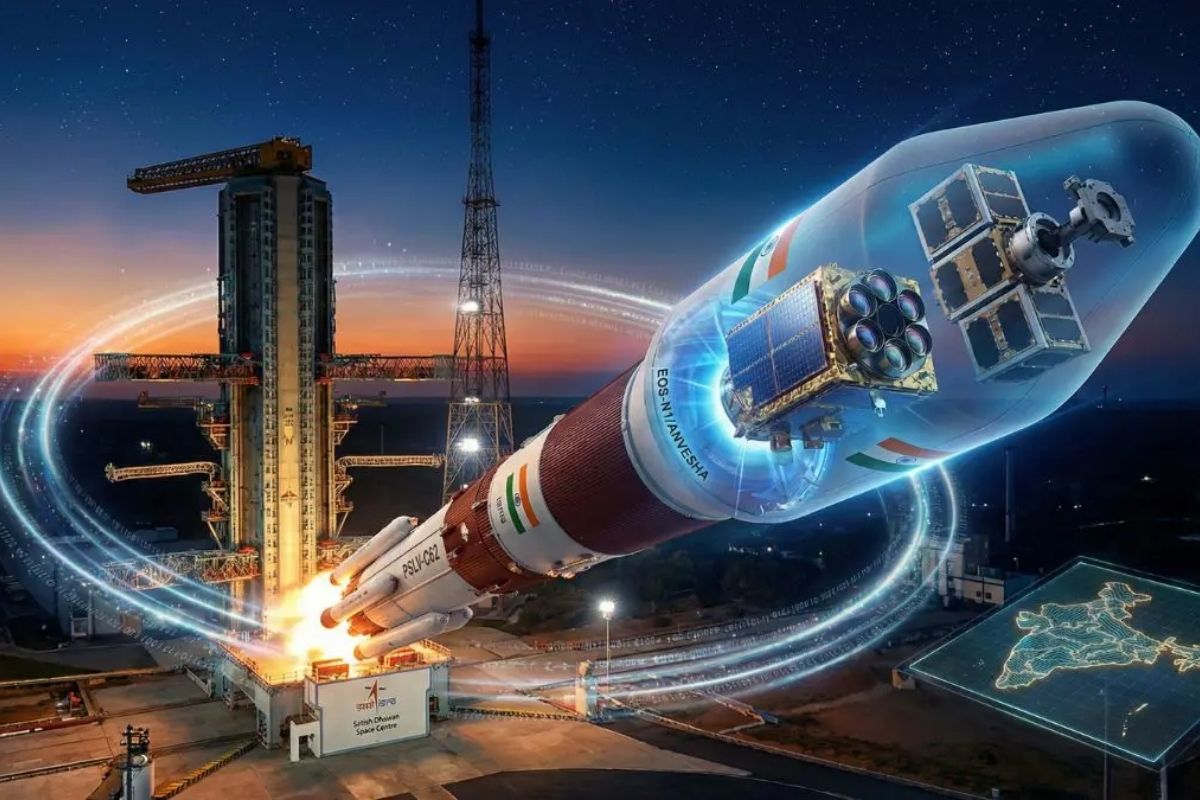
At The Satish Dhawan Space Center, In Sriharikota, India, The PSLV-C62 Launched At 10:17 AM And Failed Shortly After, Dropping 15 Payloads. Among Them Were Five Brazilian Satellites And The EOS-N1. The Mission Was Lost After Six Minutes, But The KID Capsule Sent Signals Even Without Reaching The Planned Altitude And Speed
A space launch conducted in the early hours of Monday, 12, from Sriharikota, India, ended in failure after just over six minutes and dropped a mission carrying Brazilian satellites aboard the Indian rocket PSLV-C62, in addition to the Earth observation satellite EOS-N1.
According to the Indian Space Agency, ISRO, the problem arose in the third of four stages, altering the planned trajectory and rendering the mission unfeasible. So far, there is no official information on where the rocket debris and payloads, including Brazilian satellites, may have fallen, while a European equipment surprisingly transmitted signals after the incident.
What Happened At The Launch In Sriharikota, India

The PSLV-C62 launched from the Satish Dhawan Space Center, on the island of Sriharikota, at 10:17 AM local time.
-
In Mexico, a 3,000-year-old Maya site with the dimensions of an entire city may have been built as a colossal map of the cosmos, created to represent the order of the universe and reveal how this people organized space, time, and rituals.

-
Japan wants to build a solar ring of 10,900 kilometers on the Moon to continuously send energy to Earth.

-
Weighing almost 1 ton, with temperatures of up to 3,000°C, the ability to launch 10,000 fragments within a radius of 1 km, capable of penetrating concrete and melting steel, Turkey’s terrifying bomb emerges as one of the most destructive non-nuclear weapons ever presented.

-
After a submarine disappeared beneath the “Doomsday Glacier,” scientists announce a new monstrous machine capable of operating at 3,000 meters depth to return to the heart of the ice and investigate a threat that could raise sea levels worldwide.


In Brasília, the registered time was 1:48 AM, at the same event that made headlines for losing control of the mission within the first minutes.
ISRO pointed to a failure in the third stage, within a set of four stages.
The practical effect was direct: altered trajectory, compromised mission, and loss of the planned orbital objective.
The Impact Of The Loss Of Payloads, Including Brazilian Satellites
The rocket was carrying a total of 15 payloads.
Among them were five Brazilian satellites developed for technological testing and scientific applications, along with EOS-N1, described as a strategic Earth observation satellite.
The loss of Brazilian satellites is significant because Brazil’s space research and development projects depend on international launches to place their equipment in orbit.
When a mission is lost, not only hardware vanishes: the timeline disappears, the flight validation window is lost, and a trail of dependence is left that is hard to conceal.
The European Capsule KID That Transmitted Data After The Failure
Even with the mission lost, one piece of equipment managed to operate long enough to surprise.
The Spanish company Orbital Paradigm reported that its experimental capsule Kestrel Initial Demonstrator, KID survived the failure, separated from the PSLV-C62, powered up systems, and transmitted data.
The KID was not a conventional satellite. It was a reentry vehicle designed to withstand extreme temperatures, between 300 °C and 2,500 °C, while traversing the Earth’s atmosphere.
The capsule did not reach the planned altitude and speed, but still managed to endure the process, unlike the other payloads, including the Brazilian satellites.
What The Episode Reveals About Brazil In Space
The case shows a harsh contrast: Brazilian technology onboard, but decision, schedule, and rocket outside the country.
The presence of Brazilian satellites in an international mission underscores how Brazil still relies on external access to place payloads into orbit and keep scientific programs moving.
When a launch fails, the loss is not only financial or symbolic.
It can mean research delays, loss of opportunity, and increased pressure on a strategy that ultimately still needs to address an uncomfortable question: who controls access to space also controls the pace of those trying to get there.
If it were your project, would you accept the dependence on international launches to send Brazilian satellites into space, or has that become too great a risk for Brazil?










-

Uma pessoa reagiu a isso.