





 Portuguese
  English
  Spanish
 5 min of reading
  0 comments


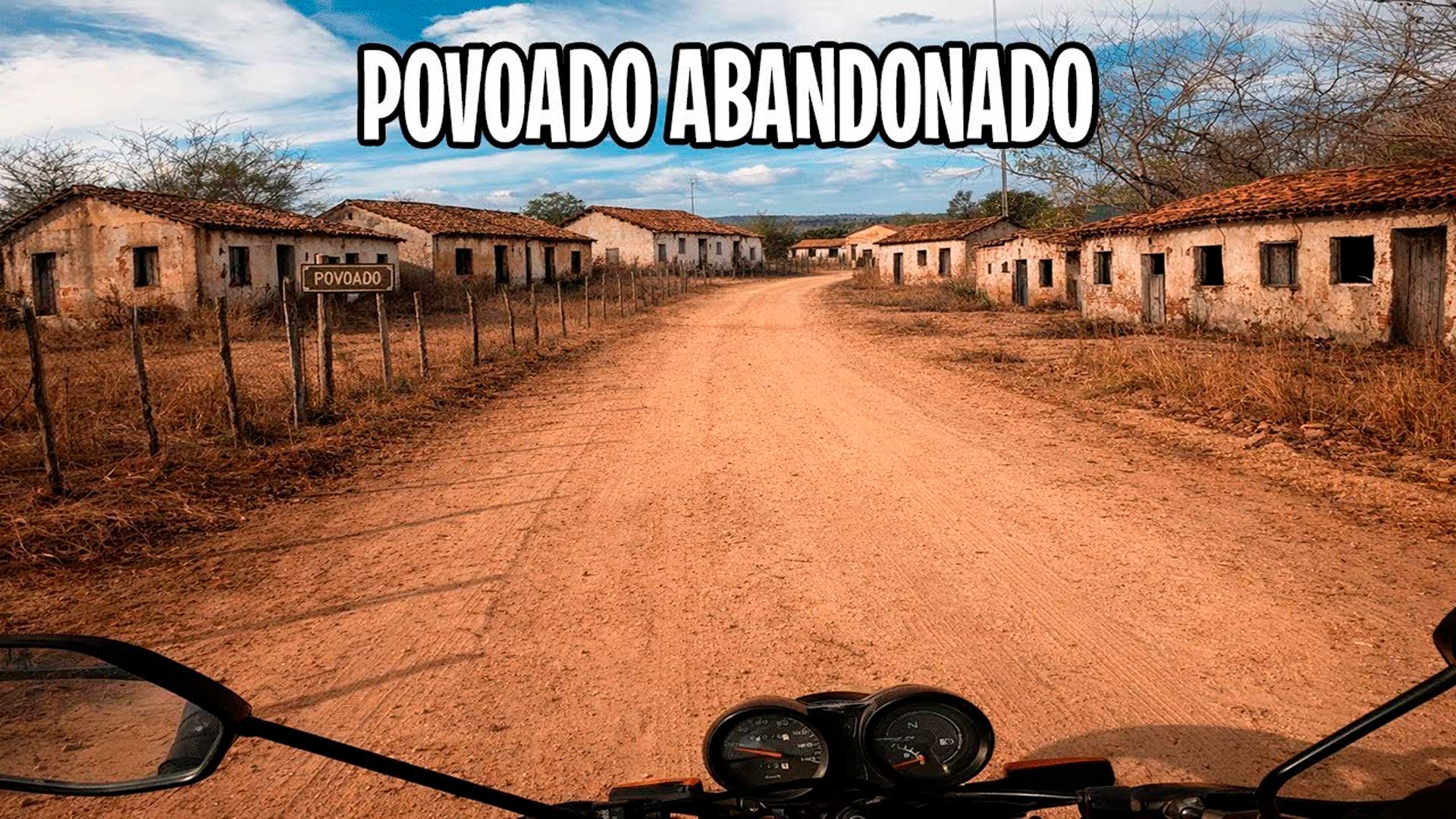
Towns of Santa Teresa do Alípio and Alto do Serrota Concentrate Vacant Properties on the Banks of Lake Araras, Highlighting Population Migration and Socioeconomic Transformations in the Sertão
The scene is desolate and repeats itself at every corner. Thatch houses with collapsing roofs, cracked walls, and locked gates compose the landscape of towns in the interior of Hidrolândia, a municipality located 259 kilometers from Fortaleza.
The phenomenon of mass abandonment of residences in the Ceará sertão gained prominence after a video recorded by YouTuber Felipe Sena, revealing the critical situation of dozens of vacant properties.
Between the towns of Santa Teresa do Alípio and Alto do Serrota, near Lake Araras, abandoned houses multiply. Some still show preserved structures, while others are already in complete ruins. Abandonment does not distinguish between old and new constructions; there are modern residences completely uninhabited next to centuries-old thatch houses.
-
He started running at 66 years old, broke records at 82, and is now a subject of study for having a metabolic age comparable to that of a 20-year-old, in a case that is intriguing scientists and inspiring the world.

-
Oldest tree on the planet reappears after 130 years of searches: Wattieza, 385 million years old, was 10 meters tall and had no leaves or seeds; Gilboa fossils in New York solved the mystery in 2007.

-
A 48-square-meter house assembled in hours with 4,000 bricks made of recycled plastic that does not absorb moisture, has natural thermal insulation, and costs less than 90,000 reais in a complete kit.

-
Luciano Hang revealed that Havan’s air fleet has already accumulated more than 20,000 landings, 10,000 flight hours, and 6 million kilometers traveled, and he says that without the planes, the company would never have grown so quickly.


“It breaks your heart here in the interior, you know? Many houses indeed”, stated Felipe Sena during the recording, traveling through deserted roads where the landscape of abandonment stretches for miles. The material documents over 20 vacant houses only in the visited area, not counting those that have already collapsed.
Residents’ Memories Reveal Historical Transformations

Understanding the abandonment goes through local history. In a recorded interview in the video, Francisco Pedro, an old resident of the region, recounts that before the construction of Lake Araras, there was a vibrant community. “It was filled with houses on this side and that side and the river was in the middle”, says the 80-year-old man, referring to the period before 1958.
According to information from the National Department of Works Against Droughts (DNOCS), the Public Dam Paulo Sarasate, popularly known as Araras, was inaugurated on July 31, 1958, by President Juscelino Kubitschek. The construction, which took two years to complete and employed over 12,000 workers, flooded inhabited areas and forced the first major population displacement.
“Then it filled up, lost the houses, folks. Then later it filled up, everyone moved up”, recalls Francisco Pedro. According to him, on April 12, 1961, the dam overflowed for the first time. Families who lost their lands to the waters had to rebuild their lives on higher ground.
From Boom to Economic Decline
In the years following the dam’s construction, the region experienced a period of prosperity. Francisco Pedro describes a time of abundance when everyone worked in floodplain agriculture and fishing. “Fish, everyone was working, making flour. Then I got tired of making a lot of flour myself”, he reports.
There were flour houses with two ovens operating simultaneously, and abundant watermelon and bean plantations. Fishing was regulated by a collection system, ensuring sustainability. However, this reality changed drastically.
Today, according to the resident, the fishing activity faces serious problems with equipment theft. “If you leave it wet when you get home and return, it’s gone. You can’t find it anymore”, he laments. Insecurity forces fishermen to constantly monitor their materials.
Agriculture has also declined. Francisco Pedro explains that he used to plant small crops and was able to harvest when everyone worked. “Now if everyone works, then it’s fine. But no one is working”, he confesses, revealing the lack of labor and collective discouragement.
Rural Exodus and the Search for Better Conditions
According to data from the IBGE, Hidrolândia has an estimated population of 17,855 according to the 2022 Census, with a population density of 19.27 inhabitants per square kilometer. Between 1970 and 2022, the municipality’s population grew by only 2.4%, while Ceará grew by 95.8% during the same period.
The phenomenon of rural exodus in the Ceará sertão is not recent, but has intensified in recent decades. Experts point to several factors contributing to the abandonment of rural areas: lack of infrastructure, difficulty accessing basic health and education services, agricultural mechanization, land concentration, and the search for work opportunities in urban centers.
In the specific case of the towns near Lake Araras, there are indications that insecurity related to thefts also contributes to the abandonment. “I don’t know if it’s because of access to the city or if it’s because of the thefts in the area”, questions Felipe Sena during the recording.
Resistance and Attachment to the Homeland
Despite the desolate scenario, some residents resist. Francisco Pedro, who was born and raised in the region, is emphatic in stating his commitment to the land: “I’m not going to the street. I have faith in God, Madam, that I was born in the woods for the fox and I will die in the woods for the foxes”.
This resistance, however, is becoming increasingly rare. The deserted roads, absence of public lighting, and isolation make life in the interior extremely challenging, especially for younger generations seeking better opportunities.
The dam that once brought hope and development to the region now witnesses the gradual emptying of the towns around it. With a storage capacity of 859 million cubic meters, the Araras remains strategic for supplying five municipalities and irrigating thousands of hectares, but it has not been enough to maintain traditional communities.
Reflection of a Regional Issue
The situation documented in Hidrolândia is not isolated. The Ceará sertão faces structural challenges that result in the progressive abandonment of towns and rural communities. The lack of effective public policies for keeping people in the countryside and unequal regional development worsen the problem.
The architectural and cultural heritage represented by old houses, many built in thatch using traditional techniques, is being lost. Without maintenance and occupation, these constructions crumble, taking with them part of the memory and identity of the sertão.
And you, would you have the courage to live in one of those abandoned houses in the sertão? The phenomenon of town abandonment in the interior of Ceará raises important questions about regional development, cultural preservation, and quality of life in the countryside. Is rural exodus inevitable or are there viable alternatives to revitalize these communities? Leave your opinion in the comments.








-

2 pessoas reagiram a isso.