





 Portuguese
  English
  Spanish
  6 min of reading
  0 comments


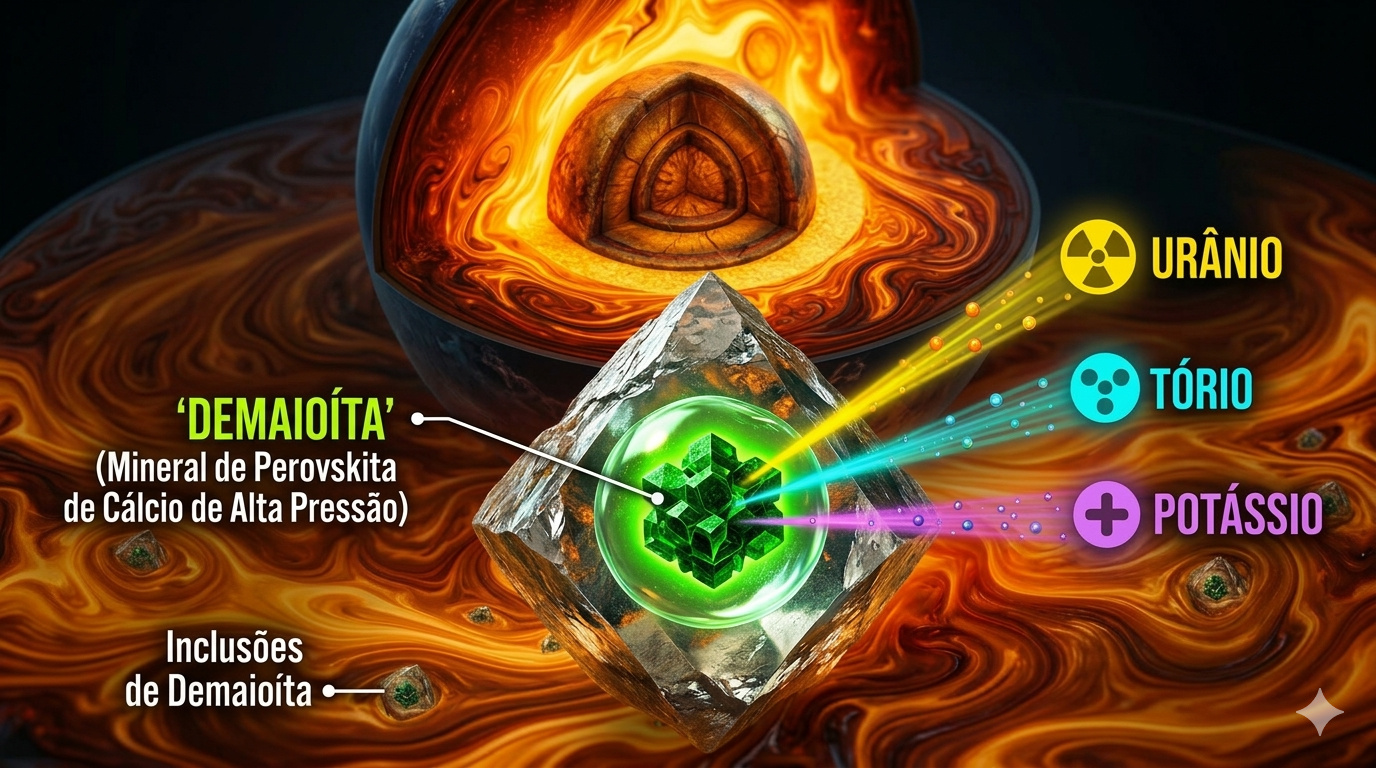
Diamonds Formed More Than 700 Km Deep Revealed Davemaoite, A Rare Mineral From The Earth’s Mantle Capable Of Storing Radioactive Elements That Heat The Planet’s Interior.
For decades, scientists knew that the Earth’s interior should contain minerals that simply cannot exist under surface pressure and temperature conditions. The problem was to find physical evidence of these materials, as the planet’s deep mantle begins hundreds of kilometers down — far beyond the reach of any human drilling. This gap began to be filled when researchers identified an extremely rare mineral hidden inside a diamond formed deep within the Earth. The mineral was named davemaoite, and its discovery was officially recognized by the International Mineralogical Association in 2021.
What makes this discovery extraordinary is the fact that davemaoite can only exist under extreme pressure conditions, like those found in the deep mantle, between 660 and 900 kilometers below the surface. When the material rises to shallower regions of the planet, it typically transforms into other more stable minerals. Thus, for decades, davemaoite existed only as a theoretical prediction based on laboratory experiments and geophysical models. It was only when scientists examined a diamond originating from these depths that they finally found a preserved fragment of this mineral.
What Is Davemaoite And Why Is It So Important For Geology
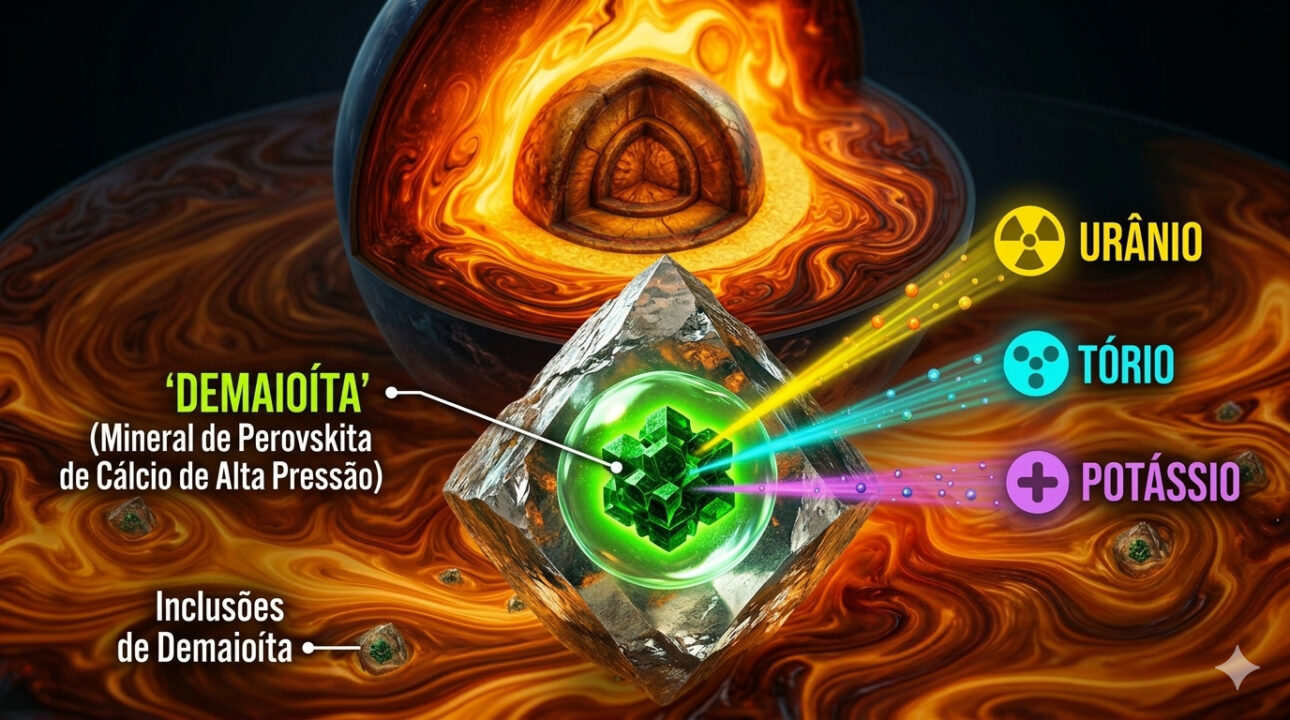
Davemaoite is a form of high-pressure calcium silicate, technically classified as CaSiO₃ perovskite. This crystal structure only forms under extremely high pressures, typical of the lower part of the Earth’s mantle. Scientists had already suspected the existence of this mineral because it frequently appears in experiments simulating the conditions of the Earth’s interior using high-pressure presses.
-
In a flooded well, archaeologists found a 1,700-year-old Roman egg that still contains clear and yolk intact inside the very thin shell.

-
Something is happening around the Earth: Inside the huge explosion of fireballs in 2026

-
A hot air bubble coming from Argentina expands over Brazil, causing thermometers to exceed 38 degrees with a thermal sensation of 40 degrees in late March, affecting 6 states at once.

-
The radish leaf that almost everyone throws away has more polyphenols, flavonoids, and fiber than the consumed root, and a 2025 study showed that the leaf contains compounds that protect the intestine, combat inflammation, and may inhibit the growth of cancer cells.


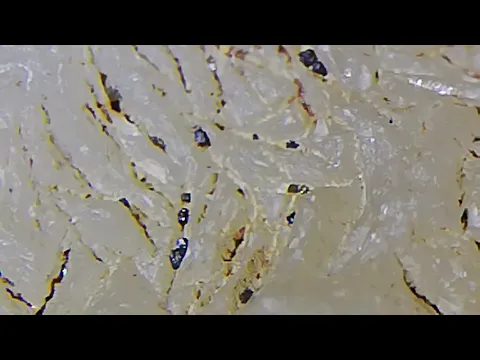

However, whenever the material was removed from these extreme conditions, it quickly transformed into other mineral forms. This happened because the structure of davemaoite is not stable under the lower pressures of the Earth’s crust.
The diamond that revealed the mineral acted as a kind of natural capsule, preserving the structure of the crystal as it was slowly transported to the surface by geological processes. This preservation allowed scientists to finally observe davemaoite in its natural state.
The Diamond That Brought A Piece Of The Deep Mantle To The Surface
The mineral was identified inside a diamond found in Botswana, Africa, a region known for producing diamonds formed at great depths. These deep diamonds are called superdeep diamonds because they originate in regions of the mantle well below the zone where most diamonds form.
While many diamonds form between 150 and 200 kilometers deep, superdeep diamonds can originate from more than 700 kilometers below the surface.
This means they form in the so-called mantle transition zone, a region where the structure of minerals drastically changes due to increasing pressure.
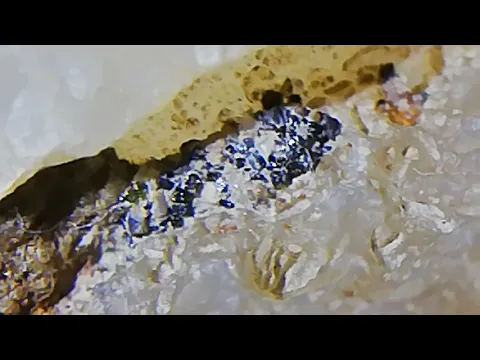
By examining the interior of this diamond using X-ray diffraction techniques and advanced microscopy, scientists discovered tiny mineral inclusions that exactly matched the properties of davemaoite.
An Essential Piece Of The Puzzle Of The Earth’s Interior
The discovery of davemaoite is not just a mineralogical curiosity. It has important implications for understanding the planet’s internal dynamics. Geophysical models indicate that davemaoite may represent up to 5% to 7% of the volume of the lower mantle, which means it could be a significant component of this layer of the planet.
But what really caught the scientists’ attention was this mineral’s ability to incorporate radioactive elements into its crystal structure. Among these elements are:
- Uranium
- Thorium
- Potassium
These elements are important because they produce heat through radioactive decay. This process slowly releases energy over billions of years, contributing to heating the interior of the planet.
The Internal Heat That Keeps The Planet Active
The Earth’s interior is extremely hot. It is estimated that the temperature in the planet’s core exceeds 5,000 °C, comparable to the surface of the Sun. Part of this heat comes from the residual energy of the Earth’s formation, which occurred about 4.5 billion years ago.
Another significant part, however, comes from the radioactive decay of elements present in the planet’s deep rocks. These elements act as small heat sources distributed throughout the Earth’s interior.
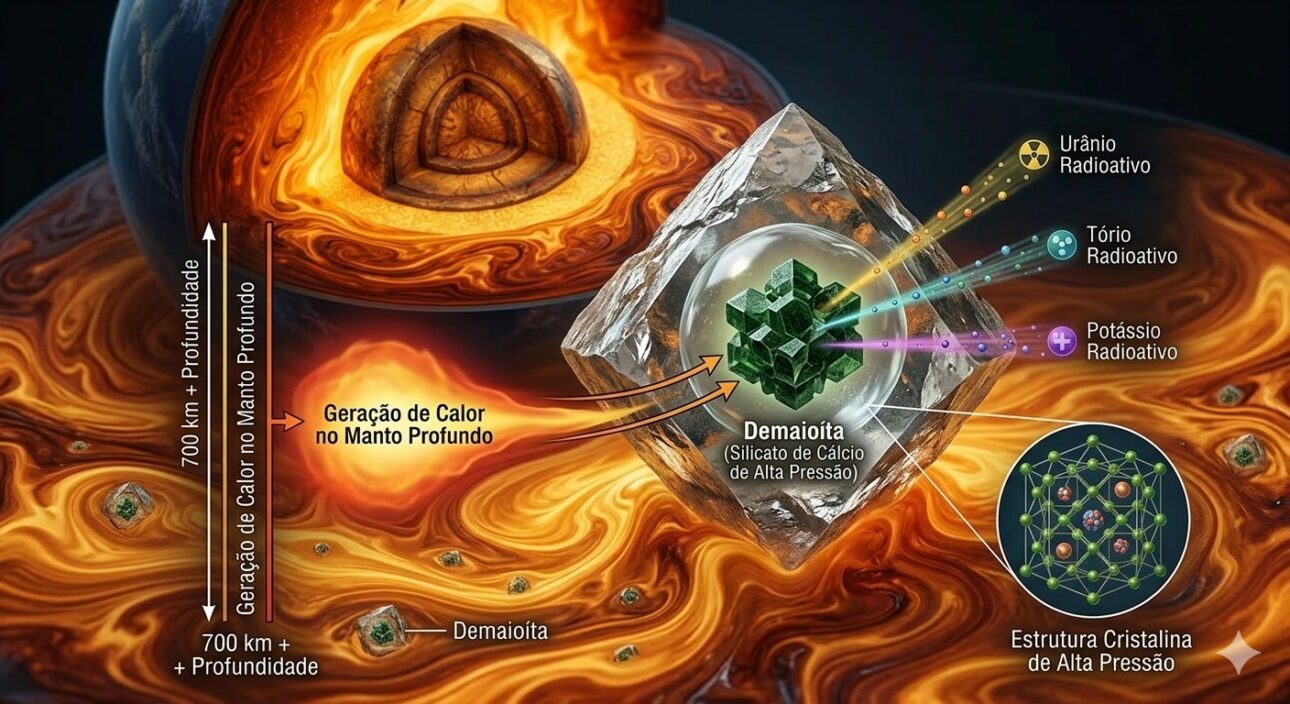
The discovery that davemaoite can store large amounts of these elements means it may play a fundamental role in generating heat in the deep mantle. Heat is the engine that powers essential geological processes such as:
- Movement of Tectonic Plates
- Formation of Volcanoes
- Creation of New Ocean Crusts
- Circulation of Material in the Mantle
The Earth’s Mantle: The Largest Layer of the Planet
To understand the importance of this discovery, it is necessary to comprehend the internal structure of the Earth. The planet is divided into four main layers:
- Crust – the surface layer where we live
- Mantle – the intermediate layer that represents about 84% of the Earth’s volume
- Outer Core – primarily composed of liquid iron
- Inner Core – solid sphere of iron
The mantle alone is about 2,900 kilometers thick. It is made up of extremely hot rocks that, although solid, can slowly deform over millions of years.
These slow movements create convection currents that transport heat from the Earth’s interior to the surface. Davemaoite is part of the rocks that compose the lower portion of this gigantic layer.
How Diamonds Function As Capsules of the Earth’s Interior
Diamonds are formed under extremely specific pressure and temperature conditions. These conditions generally exist at hundreds of kilometers deep, within the mantle. When deep volcanic eruptions transport material from the mantle to the surface, diamonds can rise along with these rocks.
During this process, small fragments of the environment where the diamond formed can become trapped inside it. These fragments are called mineral inclusions.
These inclusions function as small geological time capsules, preserving minerals that typically would not survive surface conditions. It was exactly this mechanism that allowed scientists to find davemaoite.
The Discovery That Confirmed Decades of Theoretical Predictions
For decades, geophysicists believed that davemaoite should exist in the Earth’s interior. Laboratory experiments using giant presses had already produced this mineral under pressures equivalent to those in the deep mantle.
However, until recently, no natural specimen had been found. This occurred because the mineral transformed rapidly when pressure decreased. The identification of davemaoite within a diamond was the first natural evidence of this mineral on the planet.
This discovery confirmed scientific predictions made over half a century ago regarding the composition of the lower mantle.
What Davemaoite Can Reveal About The Planet’s Evolution
The presence of radioactive elements in this mineral can also help scientists better understand how the Earth’s interior has evolved over billions of years. The heat produced by these elements directly influences the circulation of material in the mantle.
This circulation, in turn, controls fundamental phenomena such as:
- The Formation of Continents
- The Emergence of Mountain Ranges
- Volcanic Activity
- The Movement of Tectonic Plates
Without this constant flow of energy, the planet would be geologically much more static. Davemaoite may be one of the pieces that explain how this complex system remains active for billions of years.
The Earth’s Interior Still Holds Many Secrets
Even with impressive advances in mineral analysis and geophysical techniques, the Earth’s interior remains a little-explored territory.
A large part of current knowledge about the deep mantle comes from theoretical models, laboratory experiments, and indirect analyses of seismic waves.
Discoveries like that of davemaoite show that diamonds can serve as messengers from the depths of the planet, bringing information from inaccessible regions.
As new analysis techniques are developed and more deep diamonds are studied, scientists hope to reveal other unknown minerals that may exist in the Earth’s deep layers. Each of these discoveries helps reconstruct the geological history of the planet and understand the processes that shaped the Earth since its formation.
The small davemaoite crystal found within a diamond revealed only a fragment of this deep world — an extreme environment that exists hundreds of kilometers beneath our feet and continues to hide fundamental secrets about the functioning of the planet.







-

-

4 pessoas reagiram a isso.