





 Portuguese
  English
  Spanish
  4 min of reading
  0 comments


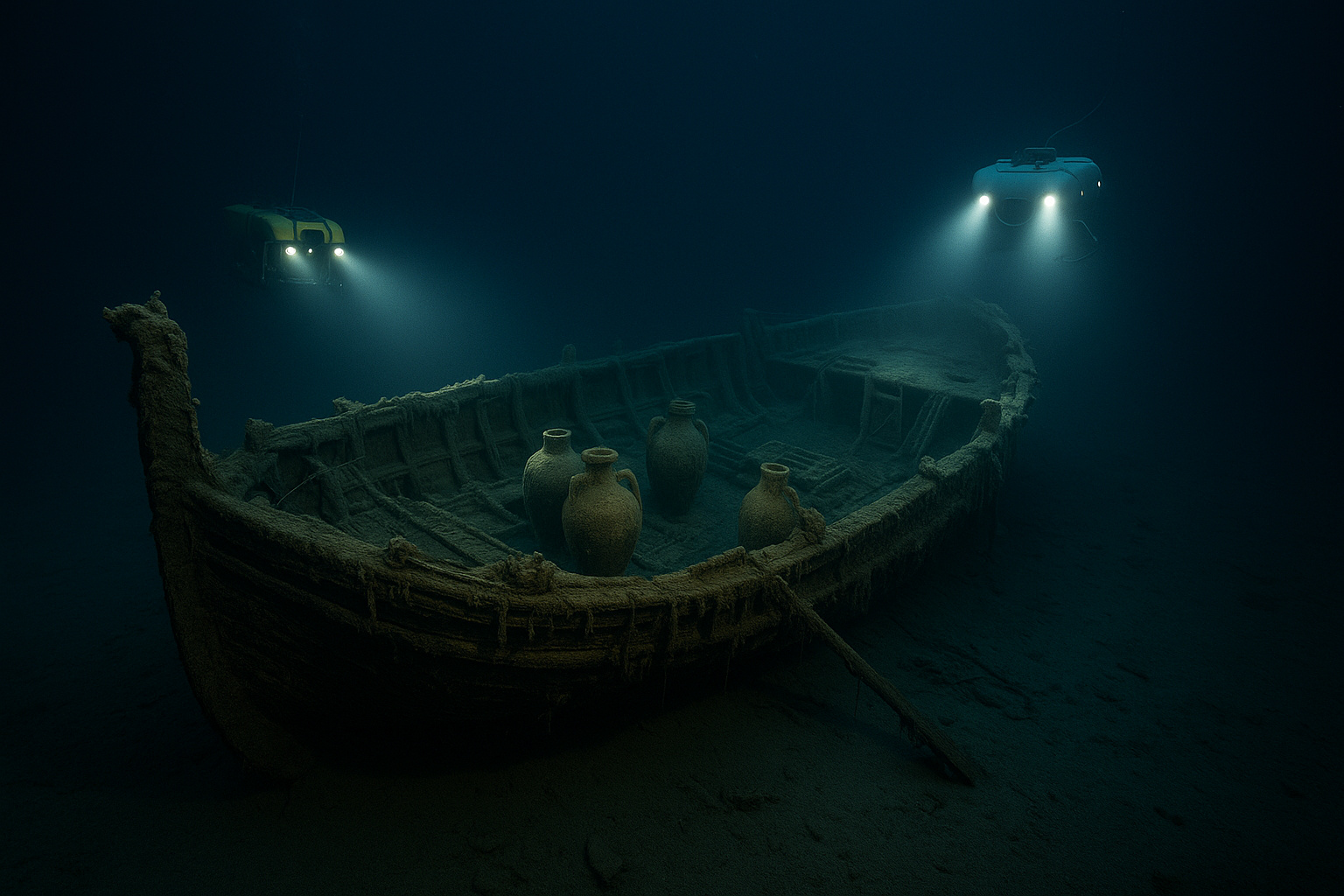
France Discovered a 16th Century Merchant Ship at 2,567 Meters Deep in the Mediterranean. The Submerged Time Capsule Could Change the History of European Commerce.
At the bottom of the Mediterranean Sea, 2,567 meters deep, France has just achieved an unprecedented feat. Using cutting-edge underwater drone technology, the military — more precisely the French Navy — located what may be one of the most important archaeological finds of Renaissance Europe: a 16th century merchant ship, temporarily named Camarat 4, in reference to Cape Saint-Camarat, near Saint-Tropez.
What makes this discovery even more impressive is not just its depth, but the virtually frozen state of preservation of the vessel, something extremely rare in the world of maritime archaeology. Measuring about 30 meters in length, the ship has been resting in absolute silence for over 400 years — like a submerged time capsule, holding secrets of European maritime trade from the Renaissance era.
An Archaeological Feat Led by the French Navy
The mission was led by the French National Navy, which operates strategically in scientific projects as well, and involved collaboration among archaeologists, oceanographers, and naval engineers. The operation utilized remotely operated underwater vehicles (ROVs) capable of navigating in extreme conditions — total darkness, high pressures, and temperatures close to freezing.
-
He started running at 66 years old, broke records at 82, and is now a subject of study for having a metabolic age comparable to that of a 20-year-old, in a case that is intriguing scientists and inspiring the world.

-
Oldest tree on the planet reappears after 130 years of searches: Wattieza, 385 million years old, was 10 meters tall and had no leaves or seeds; Gilboa fossils in New York solved the mystery in 2007.

-
A 48-square-meter house assembled in hours with 4,000 bricks made of recycled plastic that does not absorb moisture, has natural thermal insulation, and costs less than 90,000 reais in a complete kit.

-
Luciano Hang revealed that Havan’s air fleet has already accumulated more than 20,000 landings, 10,000 flight hours, and 6 million kilometers traveled, and he says that without the planes, the company would never have grown so quickly.


This combination of natural factors created an ideal environment for the preservation of the ship. Unlike wrecks in shallow waters, where wood is quickly corroded by microorganisms and sea currents, the Camarat 4 was protected for centuries in a silent, dark, and motionless world.
Archaeologists classified the find as one of the greatest achievements of French archaeology, not only for the national depth record but for its potential to rewrite parts of the knowledge about European maritime trade in the Mediterranean during the transition between the Middle Ages and modernity.
What Can the Ship Reveal About European History?
According to experts from the National Institute of Preventive Archaeological Research (INRAP), the Camarat 4 may contain artifacts, documents, and commercial cargo that were being transported between European, African, or Middle Eastern ports. During the 16th century, the Mediterranean route was vital for transporting spices, textiles, ceramics, metals, and manuscripts, many of which may have been preserved inside the ship.
Although total recovery of the cargo has yet to be performed — the process will be slow and delicate — preliminary images show amphorae, intact wooden structures, and parts of the command cabin, indicating that a significant portion of the original content may remain untouched.
This hypothesis excites historians and archaeologists: the find could unearth unprecedented documents, rare coins, trade goods between different cultures, and even personal belongings that provide clues about the daily lives of sailors and merchants in early modern Europe.
Depth Archaeology: A Field That Challenges Limits
Archaeological discoveries at depths exceeding 2,000 meters are extremely rare. Most historical shipwrecks are found in coastal areas, where access is simpler and risks are lower.
The case of the Camarat 4 challenges this logic. The French Navy had to overcome immense logistical challenges: 3D mapping of the seabed, atmospheric pressure 250 times greater than at the surface, and remote operation of robots with surgical precision.
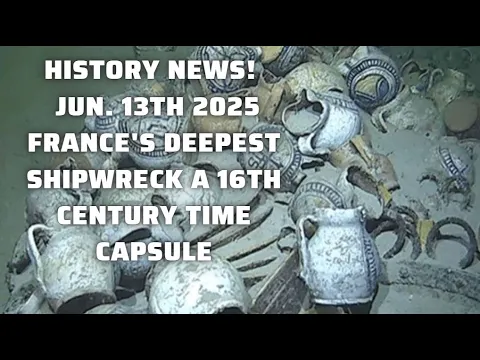

With this discovery, France joins the select group of nations investing in deep-sea archaeology, a field that requires not only historical knowledge but also expertise in advanced technologies — such as georeferencing, AI for underwater image analysis, and materials engineering for safe recovery.
Comparison With Other Historical Shipwrecks
The discovery of Camarat 4 is already considered the deepest in the history of French archaeology. However, in terms of absolute record, it still falls short compared to the case of the USS Samuel B. Roberts, a U.S. Navy warship located at 6,895 meters in the Philippines Sea — a feat accomplished in 2022 by explorer Victor Vescovo.
However, there is a crucial difference: the USS Samuel B. Roberts was a World War II destroyer, while the Camarat 4 is a Renaissance merchant ship, predating the widespread use of steel or steam propulsion.
In other words, in terms of classical archaeology, the Camarat 4 is unsurpassed in depth and significance to the history of early modern Europe.
The Global Impact of the Archaeological Discovery Made by France
Within days, news of the find spread through international media. Universities, museums, and cultural institutions around the world have already expressed interest in participating in the upcoming phases of the project, including excavation, item cataloging, and comparative studies.
Some scholars point out that the route where the Camarat 4 was found coincides with ancient shipping networks that connected Marseille, Genoa, Venice, and Alexandria — which may indicate that the ship was part of an essential commercial circuit of the 16th century, perhaps before transatlantic expansion.
Others, bolder, believe that the vessel may contain traces of Ottoman, African, or even Chinese cargo, reinforcing the idea that the Mediterranean was, for centuries, a bridge between civilizations — long before modern globalization.









-

Uma pessoa reagiu a isso.