





 Portuguese
  English
  Spanish
  6 min of reading
  0 comments


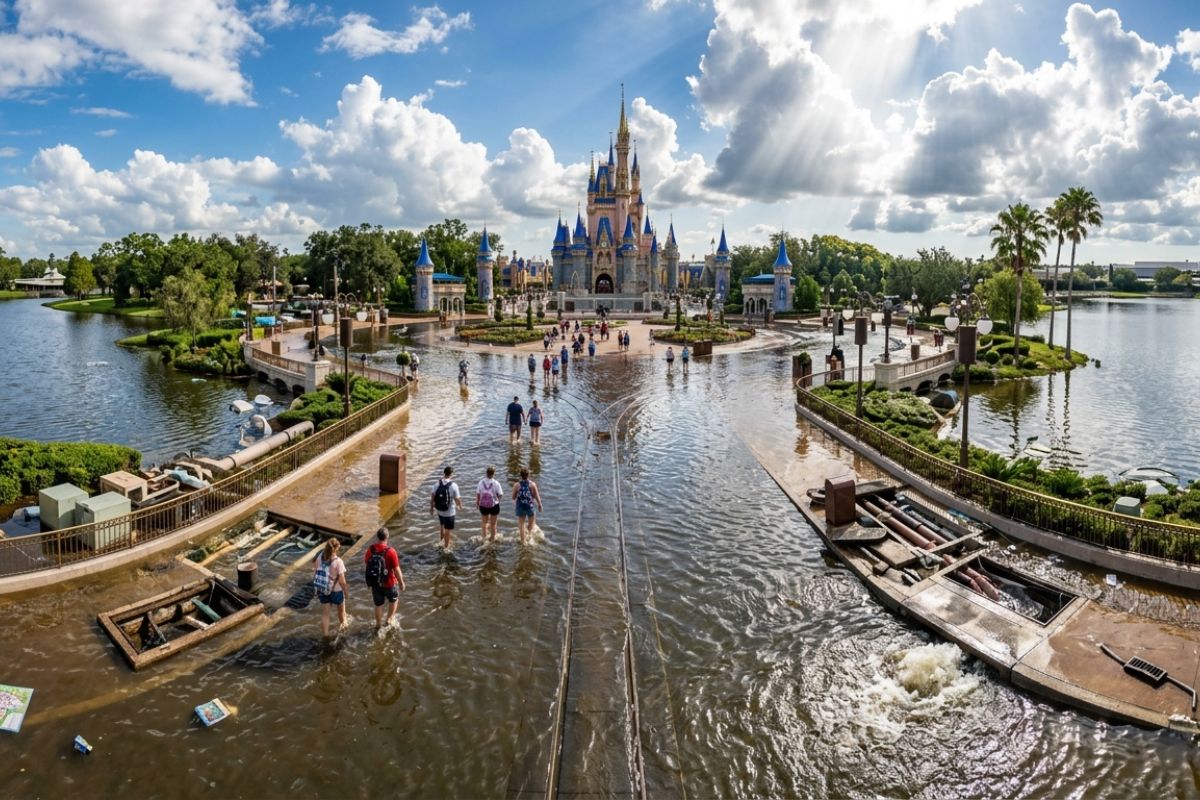
Even with tunnels, giant pipes, and retention lakes, Disney faces the simplest bottleneck: drains that get clogged in the right storm
Disney sells the “most magical place on Earth,” but there is a day when the fantasy collapses: the Magic Kingdom with water rising from ankle to knee, abandoned strollers, mud surrounding kiosks, and families trying to escape flooding in the middle of the park. And the strangest thing is that this doesn’t seem like an accident. It seems like a repeated script.
The shock is that Disney did not ignore the risk. On the contrary: for over 60 years, Disney has heavily invested in drainage, with channels, reservoirs, huge pipes, and corridors beneath the park. However, when the rain comes in the right way, the swamp shows that it still has a voice.
Disney did not build on solid ground; it built on top of a swamp

Disney built the Magic Kingdom on land that was historically swamp and flooded area. An old map of the region indicates zones of saturated soil and flooded forest dominating almost the entire area where the castle and attractions now stand.
-
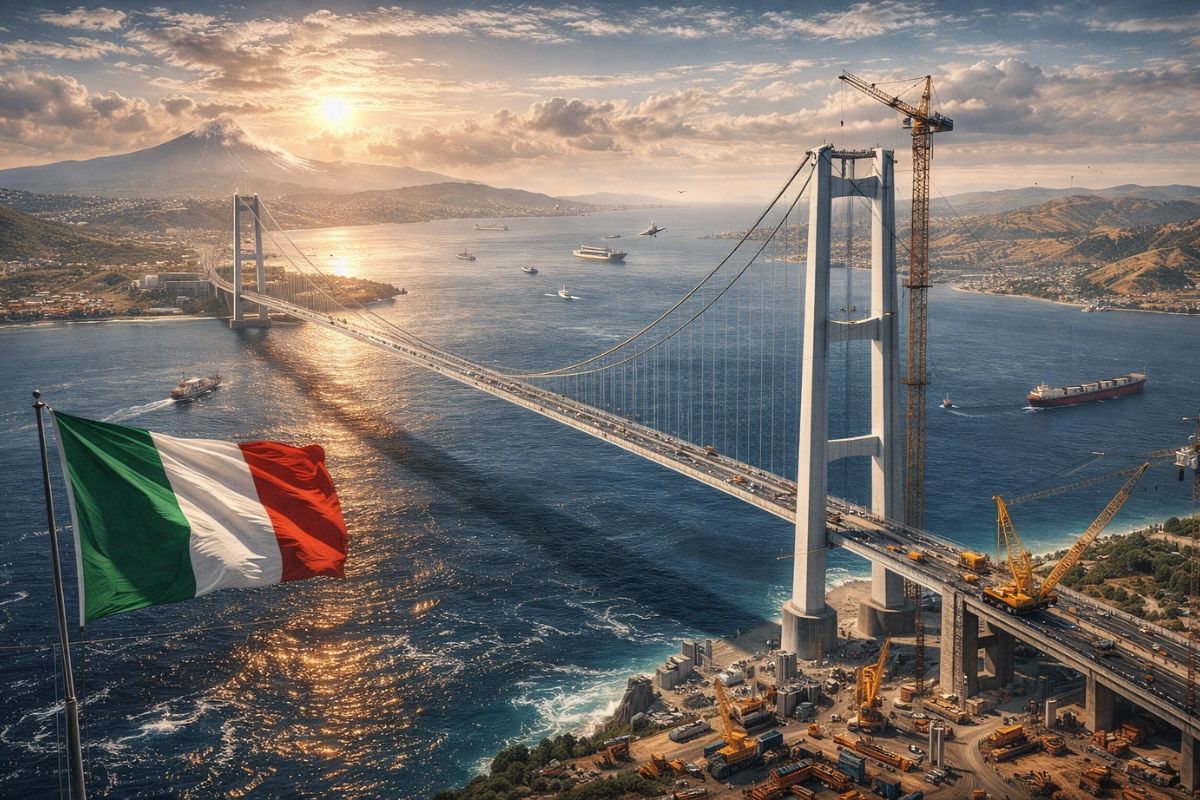
Italy is spending 16 billion dollars to build the largest suspension bridge in the world right over two active geological faults where monsters from Greek mythology had already warned about the dangers of the Strait of Messina.
-
Small house with natural light becomes a trend in sustainable architecture and shows how smart designs reduce energy consumption and enhance comfort in compact spaces.

-
Trump revealed today the design for the world’s largest triumphal arch, standing 76 meters tall, more than double the height of the Lincoln Memorial, with a golden Lady Liberty on top, four golden lions at the base, and the inscription “One Nation Under God” engraved in gold. When asked who the monument was for, he replied, “for me.”

-
Imagine a building that absorbs air pollution, regenerates itself, and becomes more resilient with each passing year: scientists from ETH Zurich have just turned this idea into reality using cyanobacteria and 3D printing.

The water table is close to the surface, and there is no natural drainage, so during heavy storms, it simply accumulates and takes a long time to go away.
Disney knew where it was entering. The swamp was seen as a natural barrier, protection, and distance from the “outside world.” The problem is that the same swamp that protects also demands a price when the sky dumps water too quickly.
Disney created a drainage district and treated the place as an engineering project, not as a park
Disney’s plan was not just to build attractions. Disney created the Reedy Creek drainage district to “dry” the area and control the water as if it were controlling an entire city.
Technical reports from 1966 to 1984 describe a harsh scenario: heavy rains turn large sections of land into real lakes, because there were almost no efficient natural channels, and the water remained stagnant for a long time.
That’s when Disney embarked on “terraforming”: channels cutting through the forest, levees, automatic gates, and a network designed to dictate where the water should flow. Disney tried to impose industrial order on an ecosystem that had functioned the same way for thousands of years.
Bay Lake: Disney did not “restore” the lake; Disney replaced the lake
One of the symbols of this logic was Bay Lake. In practice, there was no clear boundary between lake and swamp: it was water, mud, and marsh mixed together, with sludge accumulated for centuries.
To turn it into an attraction, Disney undertook a massive operation: it drained the lake, removed the mud, and found buried white sand, used to shape beaches like those of Bay Lake and Seven Seas Lagoon.
Then, Disney replenished it with clean water pumped from the aquifer. The message was clear: Disney would not adapt to the swamp; it would replace the environment with a “new” controlled environment.
The secret of the Magic Kingdom: Disney raised the park one floor above the real ground


Many people call it “underground tunnels,” but the trick is different: the utilidors were built at the original ground level and then Disney raised the park above, filling in the sides and creating a “second floor” for the public. You walk on top of a large structure, not directly over the original soil.
This changes everything because Disney needs to keep the water away from these corridors. The drainage must act quickly, invisibly, without infiltrating where it cannot.
How Disney pushes water without you noticing
Disney uses floor leveling as a hydraulic tool. Main Street has a gentle slope, sidewalks and plazas have discreet drops, and nothing is completely flat. The aesthetic of the “triumphal entry” is also disguised drainage, guiding water to collection points.
Scattered throughout the park are hundreds of surface drains and grates, connected to a network of pipes that starts at 10 inches and increases to 18, 24, 36, 48, and even 60 inches.
The water exits from the top, enters the underground mesh, and flows to ponds and retention reservoirs scattered throughout the property. Animal Kingdom, for example, has eight of these “large retention pools.”
These ponds also help treat the water: sediments settle, plants and algae absorb some of what is mixed in, and time does the rest. On paper, Disney’s system is enormous, real, and sophisticated.
So why does Disney flood? Because the bottleneck is the simplest: the surface drain
Here is the central point: the base describes that channels and ponds hold up well and that the internal piping, in general, is not the main limit.
The collapse happens at the beginning of the flow. The surface drains do not “swallow” water quickly enough when the storm hits with high intensity.
And worse: each drain does not only receive the rain that falls on it. The entire surrounding area of the park was designed to funnel water to those points, like a funnel.
In low areas, like Fantasyland, the water accumulates before any drain can handle it, and the result becomes a viral image: water at knee level in the Magic Kingdom, even with capacity left “down below.”
In other words, it’s not that Disney lacks infrastructure. It’s that, in the right storm, Disney gets stuck at the weakest link.
What Disney would have to do to reduce this, and why it’s not simple
The obvious solution seems straightforward: add more drains, reinforce drainage inlets, and better distribute collection points, starting with critical areas. However, Disney faces a practical problem: doing construction with a full park means altering the scenery, closing areas, and then perfectly camouflaging everything.
Another alternative would be to adjust the leveling and slopes to redesign the water’s path. But this is a major renovation, with the risk of displacing the problem: you save one low point and may create another.
The third option is to boost the system with pumps, reducing reliance on gravity in certain sections. Disney already uses pumps in sensitive areas, but expanding this to “street level” brings costs, maintenance, and new points of failure.
In the end, the base leaves the provocation: since these floods appear when the storm is brutal and specific, Disney is stuck in cost-benefit analysis. Is it worth stopping and breaking part of the magic to fix something that only explodes when the sky collapses?
The conclusion that bothers: Disney did not defeat the swamp; Disney only maintains a truce
After decades and billions, Disney has created a mechanism that works most of the time: drains collect, pipes carry, ponds hold and treat, channels drain, and the utilidors remain dry.
But, in the right rain, Disney faces the truth of the land again: the swamp has not disappeared; it is just waiting for the perfect combination of volume and speed to reclaim space.
The Magic Kingdom is, at the same time, a spectacle and a potential risk zone. And when the water hits knee level, it’s not just “tourist trouble.” It’s nature reminding Disney, in practice, what existed there before the castle.
Quick question for you to comment: in your view, should Disney renovate and install more drains even if it disrupts areas of the park, or accept these rare floods as the “price” of having built on top of the swamp?






Seja o primeiro a reagir!