






 Portuguese
  Spanish


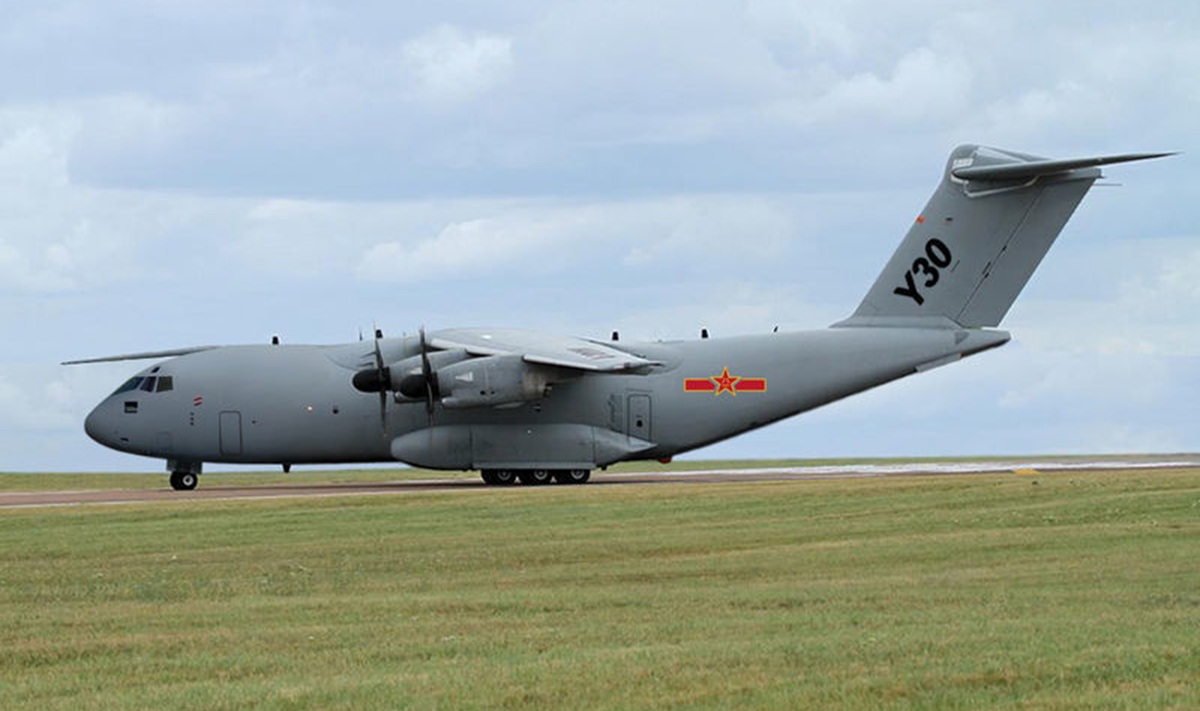

The Y-30, a medium-sized military aircraft from China, conducted its first test flight in December and is already pointed out in Chinese analyses as superior to the C-130J Super Hercules in power, payload, materials, avionics, and the ability to operate on short and unpaved runways.
The Y-30, a medium-sized military transport aircraft developed in China, is advancing as a new bet to modernize the country’s tactical fleet and is already presented by Chinese analyses as superior to the C-130J Super Hercules in key performance and design aspects. The four-engine turboprop conducted its first test flight last December and is being developed by Shaanxi Aircraft Industry Corporation, a subsidiary of the Aviation Industry Corporation of China.
Internally known as “Xin Zhong Yun,” the model is treated as a next-generation platform and emerges at a time when China is ramping up its efforts to renew its tactical airlift capabilities.
The assessment published by Beihang University in the journal Aerospace Knowledge asserts that the aircraft surpasses the C-130J in power, payload, structure, materials, avionics, and flight control software.
-
Failed Family Bakery Sparks Engineer’s Innovation, Leading to a $100 Million Energy-Efficient Oven Company in Brazil

-
Elon Musk Loses Trillionaire Status as SpaceX Shares Plummet, Wiping Out $61 Billion in a Day

-
New Railway in Mexico Diverted to Preserve 4,000-Year-Old Rock Art Resembling Aztec Rain God
-
Chinese Researchers Discover Largest Whale Graveyard in Indian Ocean: Nearly 500 Skeletons, Some 5.3 Million Years Old, Reveal Ecosystem Insights and Potentially Unknown Species



Y-30, aircraft enters the competition with the C-130J
The C-130 Hercules has recently drawn attention again in a U.S. rescue operation involving a downed pilot in Iran, reinforcing its importance in high-risk missions.
The C-130J Super Hercules version, whose development began in the 1990s, represents the most advanced evolution of a platform originally introduced in the 1950s.
Even maintaining a slight advantage in operational range over the emerging Y-30, the American model continues to be supported mainly by the maturity accumulated over decades of service. This history has allowed the C-130 to evolve into a versatile aircraft, with various specialized configurations, including search and rescue and electronic warfare.
Still, the Chinese assessment treats the Y-30 as more than just a direct competitor and positions it as a platform with strong potential for expansion into different mission profiles.
The expectation is that the aircraft will evolve beyond an equivalent to the C-130J and give rise to a wide range of specialized variants.
Engines, payload, and structure of the new aircraft
The Y-30 is equipped with four domestically produced AEP-500 turboprop engines, described as substantially more powerful than the Rolls-Royce AE2100D3 used in the C-130J. In payload capacity, the Chinese model can achieve around 30 tons, above the approximately 20 tons attributed to the American aircraft.
The design also marks a significant structural change by abandoning the traditional all-metal configuration of the C-130 Hercules. Instead, the Y-30 extensively incorporates composite materials, aiming to reduce the overall weight of the aircraft without compromising, and possibly even reinforcing, structural integrity.
In terms of electronics, the new Chinese aircraft is associated with a newer generation of systems. The Chinese analysis points out that the avionics suite, based on 2020s technology, offers a generational advantage over the main systems of the C-130J, which are linked to a modernization cycle from 1996.
Operational capacity and anticipated missions
One of the highlighted capabilities for the Y-30 is performance in short takeoffs and landings, allowing operations on unpaved runways located in narrow mountain valleys or at remote island outposts.
This feature is considered especially relevant to support the Chinese military presence along the Himalayan border and in disputed areas of the South China Sea.
With a spacious, column-free cockpit, the aircraft is designed to transport equipment such as the Type 15 light tank and medium-sized systems, including the ZBL-08, the PLL-09, the PCL-191, and the HQ-17. The Y-30 is also conceived for rapid deployment in combat, capable of transporting entire combined arms units on wheels to forward positions, as well as naval, air force, and missile-related equipment.
The expectation presented by Chinese analyses is that, when it enters service, the Y-30 will fill an important gap in the tactical airlift capabilities of the People’s Liberation Army Air Force. In this design, the new aircraft would complete a broader ecosystem of military transport that has long been in development in the country.


