





 Portuguese
  English
  Spanish
  7 min of reading
  0 comments


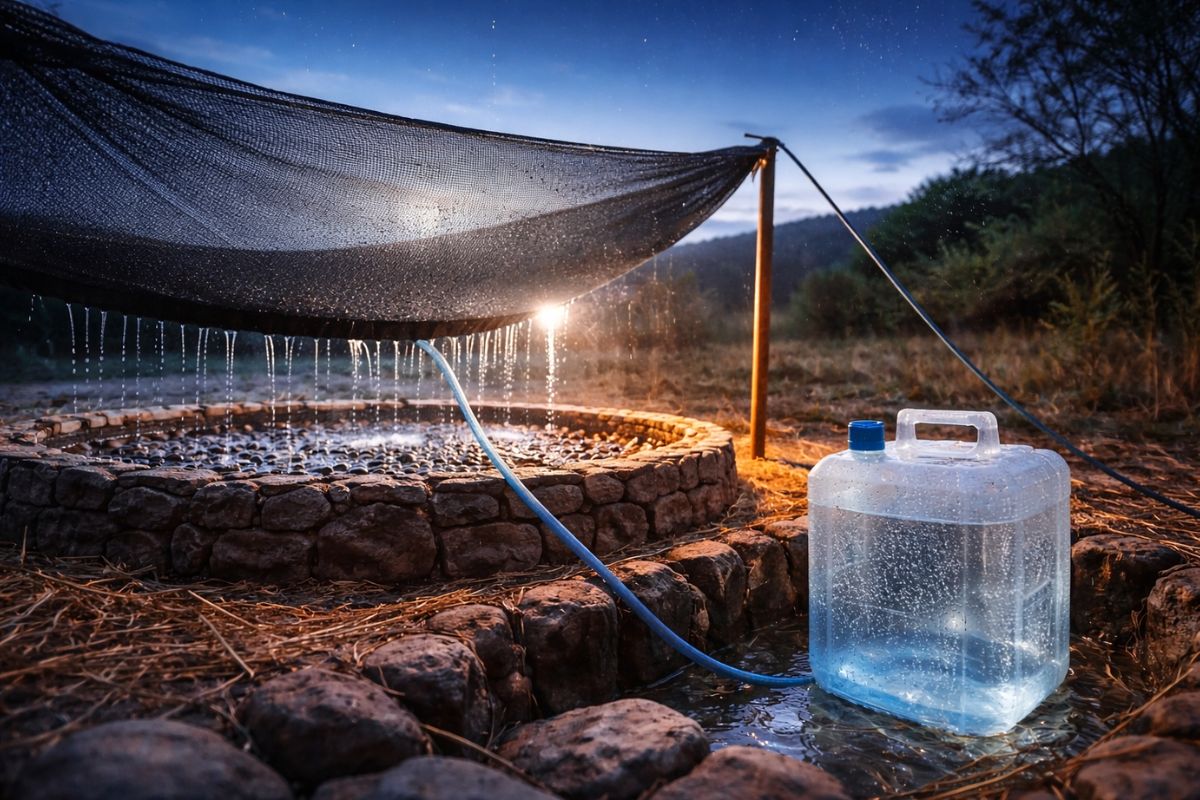
The Technique Uses Slanted Collector to Turn Invisible Water from the Atmosphere into Drops Through Condensation and Dew During the Night, Without Energy or Motor.
The idea of producing water directly from the air seems unlikely at first glance, but that is exactly what a simple device can do at night. Without pipes, wells, pumps, or electricity, the system harnesses the moisture present in the atmosphere to form drops that slowly trickle into a collection container.
The principle is not new, nor does it rely on sophisticated technology. On the contrary, it is an ancient technique, based on condensation, that has appeared in dry and isolated regions in different parts of the world. What stands out is the simplicity of the process and the fact that it can be assembled with inexpensive, accessible, and easy-to-find materials.
How Invisible Water from the Air Becomes Liquid
The starting point for understanding this system is to realize that the air around us carries water all the time, even when it is not visible. This vapor remains suspended in the atmosphere until it finds a surface cold enough to change state.
-
The most famous volcano in the world could paralyze one of the largest metropolises on the planet: Japan accelerates emergency plans for the eruption of Mount Fuji, which could bury Tokyo in ash for over two consecutive weeks.

-
The United States has a serious problem with its F-35s: China is already producing fighters at a pace that exceeds American capacity and could manufacture up to 300 aircraft per year before the end of the decade, shifting the global military balance.

-
Remains with battle wounds of over 100 soldiers from the Roman Empire are found beneath a football field in Vienna, leaving everyone surprised.
-
Elon Musk notes Brazil and lowers the price of his internet, Starlink, promising to connect all corners of the country with affordable plans, 10,000 satellites, and 1 million active users in the national territory!


It is the same phenomenon that appears outside a cold glass on a hot day, covers the grass with dew at dawn, or forms droplets on spider webs during the early morning.
When the air touches a surface at the dew point temperature, the vapor ceases to remain suspended and begins to transform into tiny drops.
It is exactly this change that the collector exploits. Instead of trying to manufacture water, the device simply creates the ideal conditions for condensation to occur continuously during the night.
What the Device Does in Practice
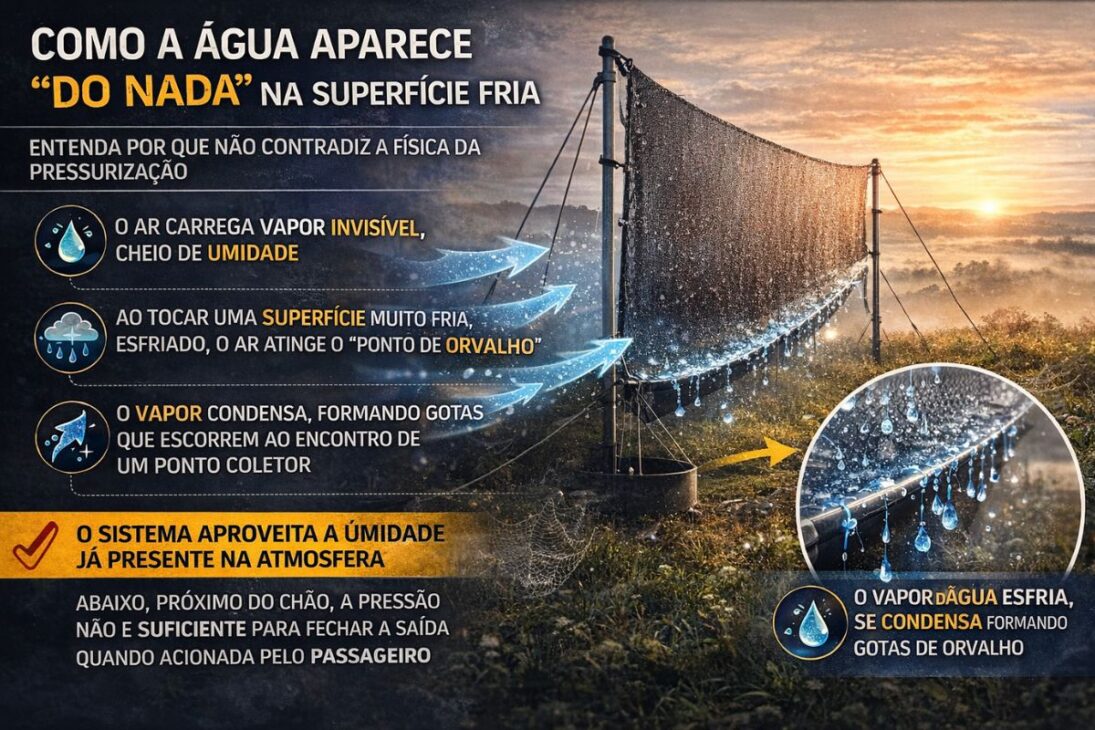
In practice, the system functions as a large surface exposed to the wind and the cool night air. As the temperature drops after sunset, this structure cools down along with the environment. When the surface reaches the right condition, the water vapor begins to condense on it.
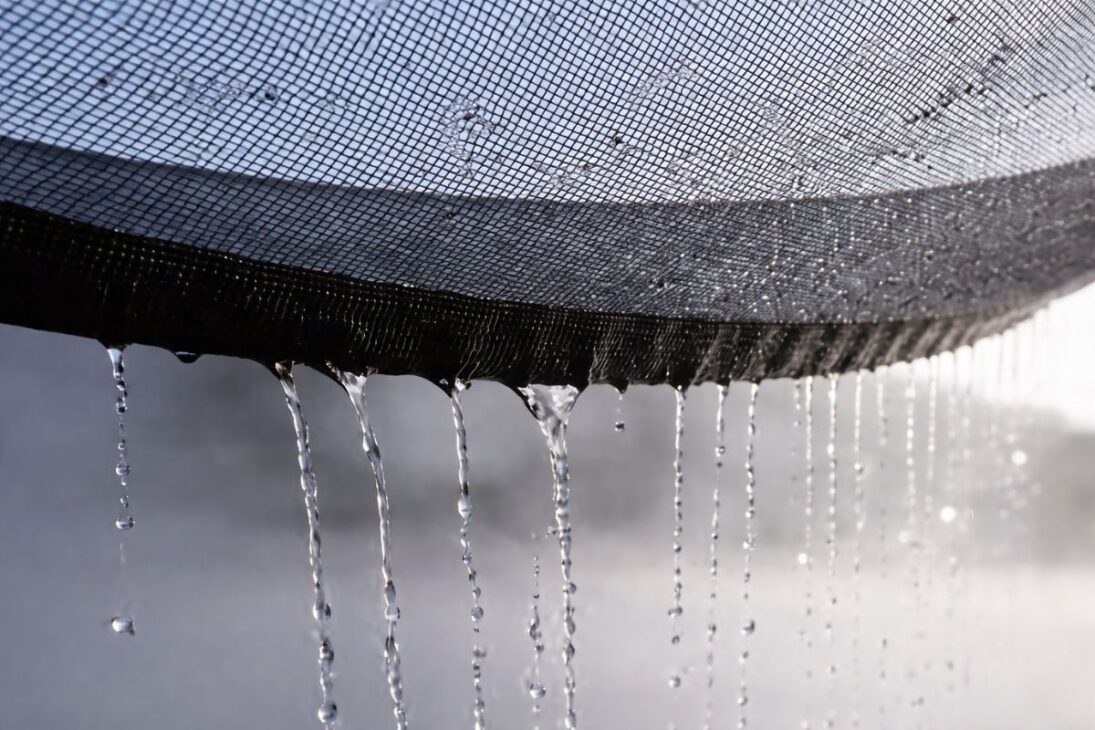
The droplets first appear on a microscopic scale. Gradually, they increase in size, join with other drops, and when they become heavy enough, they trickle down the slanted surface to the bottom of the equipment. From there, they fall into a small trough and flow into a collection container.
There is no motor, compressor, fan, or moving part. It is just physics working quietly as the night progresses. This is why the device attracts so much attention: it relies more on positioning and environment than on complex technology.
What Materials Are Used in the Assembly
The base of the system is quite simple. The project described at the base uses a shading screen or plastic mesh about 2 meters by 2 meters, four pieces of PVC pipe to form the structure, plastic ties to secure the mesh, a small section of trough to collect the water, and some stones or bricks to adjust the angle.
The logic is to use a mesh with a relatively fine weave because this increases the contact points where vapor can turn into drops. The more condensation points there are, the greater the chance of the collector forming and directing water to the reservoir.
The total cost, according to the base, ranges from 10 to 14 dollars. Within the theme you defined, this fits as a device costing less than R$ 60. In other words, the system is noteworthy not only because it works but also because it is inexpensive.
Why the Incline Makes Such a Difference
One of the most common mistakes in assembly is to imagine that the screen should lie flat, parallel to the ground. This seems intuitive, but it greatly reduces the efficiency of the system. When the surface is horizontal, the drops tend to accumulate, evaporate after dawn, and fail to reach the container.
That’s why the structure needs to be inclined, usually between 15 and 30 degrees. With this angle, each drop formed on the mesh begins to naturally flow towards the bottom edge. In this region, the trough is positioned, which receives the water and directs it for storage.
Without an incline, condensation occurs, but collection efficiency is lost. With the right incline, the process becomes continuous and makes better use of the entire night.
The Position of the Collector Directly Affects the Result
Another important detail is the place where the collector is installed. It should be mounted facing the wind, as it is the flow of humid air passing through the mesh that feeds the condensation process. If the structure is poorly oriented, efficiency decreases.
It also helps to elevate the system a bit off the ground. Even something around 30 centimeters makes a difference because the air very close to the surface tends to be warmer and drier. A little higher up, the ventilation usually favors better formation of water.
Moreover, it is ideal to avoid the exact spot where the morning sun hits first. If the light reaches the mesh too early, part of the dew evaporates before collection. The collector works best when it can operate all night long without losing what it formed at dawn.
How Much Water Can This System Generate
The amount of water produced depends on the size of the structure and local conditions. On a typical night, without fog or rain, the base reports a collection of just over half a liter with a small system. This already shows that the principle works even without extreme conditions.
In more humid regions, such as coastal areas, valleys near rivers, or places with frequent fog, the result can rise to 1 liter, 2 liters, or more per night using the same logic. As the area of the mesh increases, the volume of water captured also grows proportionally.
This point is important because it changes the perception of the project. What may seem merely a curiosity can become a real source of daily water in suitable locations. In certain contexts, a larger set of collectors goes from being an experiment to having practical utility.
Can the Collected Water Be Consumed?
The base makes it clear that the water obtained from the atmosphere starts out very clean because it hasn’t gone through the soil, hasn’t come from polluted rivers, and hasn’t carried sediments or sewage. Even so, this doesn’t mean that it should be drunk immediately without any precautions.
Over time, the mesh can accumulate dust, suspended particles, and minor environmental contaminants. Therefore, the safest route is to filter the collected water and, if necessary, boil it for a few minutes or perform simple disinfection with unscented bleach at the indicated ratio.
The text base even describes an improvised filter made with a plastic bottle, cotton, activated charcoal, and fine sand. With this care, the collected water can become safer for consumption, showing that the system not only condenses moisture but can also integrate a simple supply strategy in areas with limited infrastructure.
Why This Technique Is Not New
One of the most interesting aspects of this topic is that the principle did not emerge yesterday nor was it spawned by a modern startup.
Collecting moisture from the air through condensation has ancient roots. According to the base, civilizations and communities in different regions have already used similar ideas to obtain water where rivers, wells, and plumbing did not solve the problem.
There are cited examples in the mountains of South America, the Canary Islands, and even ancient structures in the Negev Desert. In all these cases, the logic was the same: to realize that the atmosphere holds water all the time and create a surface capable of capturing it when conditions favor dew or fog.
The knowledge has never completely disappeared, but it became forgotten as modern infrastructure spread. Today, it draws attention precisely because it combines low cost, simplicity, and energy independence.
When This Type of Collector Works Best


This system is not magical and does not generate water in any scenario with the same efficiency. Performance depends on the humidity of the air, ventilation, the drop in temperature during the night, and the correct exposure of the mesh. Drier environments tend to produce less, while regions with more vapor in the atmosphere yield better results.
That’s why the collector works especially well where there is fog, humid breeze, nighttime temperature variation, and nights more favorable to the dew point. This does not prevent tests in other contexts, but it helps to understand why some areas can harvest more water than others with the same structure.
Still, the project’s value lies precisely in showing that an extremely simple solution can be useful when well positioned. Water does not appear from nowhere. It was already in the air. The collector just creates the path for it to become visible and usable.
What This Project Teaches More Broadly
More than teaching how to assemble an inexpensive structure, this type of system helps to recover a different way of thinking about natural resources.
Instead of relying solely on large works, plumbing, and expensive equipment, it shows that certain processes in nature are available all the time, just waiting for a more intelligent use.
The great strength of this idea lies in its simplicity. Few materials, no motor, no electricity bill, and a physical principle long known.
In a scenario of seeking autonomy, cost reduction, and efficient use of the environment, this carries immediate weight.
In the end, the project shows that atmospheric water is not a distant curiosity but a real resource that can be collected with technique, observation, and proper assembly. And perhaps that is the most surprising part of all.
In your opinion, could this type of water collector work well in the region where you live?





-

Uma pessoa reagiu a isso.