





 Portuguese
  English
  Spanish
  4 min of reading
  1 comment


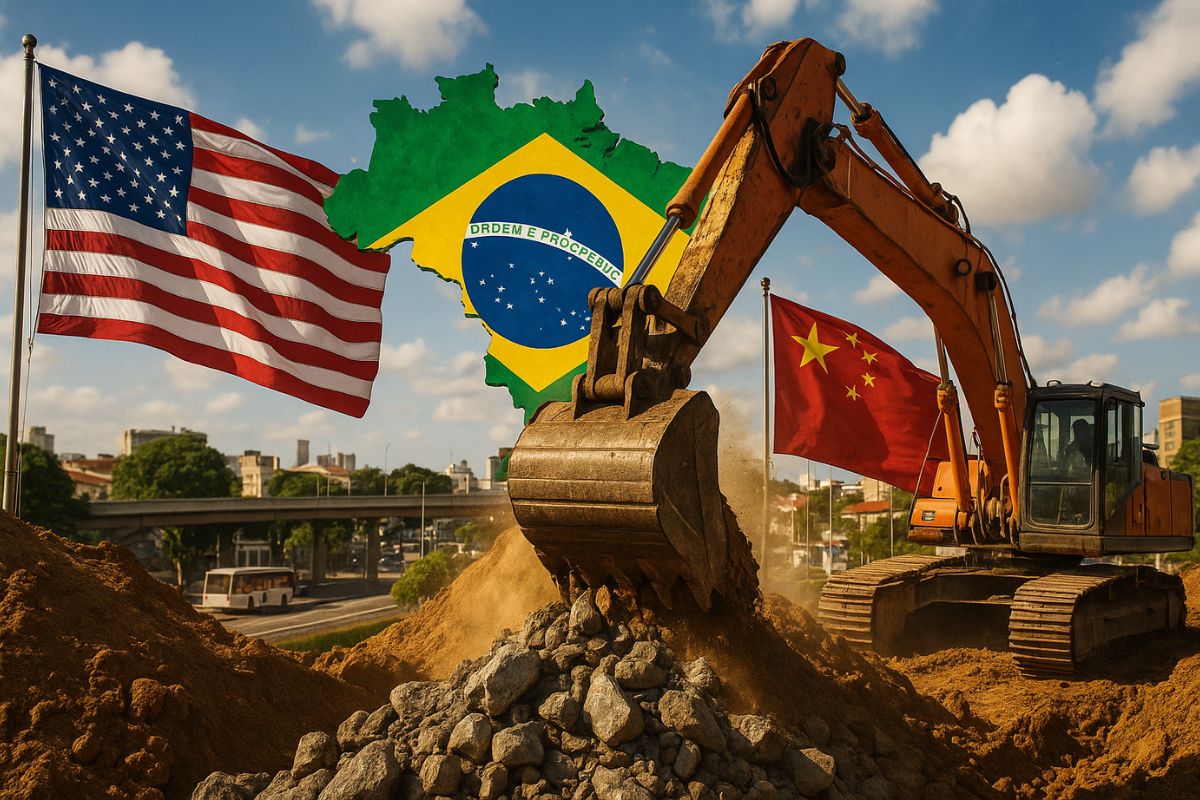


Escalation Among Powers Rekindles Race for Strategic Minerals and Highlights Brazil’s Potential as a Safe Alternative for the West.
The confrontation between United States and China has reached a new level after Beijing restricted the export of rare earths, essential inputs for the technology and military industries. In response, Washington announced the possibility of additional tariffs of 100% on Chinese products starting in November, reigniting the trade war and putting pressure on global supply chains.
According to expert Fernando Ulrich, at the center of this dispute are critical minerals, essential for semiconductors, electric vehicles, defense equipment, and clean energy. With 48% of global reserves under Chinese control, the country maintains almost complete control of production and, mainly, of processing, the most complex and polluting stage of the chain. In this scenario, Brazil emerges as a strategic alternative, with 23% of known reserves and a political environment more favorable to cooperation with the West.
Why Are Rare Earths So Strategic?
Despite the name, rare earths are not exactly scarce, but they require costly and environmentally aggressive processes for extraction and refinement.
-
Oil surged to $115 a barrel due to the war in the Middle East, and diesel in Brazil has already risen to R$ 7.45 per liter, while the United States…
-
Brazilian city bets on the business environment to generate jobs and attract investments in the energy sector — secretary reveals strategy at Macaé Energy 2026.

-
50 viaducts, 4 tunnels, 28 bridges, and 40 kilometers of bike paths: BR-262 in Espírito Santo will receive 8.6 billion reais for the largest engineering project in the state’s history, inspired by the Immigrant Highway in São Paulo.

-
Brazil produces too much clean energy and doesn’t know what to do with it: over 20% of solar and wind capacity was wasted in 2025 while investors flee and 509 renewable generation projects were abandoned in the last year.


They are 17 chemical elements used in cutting-edge technologies from permanent magnets in wind turbines and electric motors to radar systems, lasers, and satellites.
Global dependence on China solidified because the country assumed environmental and financial costs that other nations avoided.
While the West imposed strict emissions and licensing targets, Beijing subsidized the sector and built a complete industrial chain, from mining to high-tech product manufacturing.
Today, China accounts for about 70% of global rare earth production and 90% of refining, which gives it unprecedented geopolitical power.
This dominance allows the country to influence prices, pressure competitors, and ultimately condition access to the modern economy.
The Reaction of the United States and Allies


With the recent escalation, Washington has intensified policies to incentivize domestic production and diversify suppliers.
Federal programs, along with trillions in private investments, aim to rebuild the industrial ecosystem lost over the last few decades.
One symbol of this reaction came from JP Morgan, which announced a global initiative of US$ 1.5 trillion to strengthen critical industries including those of strategic minerals, artificial intelligence, and advanced energy.
The expectation is that part of this capital will be directed to mining and processing projects outside China, especially in allied countries.
In the short term, however, self-sufficiency is still unfeasible.
The extraction and refining of rare earths require continuous investment, infrastructure, and tolerance for environmental and regulatory risks, factors that make Brazil a natural alternative for integration into the Western chain.
Brazil: Second Largest in Reserves, Small in Production
Brazil ranks second globally in known rare earth reserves, with an estimated potential of 21 million tons only behind China.
However, national production is minimal, reaching less than 1% of the total global output.
In 2024, the country produced only 20 tons, while China extracted over 200,000.
The contrast reflects the lack of coordinated industrial policy, environmental hurdles, and scarcity of processing plants, which end up forcing the export of raw ores.
Still, Brazil’s geological relevance attracts international attention. The country offers unique conditions of political stability, clean energy, and logistical infrastructure that can enable a new secure supply route for the United States and Europe especially in the context of trade tensions and the risk of technological shortages.
Environmental Challenges and Geopolitical Opportunity
Brazil’s advancement in this sector will require swift and transparent environmental licensing, investment in refining technology, and scientific cooperation agreements.
The carbon footprint of the process is high, but the country has a competitive advantage by combining renewable energy matrix and environmental biotechnology, factors valued by the international market.
Beyond the ecological issue, there is the diplomatic dilemma: Brazil will need to balance relations with China, its largest trading partner, and the West, which seeks to reduce this dependence.
This strategic position could transform the country into a geopolitical bridge between the two largest economies on the planet, provided it builds a reliable and competitive regulatory framework.
The clash between U.S. and China over rare earths goes far beyond the economy: it defines who will control the foundations of the next technological revolution.
In this scenario, Brazil has resources, location, and neutrality to become an essential supplier for the West, but must act swiftly and strategically to occupy this space before other players advance.
Do you believe Brazil should heavily invest in refining and exporting rare earths or prioritize environmental preservation? Leave your opinion in the comments; the balance between development and sustainability may define the country’s role in the new global rare earth map.








Acho que deve fazer os dois procedimentos. Deve fazer acordos com os Estados Unidos e com a Europa para explorar em conjunto , refinar e adquirir tecnologia. Se não fizer um acordo bem amarrado, e melhor não fazer nada. Tudo depende da nossa competência em fazer um acordo o melhor possível.