





 Portuguese
  English
  Spanish
  4 min of reading
  36 comments


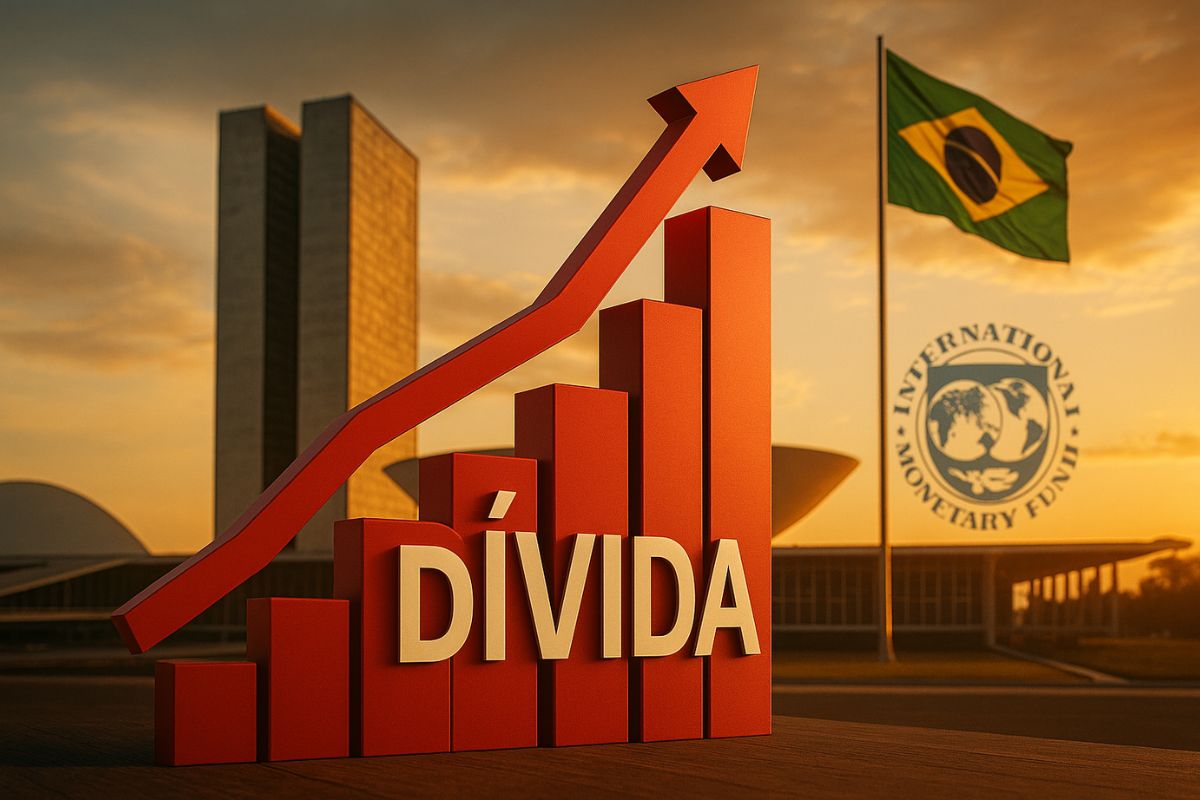


The Brazilian Public Debt Is Already 90% Of GDP According To The IMF Criteria, Well Above The Officially Disclosed By The Central Bank (77.6%), Because Brasília Does Not Account For The Treasury Bonds In The Own BC Portfolio. This Puts Brazil Among The Most Indebted Countries In The Emerging World, Increasing Pressure For High Interest Rates And Pushing Away The Investment Grade.
The real debt of Brazil reached 90% of GDP in 2025, according to calculations by the International Monetary Fund (IMF) mentioned by g1. The number is much higher than the 77.6% officially disclosed by the Central Bank because Brasília does not include public securities in the account of the Central Bank’s own portfolio, used to regulate liquidity and the Selic. This methodological detail makes all the difference: it places Brazil among the most indebted countries in the emerging world, above the Latin American average of 70% and the average of 69.5% observed in other emerging countries.
The immediate consequence of this data is clear: the higher the indebtedness, the greater the pressure on interest rates, the lower the international credibility, and the further away the return of the investment grade good payer seal lost in 2015.
Who Measures The Debt And Why The Numbers Diverge
According to the Central Bank, the real debt of Brazil is equivalent to 77.6% of GDP, or R$ 9.6 trillion, considering the concept of gross public sector debt. But the IMF adopts an international methodology that includes the securities held by the Central Bank, raising the index to 90%.
-
The largest food company on the planet, JBS, has just opened a 4,000 square meter laboratory in Florianópolis to develop customized proteins that modulate muscle mass gain, immune response, and metabolic performance.

-
After nearly 30 bids and competition among industry giants, a Spanish company purchases one of the largest airports in Brazil for almost R$ 3 billion and takes over the management of Galeão in a concession that will last until 2039.

-
The Federal Revenue Service now automatically cross-references everything you declare with data from banks, credit cards, brokerage firms, and insurance companies, and any discrepancy between your income and your expenses triggers an alert in seconds.

-
Amid global tensions, Brazil blocks the United States’ proposal at the WTO and paves the way for a trade crisis and possible retaliations.


This difference of 12 percentage points is decisive. While the government presents less alarming numbers, the international market uses the IMF criterion to compare countries.
This enhances the perception of fiscal risk and places Brazil in an unfavorable position against its Latin American neighbors.
How The Debt Grew Over The Governments
The historical series from the IMF shows that the real debt of Brazil was 67% of GDP in 2001 and remained relatively stable until 2014.
The surge began in Dilma Rousseff’s second term, with an increase of 16 points in just two years.
The peak was in 2020, under Jair Bolsonaro, when emergency pandemic spending drove the debt to the highest level in history.
Nevertheless, the government ended 2022 with 83.9% of GDP by the international criterion. Now, under Lula, the indicator has already grown another six points in just over two years.
Where The Greatest Pressures On The Budget Are
Among the measures that most pressured the real debt of Brazil in the current government are the transitional PEC, which opened R$ 170 billion in annual spending, the real adjustment of the minimum wage, which increases pension expenses, and the resumption of the constitutional floors for health and education.
In addition, the government settled R$ 92.3 billion in overdue court orders and granted raises to public servants.
According to the Treasury, the debt is expected to reach 84.3% of GDP in 2028 by the Brazilian criterion.
But, by the IMF method, it could reach 96% in 2033 and even exceed 100% of GDP in 2035 a mark associated with economies at risk of stagnation.
Why High Debt Pushes Away The Investment Grade
The impact of the real debt of Brazil goes beyond statistics. High debt puts pressure on the Selic, currently at 15% per year, and makes credit more expensive for families and businesses. This hinders consumption, investments, and limits economic growth.
In the external scenario, credit rating agencies have already reacted. Moody’s downgraded Brazil’s outlook from “positive” to “stable” in 2024, and Fitch stated that it sees no chance for the country to regain the investment grade in the short term.
Without the investment grade, more conservative international funds do not invest in Brazil, restricting the entry of long-term capital.
What Could Reverse The Trajectory
Experts cited by g1 argue that only a robust reform of mandatory spending could alter the trajectory of the real debt of Brazil. Among the proposed discussions are:
Administrative reform to contain expenses with public servants;
New pension reform or partial un-linking of benefits;
Review of the constitutional floors for health, education, and Fundeb;
Adjustments in programs like the salary bonus and unemployment insurance.
Without changes, the fiscal framework approved in 2023 risks losing validity. The rule limits real growth in spending to 2.5% per year and ties expenses to 70% of revenue growth. If mandatory spending continues to rise, the rule may become unsustainable.
Is It Worth Trusting The Official Index?
This is the central point of the discussion. While the government presents a debt of 77% of GDP, the world sees Brazil with 90% real indebtedness. For investors, the IMF number matters more, which increases distrust and raises credit risk.
This methodological divergence generates a mismatch between internal discourse and external perception. And, in the end, the practical effect is: high interest rates, expensive credit, and a stalled economy.
The real debt of Brazil already exceeds 90% of GDP according to the IMF criteria, a level that pressures the economy and moves away the possibility of recovering the investment grade.
The difference between the official statistic and the international one increases the perception of risk, raises interest rates, and hinders growth.
And you, do you think the government should adopt the IMF methodology for greater transparency? Or do you consider it valid to maintain the official index of 77% of GDP?
Leave your opinion in the comments, we want to hear from those who closely follow the impact of public debt in Brazil.







O FMI que aplique sua cartilha nos EUA que deve 40 trilhões de Dólares. E ainda tem Grau de investimento. Essas agências tudo erra.
E qual é o peso dos juros pagos ao mercado financeiro. Essa selic de 15% aa nao aumenta a divida do governo. Parem com esse absurdo de acusar o reajuste do salário mínimo, o PIS o seguro desemprego, e ainda querendo reduzir os gastos com saude e educação. Vergonhosa essa matéria.
Socorro! Acho que vou para Argentina. Só que não.