





 Portuguese
  English
  Spanish
  6 min of reading
  0 comments


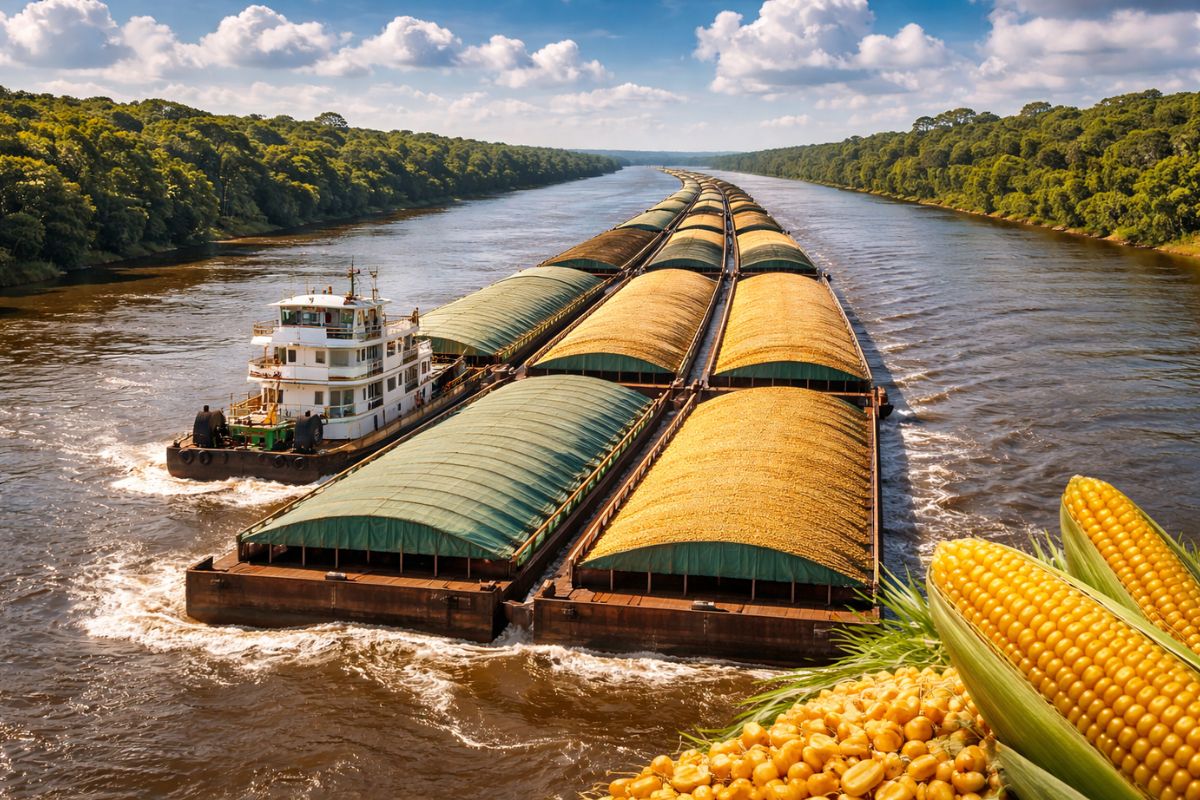
Convoy With 10 Barges and 30 Thousand Tons of Corn Navigates 30 Hours Between Miritituba and Santarém and Shows How Brazilian Exports Gain Speed Through the Northern Arc
The Brazilian grain export has gained a new face as the Northern Arc began to share the spotlight with the traditional ports in the South and Southeast. Today, the region accounts for up to 40% of corn and soybean shipments to other markets, and the Tapajós river waterway has become an essential corridor in this advancement of Brazilian exports. Between Miritituba and Santarém, in Pará, a journey of over 30 hours shows in detail how the cargo leaves the Midwest and encounters ships bound for overseas.
The route is part of a multimodal logistics system. First, soybeans and corn leave the Midwest by highways to Miritituba, where large trading companies maintain transshipment stations. There, the grains are unloaded from trucks, enter barges, and travel in convoys pushed along the Tapajós to the terminals in Santarém. From there, the Brazilian export is completed with loading onto ships that cross the ocean to major buyer destinations.
Tapajós Waterway: Corridor of the Brazilian Export
The Tapajós is now one of the main exit gates for the grains that fuel Brazilian exports. The waterway integrates a logistical design that reduces distances, costs, and time compared to older routes.
-
The government requests the Federal Revenue Service for a new system to automate the income tax declaration, reducing errors, time, and bureaucracy for millions of Brazilians.

-
Pix in installments, international Pix, and contactless payment without internet: the Central Bank revealed the new features coming to the tool that is already used by almost every adult in Brazil.

-
Mercado Livre has just started selling medications with delivery in up to three hours to your door, and this move could completely change the way Brazilians buy medicines on a daily basis.

-
In Dubai, rising tensions from the war in the Middle East are causing super-rich individuals to leave the Gulf and direct their fortunes to a new financial refuge in Asia.


In Miritituba, Pará, trucks arriving from the Midwest unload corn and soybeans at the transshipment stations. The grains are directed to barges aligned side by side and coupled to a pusher, forming a convoy that travels down the river at a constant speed to Santarém.
On this trip, accompanied by the report, the pusher Tucunaré departs from Miritituba with 10 barges loaded with corn.
There are about 30 thousand tons in total, organized in two rows of five barges each. What once depended on long truck journeys to distant ports now finds in the Tapajós a decisive riverine shortcut for Brazilian exports.
How the 10 Barge Convoy Works
Before setting sail, the crew receives safety instructions and checks every detail of the operation. Life jackets, helmets, and safety goggles are part of the routine, both on the pusher and in the central corridor formed between the barges.
Seen from above, the convoy impresses. Each barge measures about 61 meters in length and 15 meters in width. Together, they form a metallic “carpet” that glides over the river, guided by the pusher at the back. The Tucunaré keeps the formation aligned, correcting course and speed at all times.
In flood periods, this type of pusher is authorized to navigate with up to 15 barges. During low water levels in the Tapajós, as reported in this trip, the limit is reduced and the operation must be even more careful.
Even so, the ability to transport tens of thousands of tons in a single convoy is one of the factors that makes the river modal so competitive for Brazilian exports.
The company responsible for the route has tested much larger formations, with 36 barges and over 100 thousand tons of corn, demonstrating the potential scale of the waterway.
Onboard Routine: 20 Days of Travel and 10 Days of Rest
Behind the Amazon landscape that borders the Tapajós, there is an intense work routine. On board the pusher, there are 13 people on this trip, including 10 crew members and 3 passengers.
The shifts are organized into 4 hours of work followed by 8 hours of rest, in a schedule that repeats over 20 days on board. After that, each crew member has 10 days of leave on land.
In the engine room, engines, pumps, and generating systems keep the vessel self-sufficient. In the kitchen, Mrs. Rose ensures daily meals, organizing supplies of vegetables, greens, proteins, and everything necessary for life on board to keep functioning.
The pusher is designed to operate for consecutive days without external support, which is essential for a route that sustains an important part of Brazilian exports.
At night, navigation continues. When a repair is needed on a barge further ahead, the team travels by small boat, with the support of lights and constant communication with the bridge. On nights of full moon and more predictable rivers, navigation through critical points is less tense, but attention never wanes.
Northern Arc: Where the River Shortens the Path from the Midwest to the World


The advancement of the Northern Arc is directly linked to the growth of agribusiness in the Midwest and the need for new export routes for Brazil.
Instead of traveling thousands of kilometers to ports in the Southeast or South, part of the production now travels by highway to Miritituba and, from there, by rivers such as Tapajós, Madeira, and Amazonas to different terminals.
The company that operates the Tucunaré convoy already works on two main routes: Miritituba–Santarém and Porto Velho–Santarém.
On these paths, the convoys tackle sections of the Tapajós, Madeira, and Amazonas rivers, connecting producing areas in the interior to strategic shipping ports.
This interconnection transforms the Northern Arc into a kind of liquid conveyor belt, shortening the journey between the farms of the Midwest and the ships of Brazilian exports.
Fewer trucks on the road, more volume per trip, and greater logistical predictability are some of the results of this change.
From Grain to Ship: Final Stage of Brazilian Exports via Tapajós
After more than 30 hours of navigation, the convoy arrives at Santarém still in the early morning. The docking maneuver requires precision.
The pusher’s cabin turns off the lights to avoid blinding the captain and the crew. The bow and stern of the formation are secured to specific buoys positioned on the riverbed, with the support of a mooring boat.
Once the maneuver is completed, the separation begins: the pusher moves away, the barges remain secured to the buoys, waiting for smaller tugboats to take them, one by one, to the unloading terminal.
It is there that the corn unloaded in Miritituba finally touches the ground at the port of Santarém, passing to conveyors, silos, and then to the holds of the ships.
Each trip of this kind is one more link in the chain that ensures Brazilian grain exports reach markets around the world with regularity.
For the end consumer, corn is just an ingredient. For those following the grain’s journey, it’s the result of a complex operation that begins in the field, goes through trucks, crosses rivers, and ends in the sea.
The crew of the pusher, for its part, remains on board. After unloading the convoy, the Tucunaré awaits the next formation of barges to make the return trip.
Meanwhile, those who accompanied the journey disembark in the small boat that takes them back to solid ground, at the Santarém port terminal, with the feeling of having traversed, from within, one of the silent arteries of Brazilian exports.
And you, have you ever stopped to think about the path that corn and soybeans travel through the rivers of the North to emerge in Brazilian exports? What would you like to see up close on a journey like this along the Tapajós?








-

Uma pessoa reagiu a isso.