





 Portuguese
  English
  Spanish
  5 min of reading
  29 comments


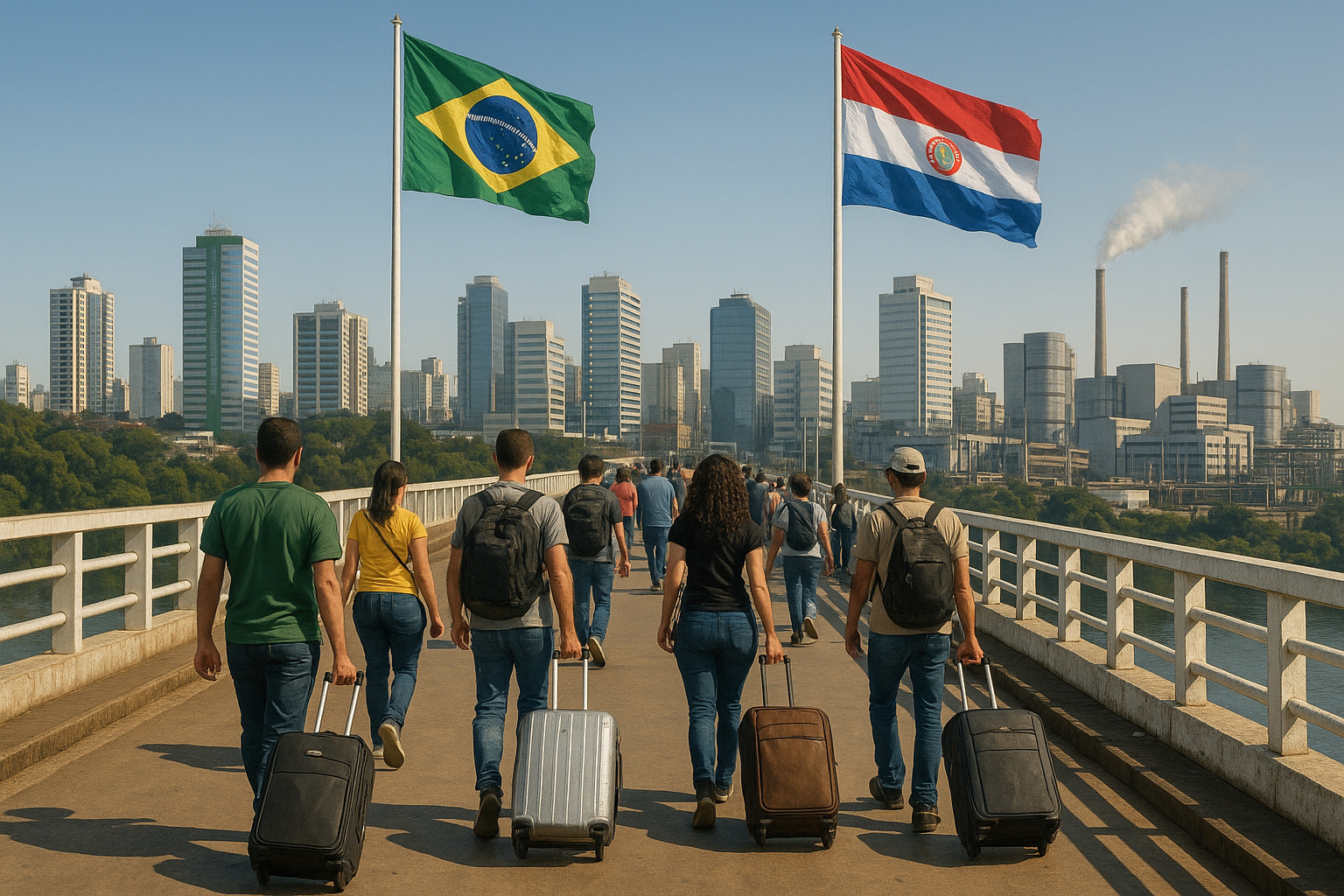


Paraguay Establishes Itself As The Main Destination For Brazilian Immigrants In South America, Offering Low Taxes, Cheap Energy, And Opportunities That Brazil Cannot Guarantee
For a long time, calling something “Paraguayan” in Brazil was almost synonymous with an insult. Jokes, stereotypes, and derogatory comments marked the way Brazilians viewed the neighboring country. However, while Brazil laughed, Paraguay was silently changing its course. It cut taxes, simplified laws, and opened up to attract companies and investors.
While the popular image associated Paraguay with smuggling, the country was structuring one of the most advantageous tax systems in South America. The result was quick to appear: today, more than 263 thousand Brazilians live in Paraguayan territory, making it the main destination for immigrants from Brazil in the entire region.
From Brasiguaios To Entrepreneurs And Students
This migratory movement did not start yesterday. Its roots go back to the period of dictator Alfredo Stroessner (1954–1989), when the country, under strong state control and military support, sought to expand its economic and geopolitical presence.
-
Grande SP gains unprecedented technology to control water flow with installation in just 8 hours and a promise to reduce leaks without the need for human intervention.
-
With the new law, shopping malls will no longer operate on Sundays, similar to supermarkets; the rule imposes closure by 9 PM, foresees a fine of R$ 15,000, suspension, and even revocation of the license in Salvador.

-
Only 7 ships have crossed the Strait of Hormuz in the last 24 hours when the normal is 135 per day, and the United Arab Emirates confirms that 230 oil tankers loaded with oil are ready to depart but are prevented from leaving while Iran turns the waterway into a sovereign control post.
-
Trump sent a treaty on critical minerals to Lula in early 2026, and the document is sitting in the president’s drawer unsigned because the Brazilian government considers the proposal too generic and refuses to turn the country into a mere exporter of raw materials.

It was precisely at this time that the construction of the Friendship Bridge and the Itaipu Treaty – both financed by Brazil – facilitated the integration of the two countries. From the late 1960s, thousands of Brazilians crossed the border, first in search of cheap land and then due to commercial opportunities.
In the 70s and 80s, entire families sold their belongings in Brazil to buy much larger agricultural properties in Paraguay. These immigrants became known as “Brasiguaios” and transformed cities like Santa Rita and Naranjal, introducing the intensive cultivation of soy and corn that, decades later, would make Paraguay one of the largest grain exporters in the world.
The Economic Leap And The Maquila Law
With the end of the dictatorship in the 1990s, Paraguay began to redesign its economy. But it was in the 2000s that the decisive shift came: a simplified tax system, industrial incentives, and integration policies transformed the country into an investment hub.
The Maquila Law (Law 1064/97), consolidated in the early 2000s, was a game changer. It drastically reduced the tax burden on exporting companies. Brazilian industries, suffocated by high taxes and labor costs in their home country, migrated to Paraguay in search of tax relief.
According to Francisco Ruiz Díaz, the Deputy Minister of Industry, “70% of Paraguay’s exports to Brazil are a result of the maquila”. The textile sector is a striking example: Brazilian companies send raw materials to Paraguay, produce locally, and re-export to Brazil, paying much lower taxes.

Paraguay As The New Brazilian Eldorado
In addition to tax incentives, other factors have made Paraguay even more attractive. The country offers electricity at prices well below the South American average, thanks to the Itaipu hydroelectric plant. To put it into perspective, while in Brazil the average cost of industrial electricity is around 123 USD/MWh, in Paraguay this value drops to just 39 USD/MWh. It’s like fueling three Paraguayan factories for the price of just one in Brazil.
Cities like Ciudad del Este exemplify this transformation. Once known for the trade of electronics and smuggling, today they house over 98 thousand Brazilians, becoming business, industrial, and student hubs.
The Phenomenon Of Brazilian Students
If in the past migration was dominated by farmers, today Paraguay attracts a new profile of immigrants. Nearly 30 thousand Brazilians study medicine at Paraguayan universities. In Felipe Monteiro’s class, a student from Amapá in Ciudad del Este, only 2 out of 80 students are Paraguayans – the rest came from Brazil.
The difference in costs explains part of this movement. While in Belém a medical tuition can reach R$ 8 thousand, in Paraguay Felipe started paying R$ 1.2 thousand and now pays R$ 1.9 thousand. This massive savings has led entire families to rethink their children’s academic future.
The Unbeatable Cost Of Living
Another major attraction is the cost of living, which is up to 2119% lower compared to Brazil, according to international indexes. Although a lunch in upscale areas can be 35% more expensive, the Big Mac Index shows that in Brazil the sandwich costs 286% more than in Paraguay.
The real estate market is also noteworthy: a one-bedroom apartment in a prime area costs on average R$ 1,931.75 in Paraguay, compared to R$ 3,019.48 in Brazil, a savings of nearly 356%. Utility costs, such as electricity and gas in an 85 m² apartment, can be up to 743% cheaper on Paraguayan soil.
Tax System: The Fiscal Ace
The Paraguayan tax system is the cherry on top. Known as “10-10-10”, it applies a 10% income tax on individuals, 10% for companies, and 10% VAT (equivalent to ICMS). Additionally, there are no taxes on inheritances or donations, and income derived from abroad is taxed at zero.
Inspired by the Mexican model, the Maquila Law still allows exporting companies to pay only 1% on gross revenue. This means that while Brazilian entrepreneurs face up to 27.5% personal income tax and 34% for companies, their counterparts in Paraguay drastically reduce their costs by merely relocating their production base.
Global Comparison And Residency Facilitation
Many Brazilians dream of migrating to the United States, Canada, or Europe. However, in these destinations, the bureaucracy of visas, high real estate costs, and entry barriers make the dream distant. Paraguay, on the other hand, offers a simplified residency process.
In just 1.5 to 4 months, the immigrant can obtain Temporary Residency. After 1 year and 9 months, they can apply for Permanent Residency. Paraguayan citizenship takes longer – it can only be requested after 3 years as a permanent resident, but even so, the process is more agile than in developed countries.
The Hidden Side Of Growth
Not everything, however, is positive. Paraguay faces serious challenges: 27% of the population lives in poverty and the country ranks 136th in the world corruption perception index, even lagging behind Brazil, which is in 104th place. These obstacles reveal that while attractive, Paraguay still carries structural vulnerabilities.
Still, according to Elementar, which published a detailed report on this phenomenon, Paraguay’s rise and the mass migration of Brazilians are reflections of historical and structural changes in South America.
From “Joke” To Real Opportunity
For decades, Paraguay was the butt of jokes. Today, however, the movement has reversed: it is Brazilians who cross the border in search of economic freedom, lower taxes and better quality of life. While Brazil tightens rules and increases the tax burden, Paraguay is growing, attracting investments, and reshaping the migratory geopolitics of the region.
The question that remains is: will we continue to laugh at Paraguay, or is it time to admit that the joke is on us?







kkkkkkkkkkkkkk Povo vive de ilusão mesmo.
Com tantas pessoas migrando ao país,logo terá aumento da carga tributaria,afinal os serviços publicos como segurança precisam aumentar,assim como a questão da seguridade social.
estou vivendo no paraguai a 1 ano e meio e posso dizer que sim, é melhor que o brasil em varios pontos, realmente aqui ainda tem algumas questoes, mas em um macro esta muito melhor que o brasil
Ainda não é idéia descartada a migração pro Paraguai… só falta decidir o local.