





 Portuguese
  English
  Spanish
  4 min of reading
  5 comments


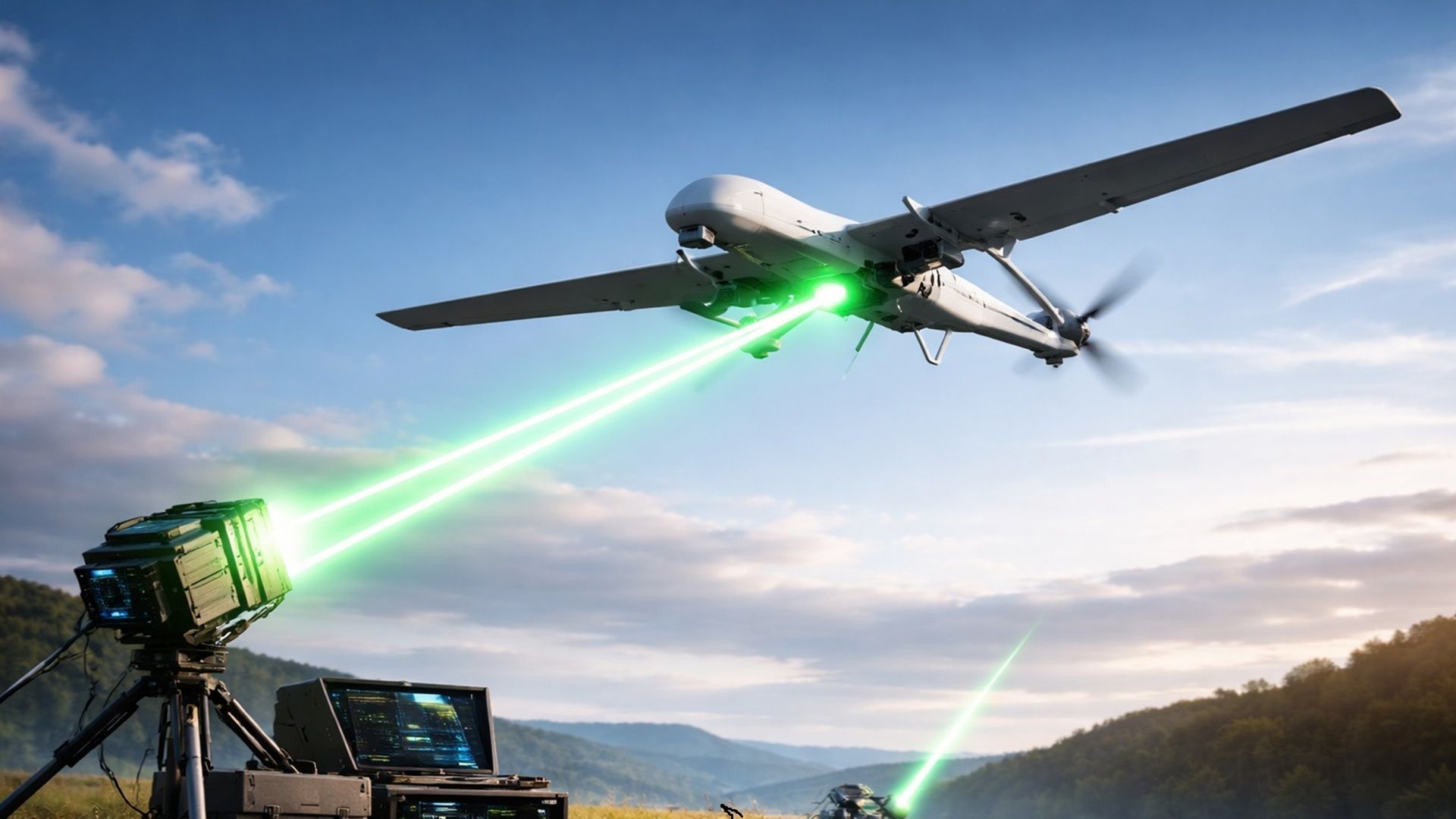


Developed by PowerLight Technologies in partnership with the United States Department of Defense, the technology uses ground-based laser transmitters in the kilowatt range to recharge drones in flight, with active tracking, an operational range of up to 1,500 meters, and flight tests scheduled for the beginning of the year
The development of a wireless power system using lasers may allow drones to remain in continuous flight by receiving electrical charge directly from the ground, according to information released by PowerLight Technologies, the developer of the technology.
Beam Transmission and Control Technology
The solution combines a ground transmitter and a receiver onboard the drone, classified as an unmanned aerial system. The transmitter integrates precise beam control software and hardware capable of transmitting power in the kilowatt range, thousands of watts, surpassing laboratory lasers that operate in milliwatts.
The software enables the fixation and tracking of cooperative targets during flight, facilitating the safe transmission of power even with the drone in motion. According to the company, the transmitter can operate at altitudes of up to 1,500 meters, keeping the beam continuously directed at the airborne receiver.
-
With a cost per shot close to zero, the DragonFire laser could change naval warfare in 2027 and provide British ships with nearly unlimited defense against drones.

-
A British startup creates tires that generate electricity in electric vehicles when passing over potholes, speed bumps, and cracks.

-
Scientists have created robots made with living cells that have their own nervous system, swim on their own, explore the environment, and self-organize without any genetic engineering, and now they want to do the same with human cells.

-
Students create a solar-powered ambulance that operates without a plug, without fuel, and still keeps medical equipment running in remote areas.

Altitude Comparison and Operational Context
For context, the operational altitude of the Raven RQ-11B, a hand-launched intelligence, surveillance, and reconnaissance drone, is between 46 and 305 meters above ground level and up to 3,200 meters above sea level. Larger drones can reach up to 18,288 meters.
These parameters indicate that the maximum altitude of the PowerLight transmitter covers a range compatible with various small and medium-sized platforms.
The company states that the system was designed to support prolonged aerial missions without the need for frequent landings for recharging.
Software Integration and Telemetry
The transmitter control software can connect to the UAS software, allowing monitoring and telemetry control. This interoperability enables the exchange of data and commands between the beam tracking system and the drone’s avionics, including information about battery levels.
With this data, ground operators can dynamically adjust the power provided, ensuring energy efficiency and continuous alignment of the laser with the target. The goal is to maintain a continuous supply while the drone executes its programmed routes and maneuvers in flight.
According to Tom Nugent, Chief Technology Officer and co-founder of PowerLight, the company is working on building a smart mesh energy network. He states that the transmitter communicates with the UAS, tracks speed and vector, and provides energy exactly where it is needed, with algorithms that have already been tested.
Onboard Receiver and Energy Conversion
The drone uses an integrated receiver weighing 2.7 kg, responsible for capturing the laser energy and converting it into electrical energy for the battery. The system employs energy laser photovoltaic converters, similar to solar cells, but optimized for high-intensity monochromatic laser light.
In addition to energy conversion, the receiver includes a control module that collects real-time telemetry on the position and operation of the drone.
This information is retransmitted to ground operators, allowing continuous monitoring of flight conditions and energy system status.
The module also establishes a bidirectional communication link based on light, enabling the sending and receiving of data through optical signals.
This functionality enhances the integration between the airborne platform and the ground system during prolonged missions.
Joint Development and Military Applications
The system was developed in partnership with the U.S. Department of Defense and will be integrated into the K1000ULE, a long-range, high-endurance drone created by Kraus Hamdani Aerospace. The K1000ULE is fully electric and focused on persistent missions.
The platform was designed to support operations of the U.S. Navy and Army, leveraging its capability for prolonged air persistence. The integration of the laser energy system aims to eliminate limitations imposed by the capacity of conventional batteries.
Prior Tests and Next Steps
Previous experiments have already demonstrated the feasibility of laser power transfer. The Defense Advanced Research Projects Agency transferred more than 800 watts over a distance of 8.6 kilometers in earlier demonstrations.
According to PowerLight, the new system represents a step forward toward practical application in mobile platforms. Recent tests validated the transmitter and receiver on the ground, while the first flight tests are expected to take place early this year.








Um dia aplicarão isso em veículos elétricos. Visualizo operadoras fornecendo os veículos e a energia via satélite ou por terra aos clientes que apenas querem pagar uma mensalidade para terem o serviço completo como acontece hoje com operadoras de telefonia celular. O carro quebrou, paga uma franquia e pega outro novo. O carro venceu, pega outro novo. Roubaram, mas fez o plano com seguro, pega outro, se não contratou com seguro paga a taxa para retirar outro.
Esse sistema deveria ser utilizado pra transmissão de energia elétrica para substituir os fios e cabos em postes. Pois seria melhor que a fiação subterrânea.
Boa sorte. Deus ajude a funcionar bem. O mundo agradece.