





 Portuguese
  English
  Spanish
  6 min of reading
  5 comments


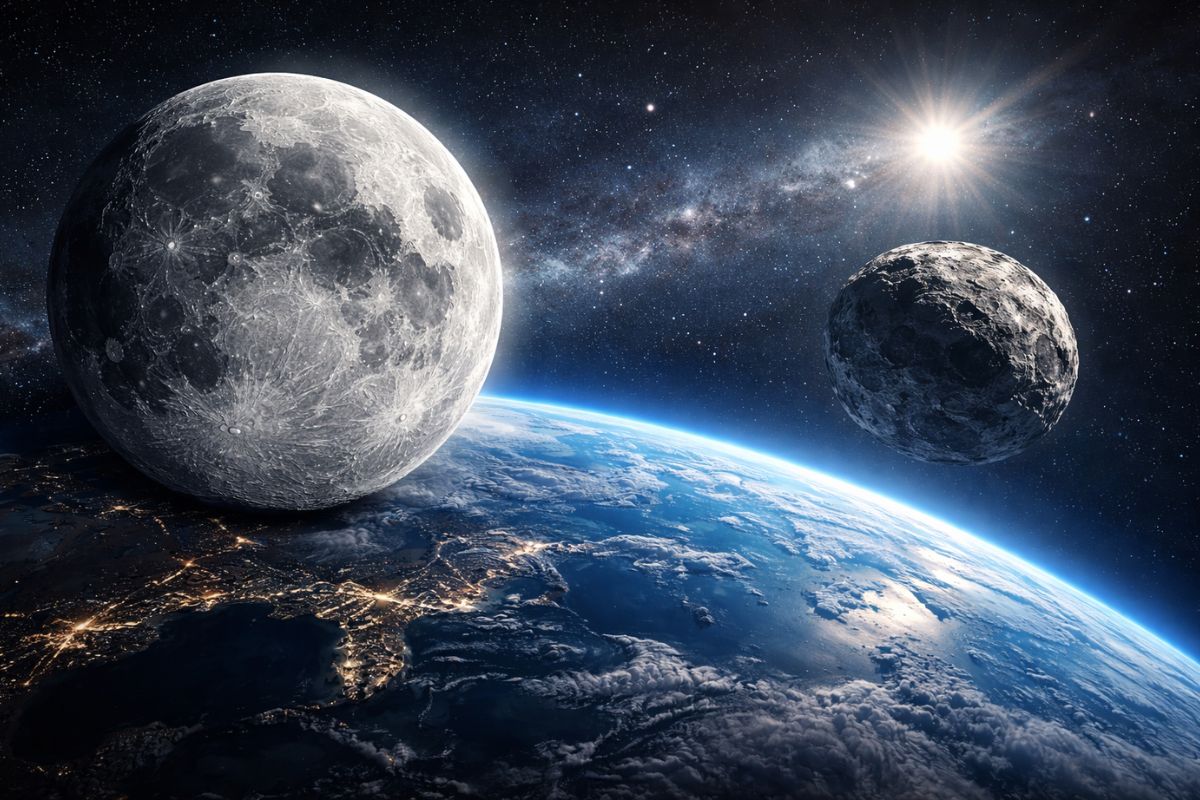


The Moon Continues to Be the Only Natural Satellite of Earth, But the Confirmation That Asteroid 2025 PN7 Follows the Planet in Synchronized Trajectory for Decades Reignites the Debate About the Near-Moons, Discreet Objects That Do Not Orbit Earth Directly, Although They Remain Close in Surrounding Space
The Moon has always occupied a unique place in the way humanity understands Earth’s neighborhood, but this perception gained an unexpected layer with the confirmation that asteroid 2025 PN7 has been following the planet in a synchronized trajectory for several decades. The discovery does not change the status of the Moon as a natural satellite, but significantly broadens what is known about objects that share Earth’s orbital region.
Identified by telescopes from the Pan-STARRS project operated by the University of Hawaii, the small celestial body drew attention for exhibiting a rare behavior: it orbits the Sun almost in the same rhythm as Earth and, therefore, creates the impression of always being nearby. It is precisely this movement that sustains the popular idea of a “Second Moon”, although the astronomical definition is much more precise and quite different from the nickname.
Asteroid 2025 PN7 and the Surprising Company of Earth
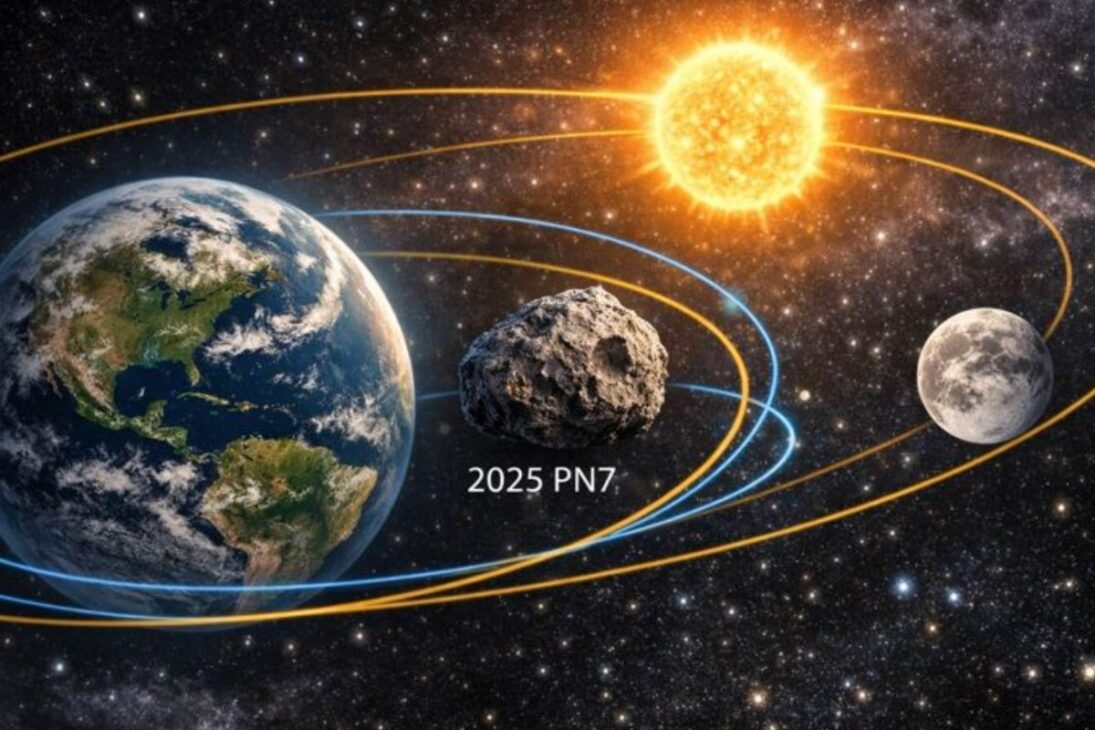
The object that aroused the interest of astronomers is named 2025 PN7 and has dimensions estimated between 16 and 49 meters in diameter, a size comparable to that of a small building. Even though it is modest on a cosmic scale, it became relevant because it shares an unusual orbital dynamic with Earth, remaining associated with the planet for a much longer period than initially thought.
-
In Mexico, a 3,000-year-old Maya site with the dimensions of an entire city may have been built as a colossal map of the cosmos, created to represent the order of the universe and reveal how this people organized space, time, and rituals.

-
Japan wants to build a solar ring of 10,900 kilometers on the Moon to continuously send energy to Earth.
-
Weighing almost 1 ton, with temperatures of up to 3,000°C, the ability to launch 10,000 fragments within a radius of 1 km, capable of penetrating concrete and melting steel, Turkey’s terrifying bomb emerges as one of the most destructive non-nuclear weapons ever presented.

-
After a submarine disappeared beneath the “Doomsday Glacier,” scientists announce a new monstrous machine capable of operating at 3,000 meters depth to return to the heart of the ice and investigate a threat that could raise sea levels worldwide.


Calculations indicate that this companionship did not start now. Simulations show that the asteroid has likely been behaving this way since the late 1950s, which makes the discovery even more intriguing. This is not a sudden visitor, but a body that has discreetly shared Earth’s orbital neighborhood while going unnoticed by human observation for decades.
Why the “Second Moon” Is Not a True Moon
Despite the catchy nickname, 2025 PN7 cannot be classified as a second Moon in the same sense that the known Moon orbits Earth. Astronomically, it belongs to the category of quasi-satellites, also known as near-moons. These objects orbit the Sun, not Earth, but do so in synchrony with the planet’s trajectory, creating a very particular visual and dynamic relationship.
In practice, what occurs is a kind of orbital dance. Earth and the asteroid follow very similar paths around the Sun, remaining relatively close for long periods. This configuration makes it seem as if the object orbits the planet, when in reality, both are simply moving along similar routes within the Solar System.
The difference is subtle to the public, but decisive for astronomy, because it separates a true natural satellite from a body synchronized only by its solar trajectory.
How This Body Has Accompanied Earth Since the 1950s
The most impressive aspect of the discovery lies precisely in the duration of this behavior. According to simulations mentioned by researchers, 2025 PN7 has been following Earth since the late 1950s and is expected to continue in this condition until approximately 2083. This means that the presence of this near-moon spans entire generations, from the post-war period to much of the 21st century, without most people even suspecting it.
This information helps explain why the discovery gained prominence. It is not just the existence of a nearby object that draws attention, but the relative stability of this companionship over time.
Rather than a brief encounter or an isolated passage, what astronomers identified was a prolonged orbital relationship, sustained by very similar trajectories between Earth and the small asteroid.
Starting in 2083, however, this configuration is expected to begin breaking apart, as the trajectory of the body will start to move definitively away from the planet.
Why Observing 2025 PN7 Is So Difficult
Even though it is considered close in astronomical terms, 2025 PN7 is very far from ordinary observation.
Its small size and distance from Earth mean it can only be detected by high-precision telescopes. This helps to understand why an object associated with Earth’s orbit for so long has remained off the public radar for so many years.
Although the nickname “second Moon” may suggest some threat or extreme proximity, this is not the scenario described by researchers. Even at its closest point, the asteroid remains millions of kilometers from Earth, at a distance considered completely safe. The difficulty does not lie in a collision risk but in the discreet nature of the object, too small and too far away to be easily observed without specialized equipment.
What Scientists Still Don’t Know About the Origin of This Near-Moon
The identification of 2025 PN7’s orbital behavior has brought important answers but has not closed the questions. According to astronomer Carlos de la Fuente Marcos from the Complutense University of Madrid, it is still not possible to determine the origin of the object with precision. This means that scientists now better understand how it moves but still cannot confidently state where it came from or how it came to share this trajectory with Earth.
The study published in the Research Notes of the American Astronomical Society emphasizes that, for now, the hypotheses about its formation remain speculative. This caution is relevant because it avoids exaggerated interpretations and keeps the discovery within the realm of scientific accuracy.
Knowing that Earth is accompanied by a temporary near-moon is already extraordinary in itself, but the absence of definitive answers about its origin shows that the space around the planet still holds poorly understood areas.
What the Discovery Reveals About the Space Around Earth
The confirmation of the presence of 2025 PN7 reinforces an important conclusion: the space near Earth is more dynamic, more populated, and more complex than it appeared in the past. The idea of a simple orbital environment dominated only by the Moon and occasional passing objects loses momentum in the face of more refined observations.
What emerges in its place is a more vibrant picture, where small bodies can remain associated with Earth for decades without being satellites in the classical sense.
This also changes the way the public perceives the Moon itself and Earth’s position in the Solar System. The Moon remains unique in its function as a natural satellite, but the discovery of a near-moon like 2025 PN7 shows that the planet’s neighborhood is less lonely than it seemed.
Earth did not gain a new true Moon, but it gained a new story to tell about its orbit, its gravity, and the discreet objects that cross space in tune with it.
The story of 2025 PN7 draws attention because it mixes scientific precision, cosmic strangeness, and a quiet revision of something that seemed obvious for centuries. The Moon remains alone as a natural satellite, but the notion that Earth travels completely isolated around the Sun no longer seems as simple as before.
And for you: should this near-moon continue to be called “second Moon” for easier understanding, or does this nickname confuse more than it explains?
Feel free to comment because this type of discovery shows how even the oldest certainties about space can change when astronomers take a closer look.










La tierra no es una esfera, es un plano de existencia!
Q tal .en mi poder existen dos fotos donde se nota esa segunda luna de la cual hablan….
Narnia