





 Portuguese
  English
  Spanish
  6 min of reading
  0 comments


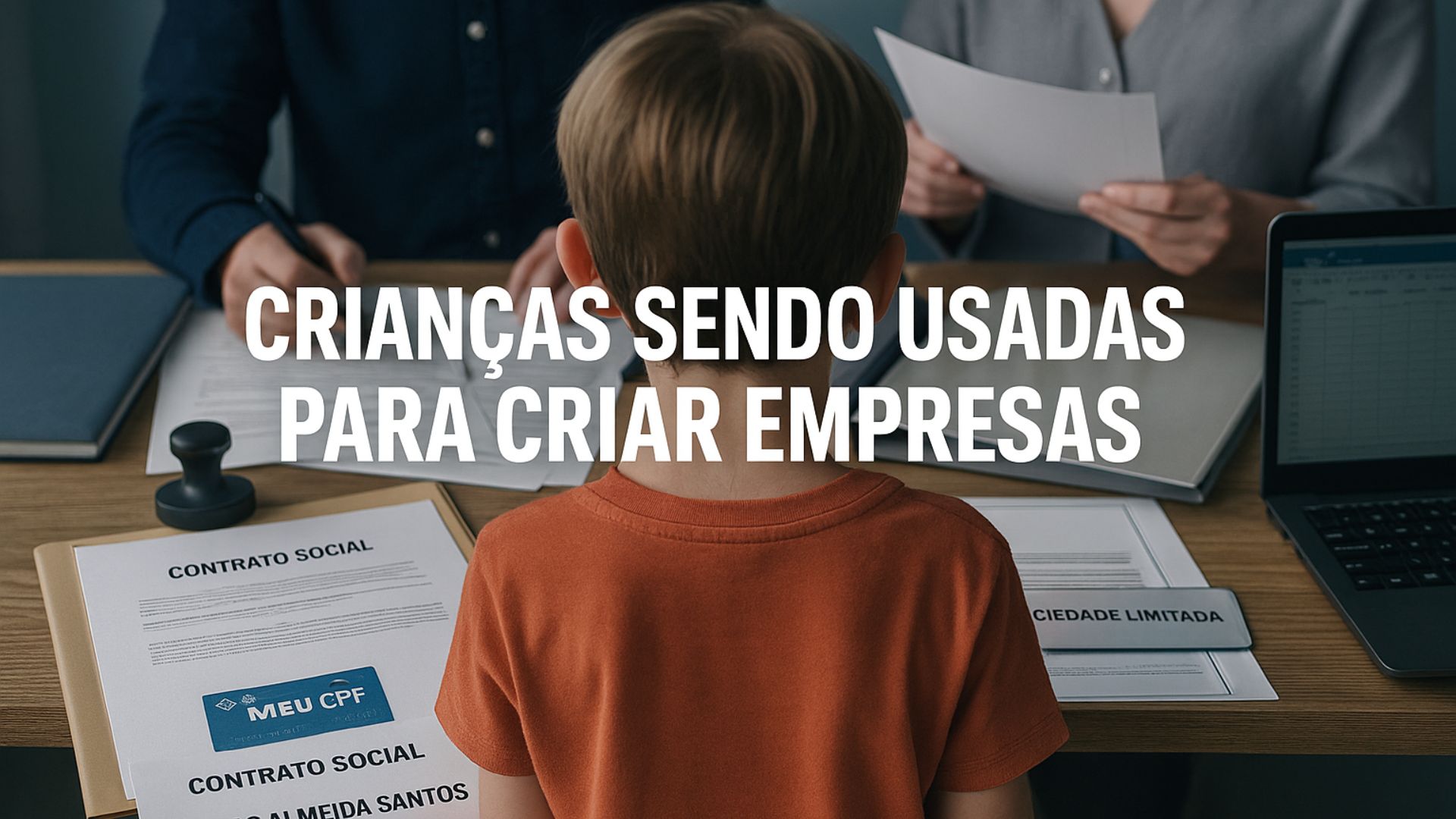
More Than 60,000 Children and Adolescents Appear as Shareholders of Companies in Brazil, According to Fantástico. The Practice Is Legal, but It Has Left Young People with Million-Dollar Debts and a Dirty Name Due to Loopholes in Legislation.
Brazilian legislation allows minors to be listed in the ownership of companies.
This is where the problem begins.
Although the law prohibits children from managing the business and requires parents or guardians’ signatures on documents, the model allows for child’s CPF to be used by family members to open companies that then accumulate labor and tax debts.
-
The largest food company on the planet, JBS, has just opened a 4,000 square meter laboratory in Florianópolis to develop customized proteins that modulate muscle mass gain, immune response, and metabolic performance.

-
After nearly 30 bids and competition among industry giants, a Spanish company purchases one of the largest airports in Brazil for almost R$ 3 billion and takes over the management of Galeão in a concession that will last until 2039.

-
The Federal Revenue Service now automatically cross-references everything you declare with data from banks, credit cards, brokerage firms, and insurance companies, and any discrepancy between your income and your expenses triggers an alert in seconds.

-
Amid global tensions, Brazil blocks the United States’ proposal at the WTO and paves the way for a trade crisis and possible retaliations.


A report aired by Fantástico, from TV Globo, revealed that more than 60,000 minors are registered as shareholders of companies in the country, a number that highlights the scale of the phenomenon and reignites the debate about legal protection.

What the Law Allows and Prohibits
According to the Civil Code, minors can be shareholders, as long as they are represented (if under 16 years old) or assisted (between 16 and 18).
However, managing the business is not the child’s responsibility; it must be exercised by an adult.
Emancipated young people from the age of 16 can theoretically take on administrative roles, but the general rule is clear: minor shareholders do not manage.
In practice, the Commercial Registry and the Federal Revenue register these relationships through the ownership records, indicating the qualification of “minor shareholder (assisted/represented).”
The procedure is legal and usual in family wealth structures, quota donations, and succession planning.
The problem arises when this formality is used for domestic fraud, with a child’s CPF being inserted into companies that have no real activity or that end up closing without settling obligations.
How Debts Reaches Children’s CPF
When a company fails to pay taxes or salaries and there are insufficient assets in the CNPJ, the courts may apply the disregard of legal personality, reaching the shareholders’ assets.
In labor executions, this mechanism is frequently used to prevent the impunity of “shell” companies.
The result, in cases of abuse, is straightforward: the minor’s CPF — who has neither contracted, managed, nor received anything — appears as a target of blockages and collections, because they are formally a shareholder.
This is what Renata Furst Galvão experienced, a case revealed by Fantástico.
As a child, strangers would come to her house calling for “Renata,” and she would hide, not understanding the reason.
“Those men who came to my house were actually court officials, looking for my assets,” she recounted.
According to the report, a relative convinced her mother to authorize the use of her name and CPF to include her as a shareholder of two companies — a pizzeria and a ceramics business.
The companies operated for a short period and went bankrupt, leaving debts with the government and former employees.
Unable to find the company’s assets, thejustice directed the executions against the shareholders.
Still a child, Renata had no assets.
“I inherited only one thing from those companies: debt and a dirty name,” she reported.
When a Dirty Name Begins in Childhood
Another case addressed by TV Globo was that of André Santos.
At 15, after his mother — the majority shareholder of a shipping company — passed away, his father included him in the partnership to maintain control of the business.
Without management experience, the company collapsed.
From the age of 17, court officials began knocking on the family’s door for labor and tax debts.
Nearly three decades later, the consequences still weigh heavily: “I cannot own absolutely anything in my name, I cannot have any type of asset, I cannot have any type of money in my account,” he said in an interview with the program.
Renata also faced a marathon of restrictions in adulthood.
Upon turning 18, she was surprised by a court blockage of her own bank account to pay off a business debt.
She moved to South Africa and then to the United States, specializing in fraud prevention in the financial sector.
“I am not a person who owes money,” she stated to Fantástico, arguing that the use of a child’s document in these conditions constitutes identity theft.
After years of disputes, she managed to clear her name in Brazil at the age of 28.
Legal Loophole Between the Civil Code and the ECA
Experts point to a mismatch between the Civil Code, which allows minors to participate as shareholders with representation, and the Child and Adolescent Statute (ECA), which embodies the constitutional principle of absolute priority.
According to the investigation by Fantástico, legal scholars assert that civil legislation retains traces of an outdated view, in which children are treated as extensions of their parents.
For Professor Vivianne Ferreira from FGV, there is a “disparity in treatment”: the civil system admits minors as part of the ownership structure but does not establish sufficient safeguards to prevent the inclusion from serving as a shortcut for fraud.
In her view, the reforms being discussed have been timid in this aspect and should provide for the direct accountability of parents or guardians in cases of bad faith, preventing young people from discovering, upon reaching adulthood, a liability they never incurred.
Changes Under Debate in Congress
In Congress, the modernization of the Civil Code has returned to the agenda.
In September, the Senate established a temporary committee to analyze the proposal for updating the 2002 text.
The debate covers hundreds of provisions, including family issues and protection of the vulnerable.
While there is no explicit change regarding the participation of minors as shareholders, legal scholars suggest calibration on three fronts:
- Requirement for an identified jointly responsible party when the shareholder is a child;
- Explicit prohibition on ascribing minors in operational companies without patrimonial, educational, or succession justification;
- Strengthened verification process, including document analysis and communication to the Child Protection Council in atypical cases.
The TV Globo program also pointed out that lawyers have advocated for adjustments in the execution process, so that the disregard of legal personality considers the age and legal capacity of the shareholder.
Thus, automatic blockages would stop affecting children’s CPFs, prioritizing accountability of those who actually managed the company.
Parents and Guardians Can Be Held Responsible
Holding parents or guardians who, fraudulently, enroll children as shareholders of problematic companies accountable is seen as a corrective measure.
In this scenario, the signature of the representatives, which currently serves as formal consent, would also act as an anchor for patrimonial responsibility in cases of default or fraud, protecting the minor’s CPF.
This is the type of change that experts advocate for closing the loophole without compromising legitimate family planning structures.
While adjustments have yet to be made, lawyers recommend caution.
The inclusion of children in companies must have a clear and demonstrable purpose, with documentation of the source of capital, real contribution of quotas, and management by a capable adult.
In already initiated disputes, defenders have resorted to evidence of the absence of management, consent, and economic benefit on the part of the minor to lift blockages, in addition to requesting that the execution first reach the effective administrators.
Victims Ask for Changes in the Law
Renata summarizes the personal impact: “The CPF of a child being used is identity theft, because that child cannot authorize.”
In her case, being classified as a shareholder occurred without understanding and without any benefit.
Years later, the consequence was the clogging of her civil life, with restrictions on opening accounts, contracting services, and performing everyday actions.
A similar situation is recounted by André, who remains unable to accumulate assets.
The accounts, revealed by Fantástico, illustrate how a corporate formality, conceived for legitimate purposes, ends up, in certain contexts, exposing minors to a risk that the system should neutralize.
If the inclusion of minors in the ownership structure is legal and, in many family arrangements, harmless, how can safeguards be constructed to ensure that the rule does not continue to serve as a shortcut for domestic fraud and for the indebtedness of those who could not even consent?







-

-

3 pessoas reagiram a isso.