





 Portuguese
  English
  Spanish
  5 min of reading
  0 comments


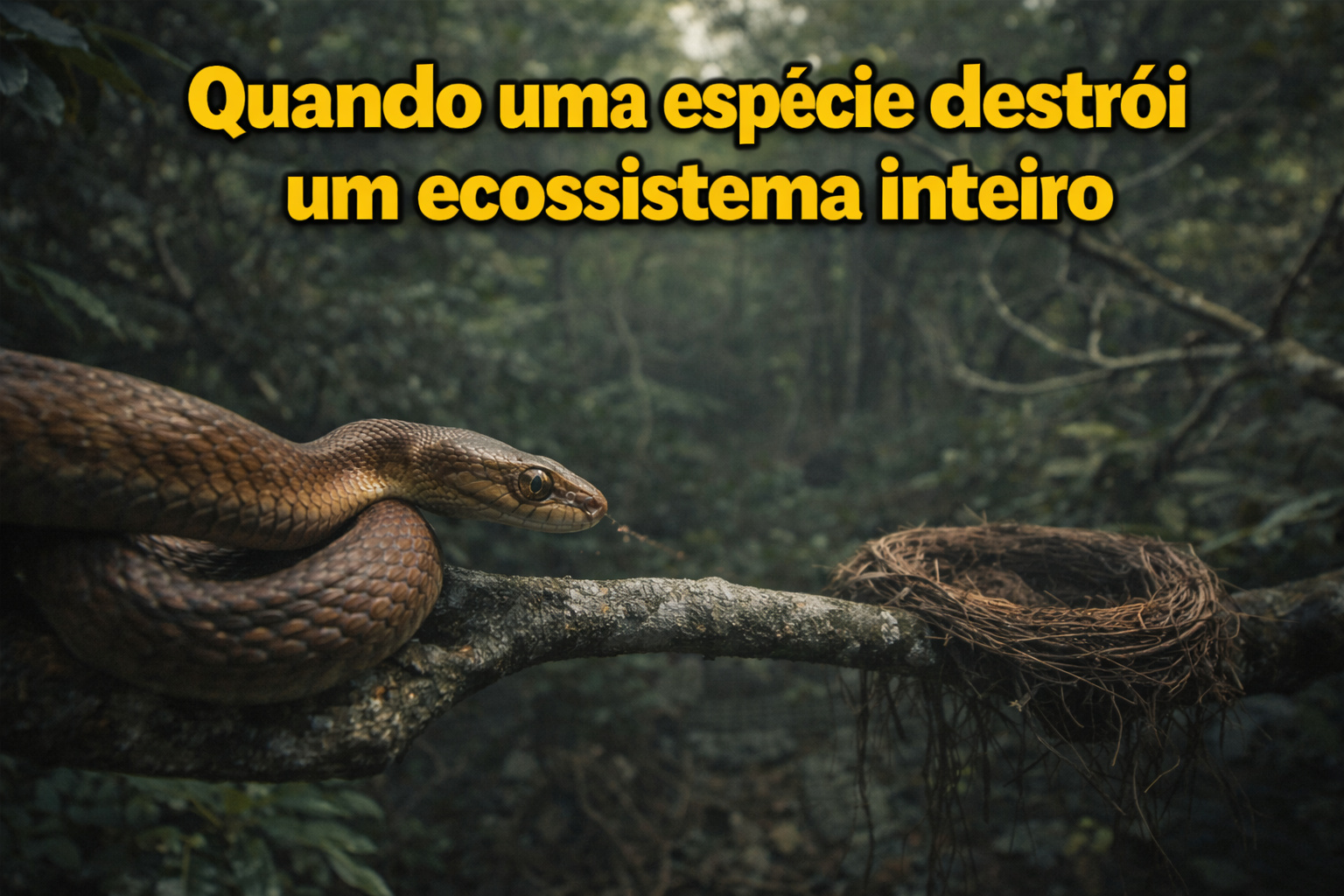
The Introduction of an Invasive Snake Eliminated Over 90% of Guam’s Native Birds, Caused Blackouts, Ecological Collapse, and Became a Global Study on Invasive Species.
Right at the beginning, it is important to clarify where this happened and why the case is so serious. The collapse occurred on the island of Guam, a U.S. territory in the Pacific Ocean, and is now considered one of the greatest ecological disasters ever caused by a single invasive species in an insular environment. The agent of this radical transformation was the brown tree snake (Boiga irregularis), a predator accidentally introduced in the post-World War II period, likely through military cargo from the southwestern Pacific.
In just a few decades, this single species was able to eliminate over 90% of the island’s native forest birds, cause definitive local extinctions, alter the functioning of the forests, generate million-dollar economic impacts, and turn Guam into a classic case cited in books, UN reports, and high-impact scientific journals such as Science, PNAS, and Nature Ecology & Evolution.
The Silent Arrival of the Snake That Changed Everything
Before the introduction of Boiga irregularis, Guam had a fundamental characteristic: there were no efficient arboreal predators capable of hunting birds in nests, canopies, and trunks. Local species evolved over thousands of years without nocturnal predatory pressure, without defense behaviors, and without threat recognition.
-
The heatwave in Brazil that hit in March is set to end as a cold front arrives between Good Friday and Easter Sunday, causing a temperature drop of up to 6 degrees and rain in the Central-South region, according to the Easter weather forecast.
-
The U.S. Army has introduced its first new lethal grenade since the Vietnam War: the M111 kills using pressure shock waves that bounce off walls and can explode the enemy’s lungs without producing a single shard.

-
Engineers are replacing pressure valves with hydraulic microturbines within drinking water networks and are generating up to 1,100 MWh per year with in-pipe hydropower technology that harnesses energy previously wasted in urban pipelines.

-
Elon Musk focused on Brazil and lowered the price of Starlink, his internet service, but the question remains: is it worth it? An expert provides a detailed analysis of the internet that promises to connect any part of Brazil.




The brown tree snake therefore found a completely unprepared ecosystem. It is a nocturnal species, extremely agile, capable of climbing trees, smooth trunks, and human structures with ease, and has a highly flexible diet. It feeds on eggs, chicks, and adult birds, primarily attacking at night when the birds are most vulnerable.
This evolutionary imbalance created the perfect scenario for a rapid collapse. In just a few decades after its introduction, bird populations began to decline continuously and irreversibly.
The Disappearance of Entire Species on a Single Island
Studies conducted by the U.S. Geological Survey (USGS) and the Smithsonian Institution documented a shocking fact: 10 of the 12 species of native forest birds in Guam have completely disappeared from nature. Some survived only in captive breeding programs outside the island, while others have never been seen again.
The impact was not gradual but accelerated. During certain periods, researchers recorded population declines greater than 80% in less than 20 years, a rate incompatible with any natural recovery.
This phenomenon led to the emergence of a term now widely used in scientific literature: “silent forests”, entire areas without the sound of birds, without movement in the canopies, and without active seed dispersal.
When the Loss of Birds Disrupts the Functioning of the Forest
The extinction of birds in Guam did not mean merely the loss of charismatic species. It directly affected the basic functioning of the ecosystem. Frugivorous birds were responsible for seed dispersal, forest regeneration, and insect control.
With the disappearance of these species, a cascading effect occurred. Plant regeneration began to fail, invasive plants started to dominate previously balanced areas, and natural insect control collapsed. Research published in PNAS showed that in areas without birds, the density of spiders was found to be dozens of times higher than in comparable areas with the presence of birds.
This type of imbalance changed the composition of the forest, the soil structure, and even the nutrient cycling, showing that the loss of birds affects much more than just the sky above the forests.
An Environmental Problem That Turned Into an Economic and Urban Crisis
The advance of the brown tree snake was not limited to the forests. It began to occupy urban areas, transmission lines, and energy structures. Guam started to experience frequent blackouts caused by snakes climbing poles and causing short circuits.
Official reports indicate more than a thousand interruptions in electricity supply per year directly associated with the presence of the invasive species. The accumulated cost over the decades amounts to tens of millions of dollars, including maintenance, economic losses, and investments in control.
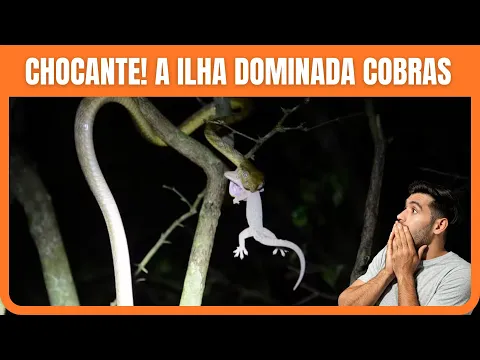
Additionally, the snake poses a risk to public health, especially for small children, as its venom, though rarely lethal to adults, can cause serious accidents.
The Living Laboratory for Combating Invasive Species
Given the magnitude of the disaster, Guam has turned into a true global laboratory for controlling invasive species. The U.S. Fish and Wildlife Service, in partnership with universities and research centers, has begun testing unprecedented containment strategies.
Among them, the use of air-dropped bait containing acetaminophen gained notoriety, a method based on the fact that the substance is lethal to the brown tree snake in controlled doses but poses minimal risk to other species when applied with strict criteria.
Furthermore, physical barriers, exclusion zones, trained detection dogs to find snakes in cargo, and constant monitoring of sensitive areas have been implemented. Nevertheless, the researchers themselves acknowledge that complete eradication is practically impossible.
Why Guam Became a Global Reference in Conservation
Today, the case of Guam is cited in UN reports, documents from the Convention on Biological Diversity, and biosafety programs of countries such as New Zealand, Australia, Japan, and Hawaii. The scientific consensus is clear: preventing the introduction of invasive species is infinitely more efficient than trying to remediate afterward.
Guam has shown that a single failure in transportation protocols can generate irreversible impacts, especially on islands, where ecosystems are more fragile and isolated.
The Alert That Remains
Decades later, Guam has still not recovered. Many birds will never return. What remains is a permanent alert for the modern world, where cargo ships and airplanes cross the planet daily.
The ecological collapse of Guam was not caused by deforestation, mining, or industrial pollution. It was caused by a single species introduced unintentionally, but with devastating consequences.
The question that remains is not whether this can happen again.
It is where the next Guam will be — and whether the world will realize before it’s too late.






-

-

-

-

-

28 pessoas reagiram a isso.