





 Portuguese
  English
  Spanish
  6 min of reading
  0 comments


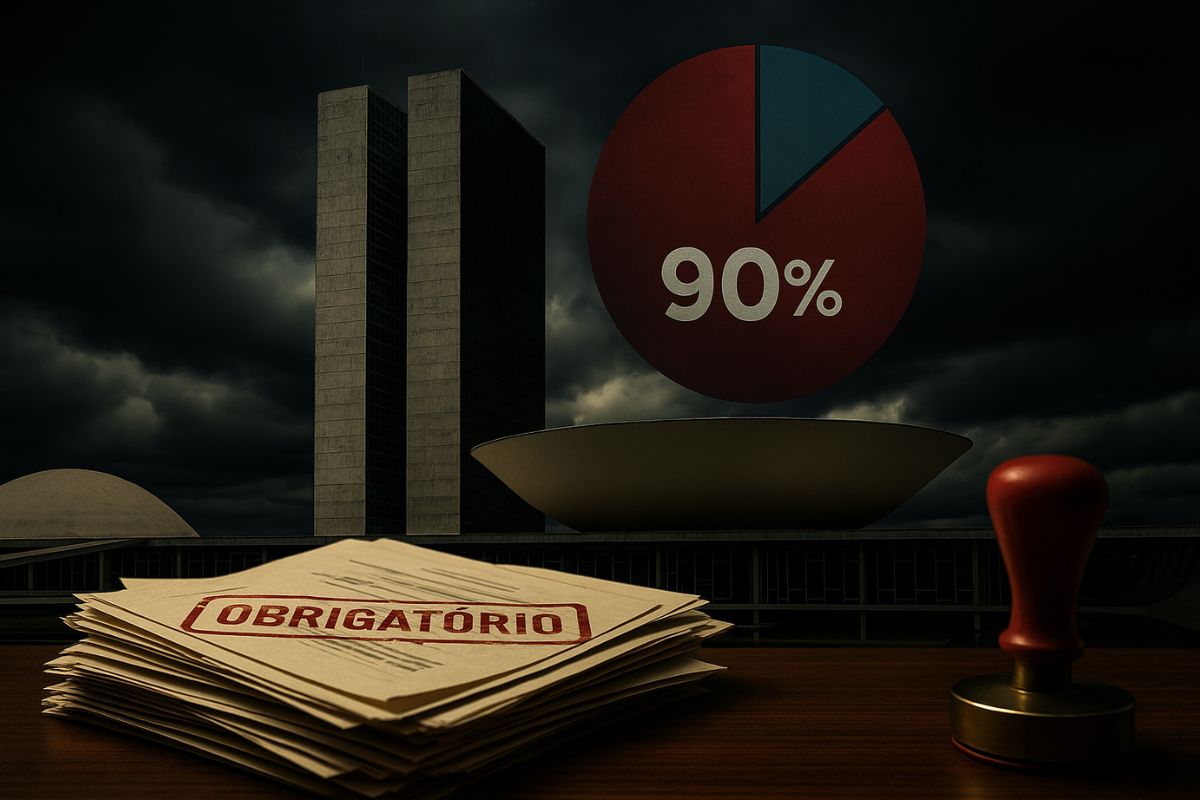
According to Economist Bruno Musa, The Public Machine Will Enter Operational Collapse by 2027: Mandatory Spending Exceeds 90% of the Budget and Suffocates Health and Education.
The Brazilian public machine operates increasingly rigid. According to Bruno Musa (economist, professor, and entrepreneur), mandatory spending now exceeds 90% of the budget, leaving less than 10% for daily expenses and essential policies — such as health and education. At this rate, by 2027 the State “will stop”, because the space for discretionary spending would be insufficient even to meet constitutional minimums.
Musa argues that the situation results from the continuous expansion of earmarked spending and decisions that increase expenses without productivity counterbalances. He also associates the scenario with high deficits, debt on an upward trajectory, and high interest rates, which impact exchange rates, inflation, and public services. In this article, we gather — in a didactic and impartial way — the main points raised by the economist, what they mean in practice and how this relates to the real functioning of the public machine.
What Does “The Public Machine Stops” Mean in 2027
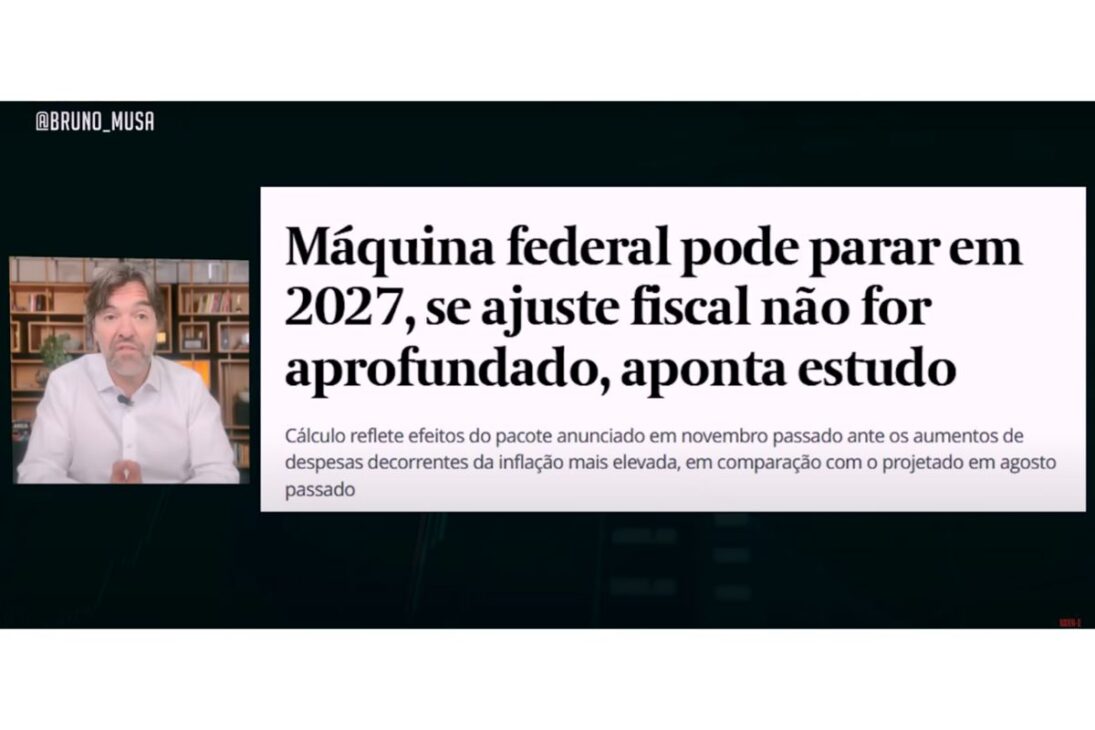
Discretionary spending (operating expenses, maintenance, purchases, investments, agreements) would be squeezed to the point of not even covering the minimums of health and education, which would require constant cutbacks and reallocations.
-
Oil surged to $115 a barrel due to the war in the Middle East, and diesel in Brazil has already risen to R$ 7.45 per liter, while the United States…

-
Brazilian city bets on the business environment to generate jobs and attract investments in the energy sector — secretary reveals strategy at Macaé Energy 2026.

-
50 viaducts, 4 tunnels, 28 bridges, and 40 kilometers of bike paths: BR-262 in Espírito Santo will receive 8.6 billion reais for the largest engineering project in the state’s history, inspired by the Immigrant Highway in São Paulo.

-
Brazil produces too much clean energy and doesn’t know what to do with it: over 20% of solar and wind capacity was wasted in 2025 while investors flee and 509 renewable generation projects were abandoned in the last year.

In practical terms, the public machine begins to act reactively: delays in maintenance, queues for services, stalled projects, and cancelled investments.
The greater the weight of expenses that cannot be cut (pensions, personnel, benefits, and linkages), the less capacity there is to respond to local demands — from a health center to a school.
How Much Is Mandatory Spending — And What Is Left Out
According to Bruno Musa, more than 90% of the budget is already earmarked by legal/constitutional rules. Thus, less than 10% is left for everything else.
It is in this “remaining” budget that the services visible to citizens live, including health and education beyond the legal minimum, as well as investments in infrastructure and maintenance.
The central point made by the economist: if mandatory spending grows faster, the discretionary space shrinks.
When this happens, investments are the first to die, then maintenance declines (which raises future costs), and, finally, even the constitutional minimums become at risk, requiring emergency cuts and very short-term solutions.
Why 2027 Has Become a Red Line
Musa states that official reports already indicate 2027 as the year when the public machine will hit the operational limit, with no space for the constitutional minimum in health and education within the current regulatory framework.
The reason would be a combination of trends: pressured mandatory spending, insufficient revenue to keep up, and low growth.
When the curve of “incompressible” expenses meets the curve of revenues, the government loses degrees of freedom.
It becomes more difficult to adjust policies without cutting services or raising taxes. It is this shock — between spending rigidity and revenue limitations — that, according to the economist, stalls the machine.
Minimum Wage, Productivity, and the Fiscal Account
In Musa’s diagnosis, real adjustments to the minimum wage without gains in productivity put pressure on mandatory spending and tied benefits, increasing the fiscal effort.
He argues that, with stagnant productivity, rising costs tend to come from the budget (in the case of the public sector) or push formal workers out (in the private sector), driving them towards informality.
The critique is not aimed at the purchasing power of workers, but at the mechanism: without investment in education and technology that boosts productivity, the real adjustment returns as pressure on deficits, debt, and interest — a gear that drains the little discretionary spending that remains for health and education.
Deficits, Debt, and Interest: The Cycle That Tightens the Budget
Musa distinguishes between primary deficit (spending minus revenue, excluding interest) and nominal deficit (including interest) and points to the latter being at a level close to 10% of GDP — something that, combined with rising debt, requires high interest rates to attract financing.
High interest rates, in turn, raise the cost of servicing the debt and consume space in the budget.
The result, according to the economist, is a vicious cycle: more mandatory spending → less investment → weaker growth → less revenue → more deficit → more debt → higher interest rates → less room for the public machine to keep functioning.
“Twin Deficits” and Balance of Payments
Another point raised by Musa is the return of the “twin deficits”: fiscal gap and current account deficit simultaneously.
He argues that the negative current account (trade balance + services/income + transfers) in the range of tens of billions annually requires external financing.
If direct investment does not cover this account, the exchange pressure increases.
With a weaker currency, inflation rises and interest rates need to stay high for longer, feeding back into the fiscal picture.
In the end, this mechanism raises the cost of public purchases, contracts, and inputs and tightens, once again, the health and education that depend on discretionary spending.
Popular Measures vs. Budget Constraints
Bruno Musa’s analysis also criticizes free proposals (such as zero fare in transportation) when there is no permanent funding source.
In his view, popular policies increase the deficit if they are not accompanied by compensation (spending cuts, efficiency gains, or stable new revenue).
This type of design amplifies spending rigidity and concentrates the adjustment in what is discretionary.
The risk, in the short term, is to push the cost to interest or exchange rates; in the medium term, to compress even more the public machine in sensitive areas.
Where the Problem Bursts First: Health and Education
When mandatory spending takes almost everything, health and education suffer in the areas that are not minimums: building maintenance, equipment, supplies, training, and expansion of supply.
This is where queues, closures, reduced class sizes, and suspension of programs appear.
Musa warns that cutting investment today increases the cost tomorrow.
A hospital without maintenance is stalled equipment; a school without investment means worse learning — and lower future productivity.
In other words, the public machine weakens both now and in the long term.
Is It Worth Adjusting? What Would Be on the Table


In the economist’s logic, adopting achievable targets, containing the expansion of mandatory spending, prioritizing efficiency, and protecting high-productivity investments (basic health, learning, essential infrastructure) rebuilds space in the budget and gives the public machine a lifeline.
He also notes that clarity of fiscal rules, predictability, and a business-friendly environment attract capital, relieve exchange rates, and lower interest rates over time.
Without this, the trend is for more compression of flexible spending and operational paralysis.
Through Bruno Musa’s lens, 2027 is an emergency alert: with more than 90% of spending earmarked, the public machine loses air and does not deliver services as it should, especially health and education.
The solution — according to him — involves disciplining the growth of mandatory expenses, protecting high social return investment, and relieving pressure from deficits, debt, and interest.
Now we want to hear from those who experience this in practice: in your city or state, where have you noticed budget restrictions hitting first — maintenance of schools, health supplies, stalled works? What adjustments do you consider viable without undermining essential services? And which recent decisions do you think have most pressured discretionary space? Leave your story in the comments — concrete experiences help illuminate the debate on how to save the public machine before 2027.









Seja o primeiro a reagir!