





 Portuguese
  English
  Spanish
  6 min of reading
  0 comments


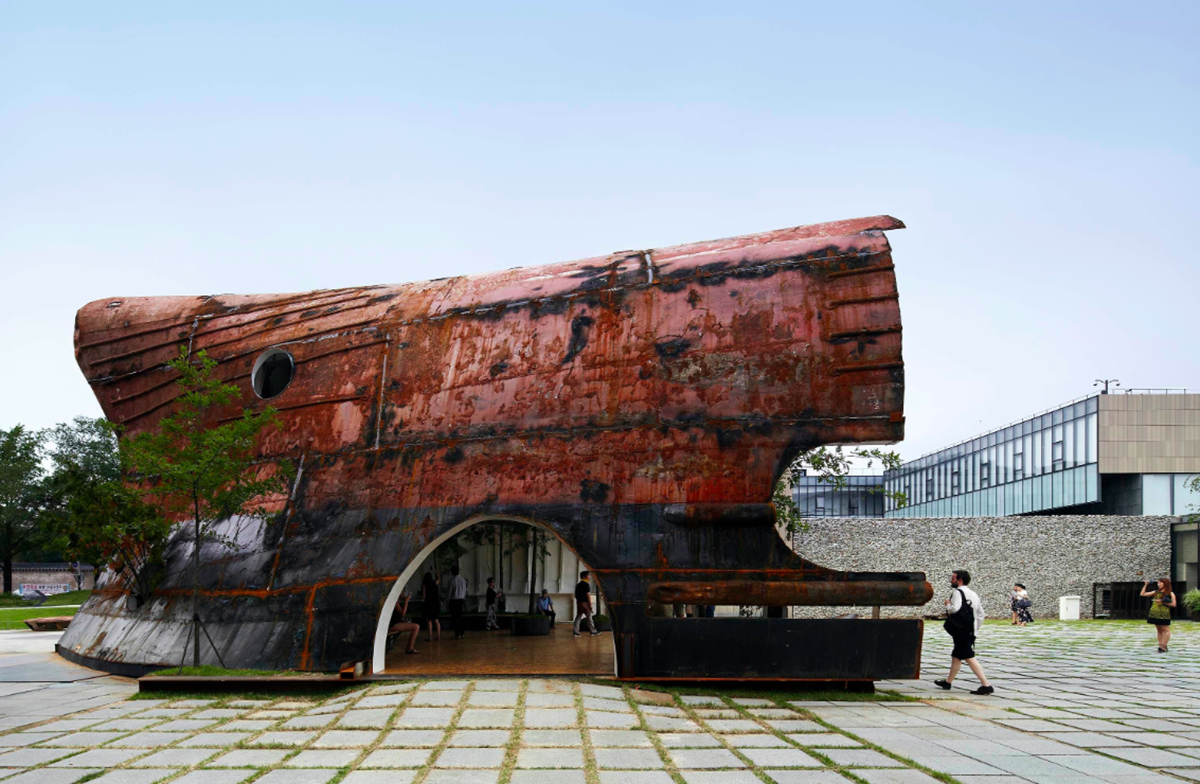
Discover the Pavilion Built from Recycled Steel of Decommissioned Warships That Cost Millions and Now Only Houses a Café. An Iconic Work That Raises Debate About Resource Use and Reuse.
In the heart of Seoul, South Korea, lies an unusual structure that blends art, military memory, and sustainable architecture. This is the Temp’L Pavilion, an architectural installation made from recycled steel of decommissioned warships, designed by the French-Korean studio Shinslab Architecture. The pavilion gained international attention for transforming military waste into an urban sculpture meant for contemplation — but, years after its construction, it now serves only as a shelter for an outdoor café.
The project, while visionary in its concept, raises important discussions about the future of material reuse in architecture and the boundaries between symbolic design and practical function. After all, how can a pavilion built from steel of decommissioned warships cost millions, yet have such limited use?
A Pavilion Made from Recycled Steel of Decommissioned Warships
The Temp’L was conceived in 2016 for the Young Architects Program (YAP) sponsored by the National Museum of Modern and Contemporary Art (MMCA) in Seoul. The goal of the competition was to create a temporary, sustainable structure accessible to the public, with a strong conceptual appeal. The winning proposal came from Shinslab Architecture, which decided to breathe new life into a decommissioned ship hull — creating an immersive, poetic, and provocative environment.
-
He started running at 66 years old, broke records at 82, and is now a subject of study for having a metabolic age comparable to that of a 20-year-old, in a case that is intriguing scientists and inspiring the world.

-
Oldest tree on the planet reappears after 130 years of searches: Wattieza, 385 million years old, was 10 meters tall and had no leaves or seeds; Gilboa fossils in New York solved the mystery in 2007.

-
A 48-square-meter house assembled in hours with 4,000 bricks made of recycled plastic that does not absorb moisture, has natural thermal insulation, and costs less than 90,000 reais in a complete kit.

-
Luciano Hang revealed that Havan’s air fleet has already accumulated more than 20,000 landings, 10,000 flight hours, and 6 million kilometers traveled, and he says that without the planes, the company would never have grown so quickly.


The base material of the installation is naval steel, taken from the hull of a dismantled military cargo ship at a shipyard in southern Korea. The ship’s structure was sectioned, transported, and carefully shaped to create a habitable sculptural space. The steel, with its marks of corrosion and dents, was intentionally left exposed — as part of the material’s memory.
The work quickly became an architectural icon. Its design resembles a capsized vessel or a post-industrial archaeological fragment. Inside the curved and dark space of the hull, visitors find a circular courtyard with planted trees and wooden benches — as if they were inside a temple.
Location: Art and Steel in One of Korea’s Largest Museums
Located in the central courtyard of the MMCA of Seoul, in front of Gyeongbokgung Palace, the Temp’L Pavilion is part of the most prestigious cultural circuit in the Korean capital. The museum promotes national and international modern and contemporary art, attracting thousands of visitors each week.
The presence of the pavilion reinforces the idea that architecture can also be critical, historical, and environmental. The structure lacks windows, doors, or divisions — it is an open space subject to interpretation and the flow of people. The only practical function incorporated since 2020 has been to house a small café with a minimalist design inside.
While this may seem minimal, the project authors claim that the goal was not to construct a functional building, but “a habitable sculpture made of recycled steel that speaks about war, time, peace, and renewal.”
Technical Data of the Temp’L Pavilion
Even though it is a temporary installation, the pavilion required cutting-edge engineering to adapt a naval hull to the urban environment of a museum. The naval steel, known for its high resistance to pressure and corrosion, needed to be treated to ensure visitor safety.
Main Technical Data:
- Source of Steel: Decommissioned military cargo ship
- Estimated Weight of Structure: 12 tons
- Usable Interior Area: Approximately 100 m²
- Maximum Height: 4 meters
- Type of Steel: Reinforced naval steel, thermally treated
- Execution Time: 6 months
- Estimated Project Cost: Between US$ 1.5 million and US$ 2 million (estimated values from contemporary reports)
The work was built at a shipyard, cut, and then transported to Seoul in modules. The final assembly was done at the museum itself, with structural metal support that is invisible to the public.
The Symbolism of Recycled War Steel
Using steel from decommissioned warships as raw material for a public artwork carries significant symbolic weight. These materials, designed for conflict, death, and geopolitical control, gain a second life as a place for rest, observation, and coffee.
This inversion of meaning lies at the core of Shinslab Architecture’s proposal. In an interview with the portal ArchDaily, the project’s lead architect stated:
“We wanted to show that even steel created to kill can be transformed into a place of peace.”
The project also proposes a critique of the linear production and disposal model of the naval and military industry. Rather than destroying the hulls, why not use them as raw material for new urban spaces?
Performative Sustainability
Despite the sustainable proposal, the pavilion also became a target of criticism. The high cost and limited use raised questions about the actual effectiveness of architectural installations like this. What started as an ephemeral cultural center now functions solely as a backdrop for a café with a few tables — and for most of the time, it remains closed or inactive.
Media outlets such as Business Insider and BBC Culture have addressed the phenomenon of “performative sustainability”: when projects are presented as green and conscious, but their functional impact is minimal. In the case of the Temp’L, the structure itself is a visual manifesto, but its practical presence in public space is minimal.
The criticism does not diminish the quality of the project but highlights the importance of combining aesthetic impact with permanent social and cultural functions.
Other Examples of Architecture with Warship Steel
The use of recycled steel from decommissioned warships has been growing in architectural projects worldwide. Here are some notable examples:
- Halifax Innovation Hub (Canada): An innovation center built with steel from a Canadian Navy destroyer, currently housing startups and collaborative spaces.
- Kobe Memorial Center (Japan): An auditorium built with naval steel from ships destroyed in the 1995 earthquake.
- Floating Library of Amsterdam (Netherlands): Built with the hull of an old ferry.
- Maritime Museum of Hamburg (Germany): Part of its cladding was made with naval steel recovered from decommissioned submarines.
These examples show that repurposing materials from the military industry can yield not only symbolic results but also functional and high-impact social outcomes.
The Future of Temp’L: Art or Abandonment?
The structure of Temp’L remains stable and in good condition. The MMCA occasionally operates the café, especially during the spring and summer months. However, there are no indications that the pavilion will be removed or gain new functions in the short term.
Architects and cultural critics suggest transforming the space into a public reading center, sound gallery, or permanent exhibition on sustainable architecture. So far, nothing has been confirmed.
Meanwhile, the pavilion stands as a monumental sculpture made from recycled warship steel, frozen in time — an icon between war and art, waste and rebirth.
The Temp’L Pavilion, built from recycled steel of warships, is a radical example of what contemporary architecture can achieve when it aims to transform material — and meaning. More than an open-air café, it is a poetic gesture: a dismantled ship that became an urban temple.
While its current functionality is limited, the symbolic impact remains powerful. It invites us to envision cities where destructive pasts can be recycled into spaces of beauty, rest, and reflection. Even at a standstill, the Temp’L quietly navigates between the concepts of war, art, and future.









Seja o primeiro a reagir!