





 Portuguese
  English
  Spanish
  4 min of reading
  12 comments


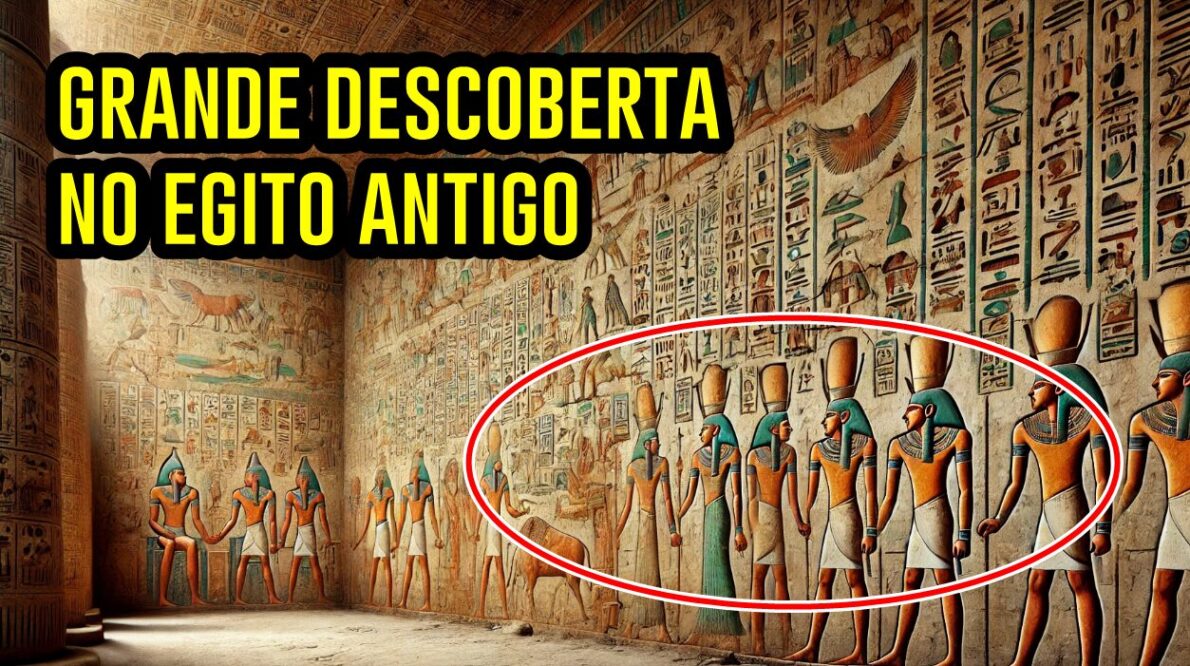

In The Egyptian Temple Of Esna, Archaeologists Unveil Ancient Paintings That Illuminate Aspects Of Ancient Egyptian Culture And Religion. See The Details Of This Fascinating Discovery And What It Reveals About History!
Dedicated to the Egyptian god Khnum, the Egyptian temple of Esna is an impressive example of temple architecture of Ancient Egypt. Located in the south of the country, this temple has survived the test of time, but not in its entirety: only the vestibule, or pronaos, remains standing.
Interestingly, it was preserved by being used as a cotton warehouse in the 19th century, thus avoiding the destruction that befell other ancient temples.
Amazing! Archaeologists Find 3,500-Year-Old Preserved Wooden Shovel In English Trench
ARTICLE CONTINUES BELOWSee also
He started running at 66 years old, broke records at 82, and is now a subject of study for having a metabolic age comparable to that of a 20-year-old, in a case that is intriguing scientists and inspiring the world.

Oldest tree on the planet reappears after 130 years of searches: Wattieza, 385 million years old, was 10 meters tall and had no leaves or seeds; Gilboa fossils in New York solved the mystery in 2007.

A 48-square-meter house assembled in hours with 4,000 bricks made of recycled plastic that does not absorb moisture, has natural thermal insulation, and costs less than 90,000 reais in a complete kit.

Luciano Hang revealed that Havan’s air fleet has already accumulated more than 20,000 landings, 10,000 flight hours, and 6 million kilometers traveled, and he says that without the planes, the company would never have grown so quickly.

Structure And Dimensions Of The Discovery In Ancient Egypt
The pronaos of Esna measures 37 meters in length, 20 meters in width, and 15 meters in height. This structure was built during the Roman period, between the 1st and 3rd centuries A.D., and is noted for the quality and sophistication of its sandstone construction.

The architecture of this vestibule was probably even more grandiose than the original temple, indicating the importance that Esna held as a sacred site at the time.
“The pronaos is a rare example of an Egyptian temple preserved amid urban development,” explains Professor Christian Leitz from the Institute of Ancient Near Eastern Studies at the University of Tübingen.
Esna’s central position, in the heart of the city, contributed to its survival, while other temples were dismantled during Egypt’s industrialization, used as a source of stones for new constructions.
Decorations Revealed After Centuries Of Darkness
Over the last 1,800 years, the temple suffered from the accumulation of soot, a result of fires lit by local inhabitants in the vestibule, which completely darkened the colors of the walls and columns.
However, a restoration effort initiated in the last six years has brought back the original beauty of the temple, with its vibrant and detailed decorations.
The restoration team, consisting of up to 30 Egyptians, unveiled the colors of the astronomical images that cover the entire ceiling of the temple and the 18 internal columns, revealing a variety of yellow and red tones that differ markedly from the colors observed in other temples, such as Dendera, where white and blue predominate.
Recent Discoveries And Their Meanings
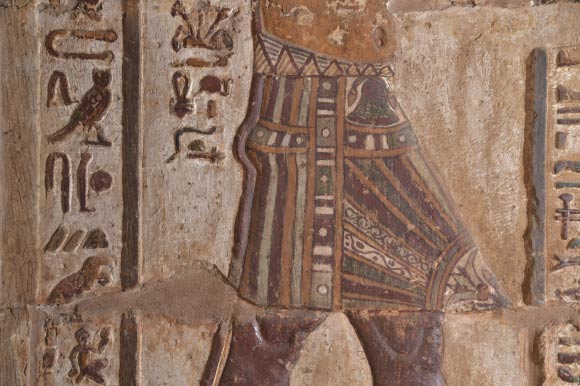
Among the most important discoveries is the wealth of details in the garments and adornments of the divine figures and the king. Professor Leitz highlights: “Previously, we could not see these details due to the thick layer of soot over the reliefs. These details are not merely decorative but also hold symbolic value in the scenes of offerings, adding a level of depth to the representations of royal and divine power.”
For instance, in a scene of offering to the goddess Neith, the team found four painted arches on the throne, possibly part of the nine traditional arches that symbolize Upper and Lower Egypt and the territories ruled by the pharaoh.
In another representation, the king’s apron features two plants: the papyrus, symbolizing Lower Egypt, and the lily, representing Upper Egypt, symbolizing the unification of the country under the king’s rule.
The Sacred Barge And The Procession Of The God Khnum
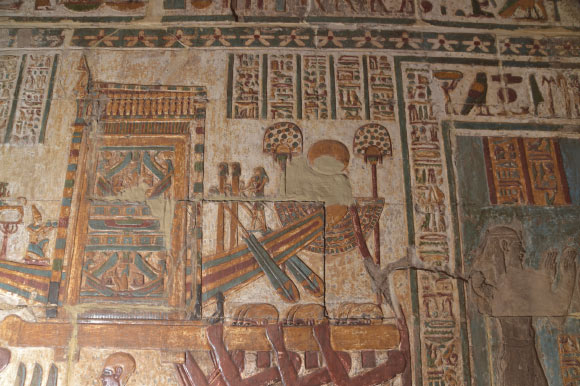
One of the most striking scenes in the temple of Esna is that of the sacred barge of Khnum. This boat, carried by priests in procession, brings the deity’s sanctuary outside the temple, allowing the local population to glimpse the sanctuary on special occasions, even though it remains closed.
For most of the year, however, Khnum’s sanctuary remained hidden, accessible only to the priests.
This discovery highlights not only the religious significance of Esna but also the importance of rituals for proximity to the divine for ancient Egyptians.









Excelente!!! Só teremos vida no futuro se conhecermos o passado
Toda Civilização passa… mas a palavras de Deus permanece ETERNAMENTE…..
Queria ver de perto coisa mais linda são essas coisas do Egito fico facinada