





 Portuguese
  English
  Spanish
  5 min of reading
  2 comments


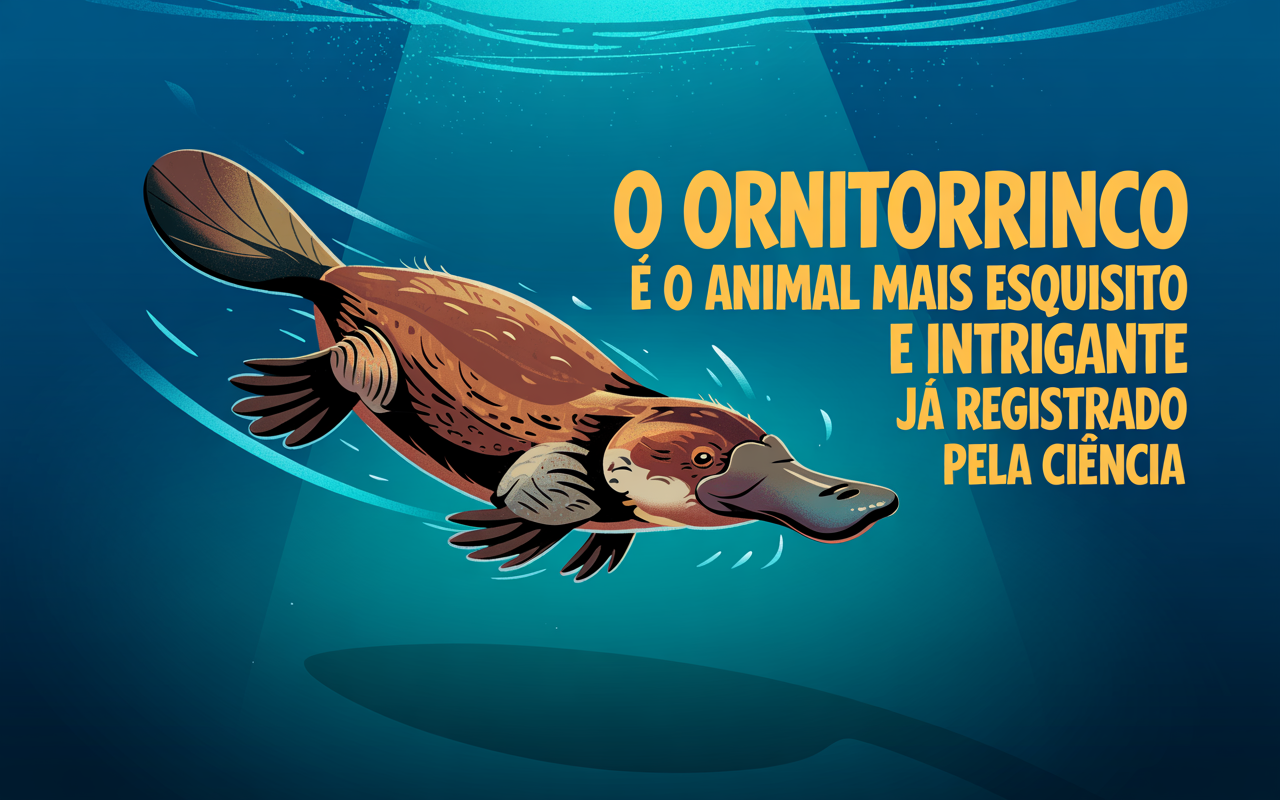


Discover Everything About The Platypus, The Strangest Animal In The World: A Mammal That Lays Eggs, Has No Stomach, Is Venomous, Hunts With Electricity, And Even Glows In The Dark. Biology Has Never Seen Anything Like It.
When the first British explorers sent platypus skins to Europe in the 19th century, many scientists believed it was a hoax. After all, how could a mammal that lays eggs, has a duck bill, a beaver tail, otter feet, and even venom glands be real? More than 200 years later, the platypus continues to intrigue science — and with good reason. This animal defies nearly all the rules of modern biology. It has no stomach, uses electrical sensors to hunt, has 10 sex chromosomes (while humans only have two), and even glows in the dark. No wonder it is among the strangest animals in the world.
The Platypus: One Of The Strangest Animals In The World


The platypus (scientific name Ornithorhynchus anatinus) is endemic to Australia and Tasmania. It lives in freshwater environments, such as rivers and streams, where it builds burrows on the banks. Despite looking like a mythical creature, it is a real and well-documented animal — although still shrouded in many mysteries.
Scientists classify it as a monotreme, a rare group of mammals that includes only the platypus and four species of echidna. Monotremes are the only mammals that lay eggs, a characteristic that dates back to the evolutionary origin of mammals.
-
He started running at 66 years old, broke records at 82, and is now a subject of study for having a metabolic age comparable to that of a 20-year-old, in a case that is intriguing scientists and inspiring the world.

-
Oldest tree on the planet reappears after 130 years of searches: Wattieza, 385 million years old, was 10 meters tall and had no leaves or seeds; Gilboa fossils in New York solved the mystery in 2007.

-
A 48-square-meter house assembled in hours with 4,000 bricks made of recycled plastic that does not absorb moisture, has natural thermal insulation, and costs less than 90,000 reais in a complete kit.

-
Luciano Hang revealed that Havan’s air fleet has already accumulated more than 20,000 landings, 10,000 flight hours, and 6 million kilometers traveled, and he says that without the planes, the company would never have grown so quickly.


Egg-Laying Mammal: An Exception To The Rule
One of the most unusual characteristics of the platypus is that, although it is a mammal, it does not give birth to live young — instead, it lays eggs. After an incubation period of about 10 days, the eggs hatch, and the offspring are fed with milk produced by mammary glands, but without nipples: the milk flows through grooves in the mother’s skin.
This makes the platypus one of the few living representatives of an evolutionary stage between reptiles and modern mammals.
Stomach-less Animal: How Does It Digest?
Another surprising fact: the platypus does not have a stomach. That’s right. It has no gastric acid or a stomach chamber like most vertebrates.

Instead, its esophagus connects directly to the intestine. This condition is extremely rare and shared only by a few other fish and amphibians. Scientists believe the platypus lost its stomach over the course of evolution because its diet, primarily composed of small aquatic invertebrates, does not require acidic digestion.
Hunting With Electricity: A Natural Radar
During underwater hunting, the platypus closes its eyes, nostrils, and ears. This raises the question: how does it see its prey? The answer lies in one of the most fascinating senses in the animal kingdom: electrolocation.
The platypus uses electroreceptor sensors located in its bill to detect the electric fields generated by the muscle movements of prey, such as small shrimp and aquatic insects. This ability works like a kind of “biological radar,” allowing it to capture food in total darkness.
Venomous Platypus: A Stinging Mammal
Few know, but the platypus is one of the rare venomous mammals known. Males possess a spur on their hind legs connected to a venom gland, active mainly during mating season.
This venom is not lethal to humans but can cause intense pain and swelling that lasts for weeks. Studies have shown that the venom has a complex composition, with proteins that are still being investigated for possible medical uses.
It Glows In The Dark: The Invisible Bioluminescence
In 2020, a study from Mammalia Journal revealed that the platypus exhibits biofluorescence — that is, glows in the dark under ultraviolet light. Its fur emits a blue-green light, a phenomenon previously observed only in some birds, fish, and amphibians.
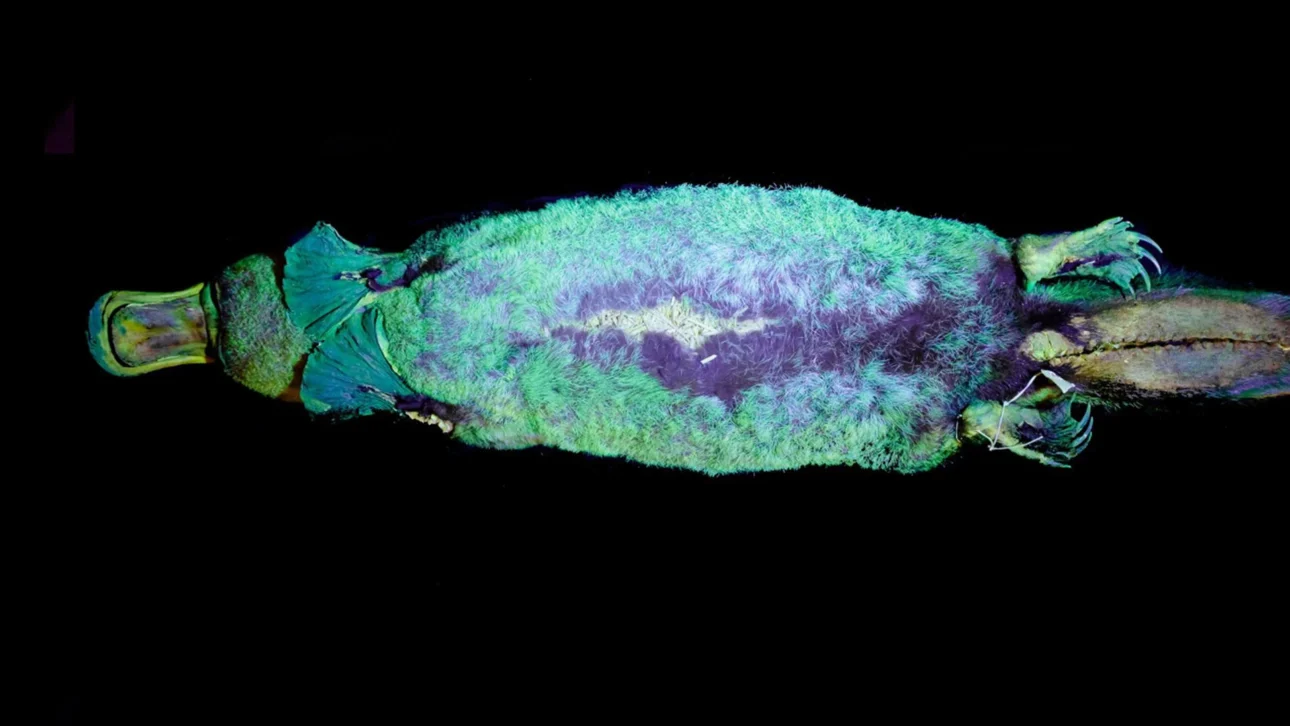
The evolutionary function of this characteristic is still unclear, but scientists speculate that it may be related to communication between individuals or camouflage.
Ten Sex Chromosomes: A Genetic Puzzle
While humans have two sex chromosomes (X and Y), the platypus has ten: five X and five Y, organized in a chain format during reproduction.
This unique system baffles scientists. Part of the platypus’s sex genes is similar to those found in birds, suggesting that current mammals and monotremes diverged over 160 million years ago. It’s as if the platypus froze an ancient chapter of evolution.
Other Curiosities About The Platypus
- Has No Teeth: although born with teeth, they fall out before adulthood. Adults grind food with keratin plates in their bill.
- Swims Like A Submarine: with webbed feet and a flattened tail, it is an excellent swimmer, capable of staying submerged for up to two minutes.
- Is Silent: the platypus rarely vocalizes, which makes it difficult to observe in the wild.
- Species Threats: although not classified as endangered, its habitat is being degraded by climate change and pollution of Australian rivers.
Why Does The Platypus Fascinate Science So Much?
The platypus is considered by many to be the strangest animal in the world because it challenges several taxonomic boundaries. It is a true “Frankenstein” of nature, bringing together traits of reptiles, birds, and mammals. For this reason, it is used as a model in various fields of science:
- Evolution Of Mammals
- Pain Studies For Pharmaceutical Purposes
- Comparative Genetics Research
- Advanced Sensory Systems
Moreover, its genome was fully sequenced in 2008, revealing over 18,000 genes, many of them hybrids of different animal classes.
The Platypus In Popular Culture
As bizarre as it may seem, the platypus gained fame in pop culture thanks to the character Perry The Platypus from the cartoon “Phineas and Ferb.” The series helped to expose the animal to new generations, albeit in a caricatured way.
In Australian Aboriginal tradition, the platypus also has a symbolic role, often seen as a sacred being due to its uniqueness.
The platypus is not just an exotic animal from Australia. It is a living enigma of modern biology, bringing together traits that challenge scientific categorization. Among the strangest animals in the world, it stands out not only for its appearance but also for its behavior, genetics, and almost incredible sensory capabilities.
If there is a creature that proves that evolution is a process full of surprises and improbable adaptations, that creature is the platypus.









Não acredito na evolução, achar que um **** tão fascinante como o Ornitorrinco surgiu do nada e evoluiu milhares de anos até desenvolver essas habilidades exige muita fé dos cientistas. Principalmente por ser um processo que nunca poderia ser visto para ser confirmado e é baseado apenas em teorias.
Excelente trabalho sobre uma espécie de mamífero que é um elo notável de evolução das espécies
Parabéns pelo conteúdo científico