





 Portuguese
  English
  Spanish
  5 min of reading
  0 comments


The Volkswagen Golf Is The Best-Selling Popular Car In The World, Surpassing Beetle And Uno With Over 34 Million Units Sold In 50 Years Of History.
When it comes to popular cars, many Brazilians immediately think of models like the Beetle, the Gol, or the Uno. After all, these vehicles marked an era and dominated the streets of the country for decades. However, few know that the title of the best-selling popular car in the world belongs to another model — a European hatchback that has conquered the planet and, in 2024, exceeded the impressive mark of 34 million units sold globally: the Volkswagen Golf is considered the best-selling popular car in the world.
Yes, it is. Created to replace the iconic Beetle in the 1970s, the Golf ended up charting an even more successful trajectory, with a solid presence in over 150 countries and a legacy that spans eight generations, always combining performance, economy, and modern design.
Volkswagen Golf: The Best-Selling Popular Car In The World
The Golf is officially the best-selling popular car in the history of the automotive industry. The figure of 34 million units was confirmed in 2024 through data released by Volkswagen itself, placing the model ahead of heavyweight rivals such as:
-
He started running at 66 years old, broke records at 82, and is now a subject of study for having a metabolic age comparable to that of a 20-year-old, in a case that is intriguing scientists and inspiring the world.

-
Less than a Tera TSI, up to 710 km of range and charging in 9 minutes: the new BYD Song Ultra expands the Chinese brand’s bet on increasingly faster, more technological, and competitively priced electric SUVs.

-
Oldest tree on the planet reappears after 130 years of searches: Wattieza, 385 million years old, was 10 meters tall and had no leaves or seeds; Gilboa fossils in New York solved the mystery in 2007.

-
A 48-square-meter house assembled in hours with 4,000 bricks made of recycled plastic that does not absorb moisture, has natural thermal insulation, and costs less than 90,000 reais in a complete kit.


- Toyota Corolla
- Ford F-Series
- Volkswagen Beetle
- Honda Civic
- Toyota Hilux
- Chevrolet Silverado
The most curious thing is that, even being a vehicle associated with the European audience, the Golf gained prominence in Brazil and still maintains a strong group of enthusiasts and collectors — especially from the GTI generations.
Launched to Replace the Beetle, the Golf Became a Global Phenomenon
The Volkswagen Golf was launched in 1974 with the humble mission of replacing the legendary Beetle, which was already showing signs of technical and aesthetic aging. Unlike the air-cooled rear engine of the Beetle, the Golf brought a new standard: front engine, front-wheel drive, straight lines, and superior dynamic behavior.
From the beginning, the car was designed to please both urban drivers and those seeking versatility for trips and family use. With this proposal, the first generation of the Golf quickly became popular among European audiences — and soon spread to other continents.
A Car With Sporty Performance – Know The Details Of The Best-Selling Popular Car In The World
One of the secrets to the Golf’s success was its ability to adapt to various consumer profiles without losing its identity. The most emblematic version of the lineup is undoubtedly the Golf GTI, also launched in 1976. The model combined the appeal of a sports car with the price and maintenance of a popular car.
This made the GTI a global reference in the segment of sporty hatchbacks, helping to solidify the Golf’s image as a reliable, fun-to-drive, yet accessible vehicle.
Even the entry-level versions of the Golf have always shown good results in consumption, safety, and performance, consolidating its reputation as a complete popular car.
More Than 50 Years In Brazil: A Relationship Of Ups And Downs
In Brazil, the Golf officially landed in the 1990s, imported from Europe. But it was from the early 2000s that the model began to be produced on national soil, at the plant in São José dos Pinhais (PR). The nationalized generation was a huge success, especially in the GTI version with a 1.8 turbo engine.
Over the following decades, the Golf enjoyed periods of great popularity in the country, always seen as a premium option among popular cars. However, the arrival of compact SUVs, like the T-Cross, and Volkswagen’s global strategy to prioritize electric and SUV models led to the end of Golf production in Brazil.
Still, used units from generations 4, 5, 7, and even imported from generation 8 are highly sought after by enthusiasts of robust and well-equipped hatchbacks.
Golf Surpasses Beetle, Gol, And Uno In Global Sales
For many, the idea that the Golf has sold more than the Beetle, which dominated Brazil for decades, may seem surprising. But the numbers don’t lie:
- Volkswagen Golf: +34 million units
- Toyota Corolla: +50 million (but with significant changes in style and platforms over the years)
- Volkswagen Beetle: 21.5 million
- VW Gol (Brazil): about 8.5 million
- Fiat Uno: about 10 million (including old and new versions)
It’s worth remembering that the Golf maintained a consistent visual and structural identity, with MQB platform in recent generations, while other competitors underwent drastic transformations over time.
For this reason, many experts consider it the true champion among cars that maintain the original spirit of the project, even after decades of evolution.
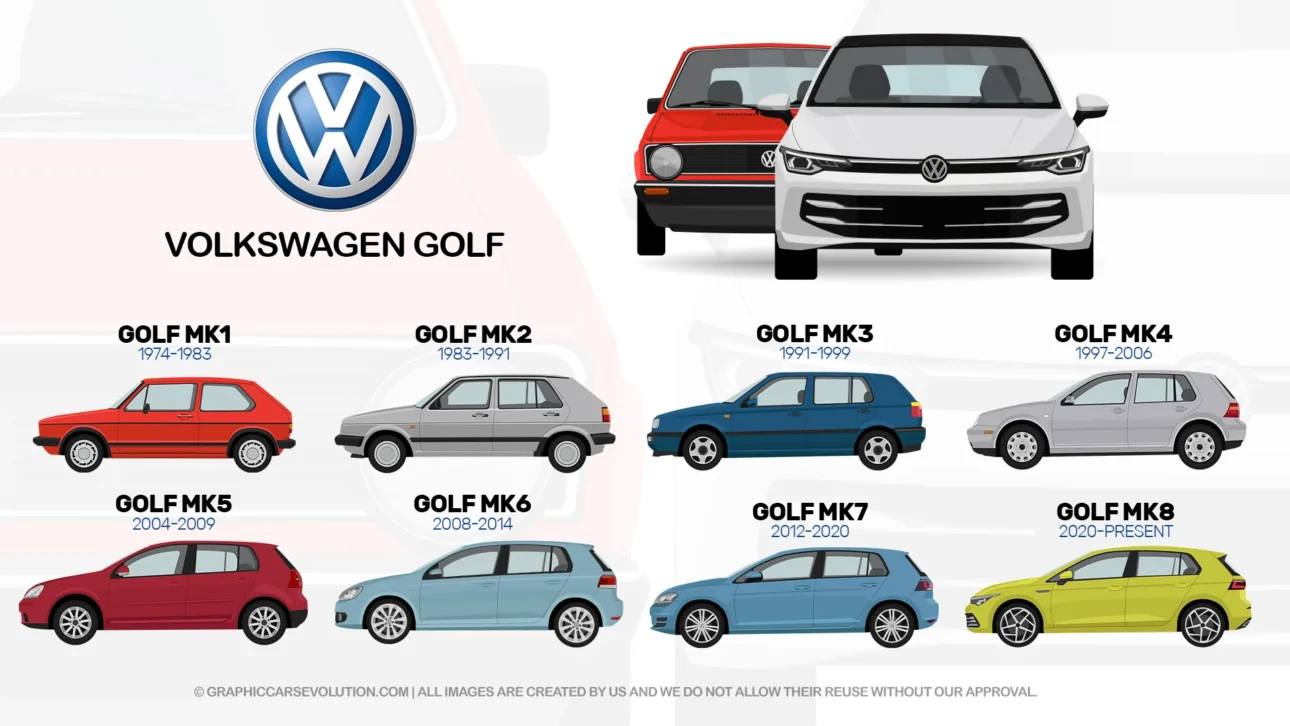
The Eight Generations Of The Golf: Constant Evolution
One of the factors that helped the Golf stay on top for so many years is its ability to update without losing its essence. Here’s a summary of the eight generations:
1st Generation (1974–1983)
The pioneer. Brought front engine, front-wheel drive, and started the GTI line.
2nd Generation (1983–1991)
Larger and safer, with diesel and all-wheel drive versions.
3rd Generation (1991–1997)
Innovation in safety: airbags, ABS brakes, and traction control.
4th Generation (1997–2003)
Popular in Brazil. Marked the beginning of the GTI with a turbo engine.
5th Generation (2003–2008)
Smoother design, new platform, and better performance.
6th Generation (2008–2012)
Refinement in finish and standard equipment.
7th Generation (2012–2019)
Built on the MQB platform. Great global success.
8th Generation (2019–Present)
More digital design, 100% virtual cockpit, and plug-in hybrid versions in Europe.
Why The Golf Is Considered The Most Balanced Car In History?
Throughout its eight generations, the Golf has always been a benchmark in:
- Mechanical Reliability
- Balanced Consumption
- Active And Passive Safety
- Superior Driving Dynamics
- Building Quality
Additionally, the model manages to connect with diverse audiences: it’s a car for young people, adults, small families, sporty individuals, and even executives who seek discretion and sophistication.
This balance between performance, practicality, and cost is what has established the Golf as the best-selling popular car in the world.
And The Future Of The Golf? Hybrid And Electric Versions On The Horizon
Although Volkswagen’s current focus is on the ID line of electric vehicles, the Golf still has a long life ahead. The eighth generation already offers plug-in hybrid versions (eHybrid and GTE) in Europe, and the brand confirmed that the 9th generation Golf will be 100% electric — while keeping the original name and proposal.
In other words, even in the face of the automotive sector’s electrification, the Golf will remain one of the brand’s most relevant cars, now revamped for the challenges of the 21st century.
Golf Is More Than A Car — It Is A Global Popular Icon
Surpassing the Beetle, Gol, and Uno in sales is no small feat. The Volkswagen Golf achieved this by combining what everyone expects from a car: economy, performance, reliability, and comfort. And even being labeled as a European car, it managed to take root in Brazil, where it is revered for its history, especially in the GTI versions.
For all these reasons, the Golf is — rightfully so — the true best-selling popular car in the world. And all indications suggest that we will still hear a lot about it in the coming years, now in its electric version.








Seja o primeiro a reagir!