





 Portuguese
  English
  Spanish
  5 min of reading
  4 comments


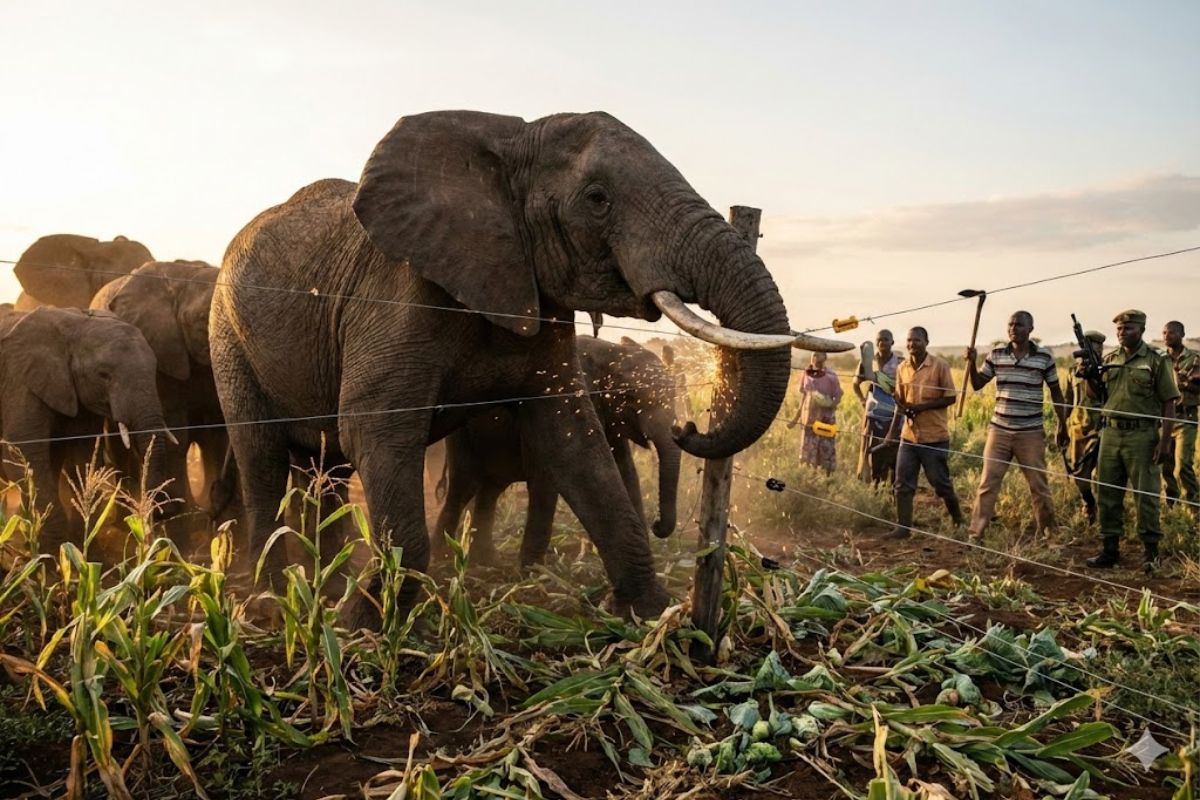


Elephants Transform Electric Fences Into Overcomeable Challenges When Discovering That Tusks Do Not Conduct Electricity, Break Fences With Repeated Technique, Access Valuable Crops, Increase Losses In Kenya And Force Wildlife Managers To Adopt Partial Tusk Removal, Reducing Damage But Creating Lasting, Complex And Persistent Ethical, Ecological And Social Dilemmas.
The African elephants living in Kenya have shown a surprising adaptation by learning to use their own tusks to break electric fences, access agricultural areas, and escalate an increasing conflict between wildlife and human communities in border regions between reserves and farms.
This behavior has forced conservation authorities to permit the partial removal of tusks from highly destructive individuals, a measure that drastically reduced damage to fences, but opened deep discussions about social impacts, ecological, behavioral, and even genetic within elephant populations.
Human Expansion And Territorial Overlap
The conflict between humans and elephants intensifies as the human population grows and occupies areas previously used exclusively by wildlife.
-
In Mexico, a 3,000-year-old Maya site with the dimensions of an entire city may have been built as a colossal map of the cosmos, created to represent the order of the universe and reveal how this people organized space, time, and rituals.

-
Japan wants to build a solar ring of 10,900 kilometers on the Moon to continuously send energy to Earth.

-
Weighing almost 1 ton, with temperatures of up to 3,000°C, the ability to launch 10,000 fragments within a radius of 1 km, capable of penetrating concrete and melting steel, Turkey’s terrifying bomb emerges as one of the most destructive non-nuclear weapons ever presented.

-
After a submarine disappeared beneath the “Doomsday Glacier,” scientists announce a new monstrous machine capable of operating at 3,000 meters depth to return to the heart of the ice and investigate a threat that could raise sea levels worldwide.

In Kenya, the annual population increase of about one million people pressures land use, leading to settlements, agriculture, and infrastructure moving into areas traditionally traversed by elephants.
This territorial overlap generates crop loss, damage to properties, risk to human life, and direct impacts on conservation, making the mitigation of this conflict one of the central priorities of environmental management in the country.
Electric Fences Stop Being A Definitive Solution

Electric fences are seen as a strategic tool to separate humans and elephants on a landscape scale.
Despite the high cost of construction and maintenance, they act as physical barriers that limit animals’ access to vulnerable areas.
The problem arose when elephants learned that tusks do not conduct electricity. Thus, they began to push electrified wires up or down until they broke them.
This technique allowed them to bring down entire sections of fence, drastically reducing the effectiveness of one of the main control strategies.
The Lewa Wildlife Reserve And The Study Scenario

The situation was analyzed in the Lewa Wildlife Reserve, in northern Kenya, an area of 62,000 acres located between altitudes ranging from 1,450 to 2,300 meters above sea level.
The reserve is intersected by two permanent rivers and includes essential wetlands for the local fauna.
The outer fence of the reserve is 142 kilometers long, 2.1 meters high, and has 12 wires alternating between phase and ground, with voltage maintained between 5 and 9 kilovolts.
Some internal zones have additional wires to protect vegetation used by black rhinoceros.
About 500 elephants live in the area, consisting of approximately 150 males and 350 females.
The age structure includes 16 percent juveniles, 36 percent subadults, and 48 percent adults.
Detailed Monitoring Of Intruding Elephants
Between September 2010 and September 2013, 1,041 incidents of fence breaches were recorded. In 816 cases, the responsible elephants were identified.
Only 67 individuals, equivalent to 13.4 percent of the local population, broke fences at least once.
Although 57 of these were females and only 10 were males, the numbers revealed a crucial insight.
Males were responsible for 94.85 percent of all incidents, showing that breaking fences was a skill concentrated in very few specialized individuals.
The average rate was four breaches per elephant every 100 days among the main intruders, a high frequency enough to cause constant damage and open passages for other animals.
Cascade Effect In The Invasions
When an elephant breaks down a fence, others pass through the same point. If the intruder is a matriarch, entire family groups can cross, with numbers ranging between six and twelve individuals.
Solitary males tend to be followed by smaller groups.
About 75 percent of the damage occurred in exclusion zones created to prevent access from large herbivores and preserve vegetation.
Other breaches happened in sections near farms growing wheat, corn, carrots, and potatoes, crops that are highly attractive to elephants.
The Decision To Remove The Tusks

In light of the recurrence of attacks, four of the most destructive males had two-thirds of their tusks removed.
The procedure was carried out under sedation, veterinary monitoring, and care to avoid exposing the central nerve.
After the intervention, the rate of fence breaches dropped between 1.67 and 14.5 times, with an average reduction of six times in attacks.

The decrease was statistically significant in both the dry and rainy seasons.
Without long tusks, elephants lost their main leverage tool used to push electrified wires. Some still attempted to break fences using head, paws, and trunk, but with much less efficiency.
Learning And Adaptation Continue
Even after partial tusk removal, observations showed that certain elephants continue to try new techniques, such as flattening posts with their feet or using the remaining parts of their tusks, even though they receive shocks during the process.
This behavior reinforces the idea that the species has a high cognitive capacity and social learning, factors that complicate permanent solutions to the conflict.
Social And Reproductive Consequences
Tusks are essential for digging roots, stripping bark from trees, extracting minerals from the soil, and competing for dominance among males.
They directly influence social hierarchies and reproductive success.
Males with reduced tusks may lose status, decrease mating opportunities, and alter the genetic dynamics of the population.
The difficulty in accessing minerals may also lead to significant nutritional deficiencies.
Ecological Impacts And Human Perception
Tusks help in feeding during dry periods and in defending against predators. Their reduction may make elephants less efficient in savanna and mountain environments, affecting survival and behavior.
There is also the aesthetic factor. Elephants without tusks present a different appearance from the classic image of the species, which may influence public perception and even tourism, a relevant sector in conservation areas.
An Effective Solution Surrounded By Dilemmas
The partial tusk removal has shown great effectiveness in reducing damage to fences and indirectly containing agricultural invasions.
By preventing the actions of a few specialized individuals, the measure also protects agricultural areas and reduces the cascade effect.
At the same time, it raises profound questions about animal welfare, behavioral changes, nutritional impacts and changes in social structures of elephants, as well as possible long-term evolutionary consequences.
In the face of increasingly intelligent and adaptable animals and communities that need to protect their crops, do you believe that physical interventions like this are an acceptable way to balance coexistence between humans and elephants?








No! We need to limit our incursions into elephants’ known areas and corridors. Kenya has vast arid and semi arid land thay we should be looking into to alter so that people can live there, in much the same way as the Israelis have turned large parts of Israel’s desert areas into highly productive, fertile land. The costs would probably be the similar to what we’re currently doing but with positive results all arouns. Mutilating and adversely affecting the lives of such an intelligent, magnificent **** hardly does us credit.
Com a lavagem do nosso dinheiro e os aumentos dos impostos vai pra Arábia Saudita, Venezuela, China e Cuba aqui só fica as migalhas
No, esa tierra es de los animales, no sería lo correcto que ellos tuvieran la prioridad. Hay países, muchos, con poca natalidad, porque no permitir que gente de ahí haga una nueva vida en otro país, todos saldría ganando, lo animales recibirían su territorio y los seres humanos no dejarían de crecer y vivir su vida.