





 Portuguese
  English
  Spanish
  7 min of reading
  0 comments


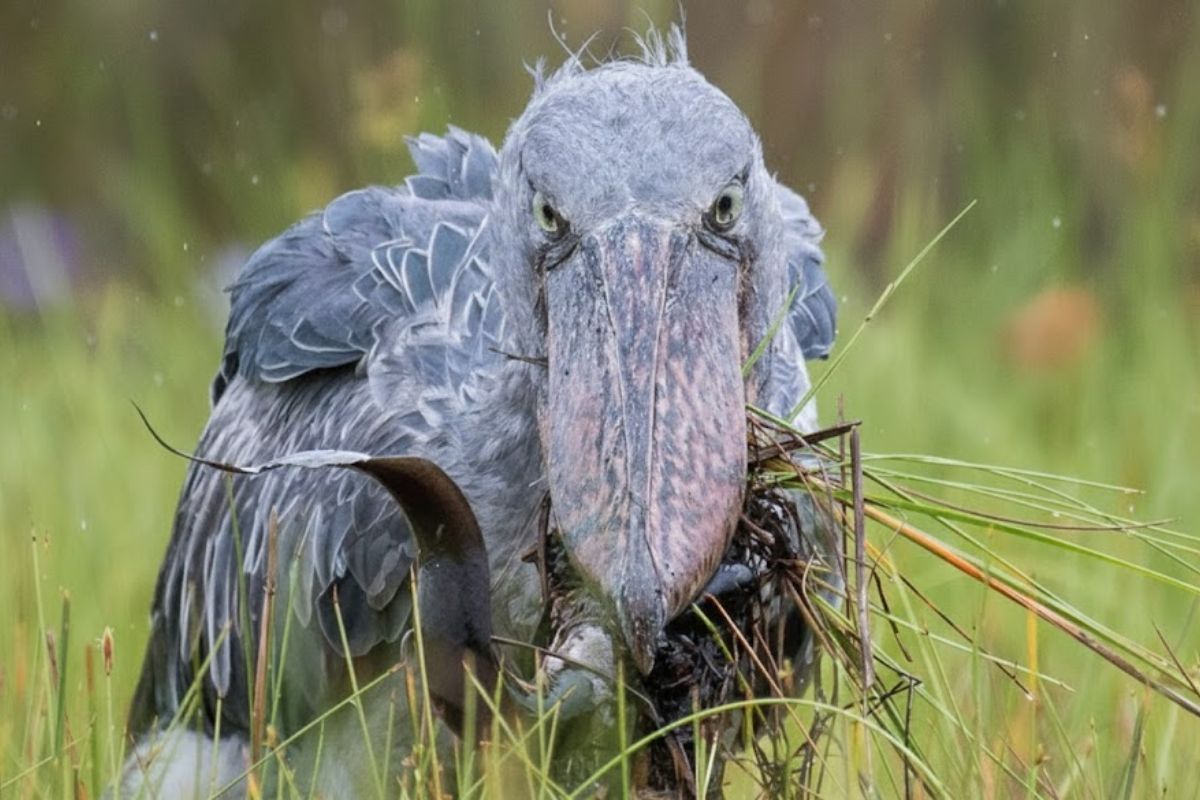
In The Swamps Of East Africa, Shoe Bills Spend Hours Motionless, Planning Attacks And Use A Huge Circumference Bill To Catch Lungfish, Bichirs, Frogs And Snakes. Over 1 Meter Tall, With Wings Measuring 230 To 260 Cm And The Sound Of A Drill, They Have Become A Symbol But Vulnerable In Decline Due To Hunting And Capture.
Shoe bills seem to have come out of a design flaw: a tall body, square head, and a bill that resembles a shoe flap, yet operating with precision. Instead of running or making a fuss, they bet on the opposite: staying still for so long that the swamp “forgets” there’s a predator there.
This strangeness is not just aesthetic. Shoe bills carry traits that make many people think of dinosaurs, and not out of exaggeration. The hunting logic, the fixed gaze, and the sound of a drill reinforce the feeling that some birds are not just birds, but the continuation of an ancient lineage specialized in surviving where almost everything is mud, water, and waiting.
A Modern Dinosaur With An Impossible Appearance

Shoe bills draw attention because they look like a mix of “parts” that shouldn’t match. Legs reminiscent of tall wading birds, a body that evokes storks, and a head that seems too angular for a swamp animal.
-
Finland, the happiest country in the world, wants to hire 140,000 technology professionals and is eyeing Brazilians: visas are issued in just two weeks and salaries with a 37-hour workweek are surprising.

-
Mr. Mário reveals the technique of the caipira papaya: he cuts the fruit in half, discards the seeds from the tip, and plants the ones from the back to increase the chance of a productive female tree.

-
Few remember, but the submarine that disappeared in 1968 with 52 crew members was found after 51 years at the bottom of the sea at more than 2,000 meters, intriguing the entire world.

-
With 1,200 tons suspended, the Japan mega-structure in a grid shape with a floating sphere from Fuji TV features two 25-story towers connected by elevated walkways, titanium panels, and impresses the world with its ability to reduce wind impact.

The result is a predator that doesn’t need to look elegant to be effective, and perhaps that’s why it causes so much discomfort in those who observe.
Even in classification, shoe bills evade the obvious: despite the nickname and appearance, they are noted as being closer to ibises and pelicans than many people imagine, appearing as a very particular group within waterfowl.
A detail that amplifies the strangeness is the mention of a confirmed ancestor, Golitia, described as a giant bird over 2 meters tall, as if size always played a part in this story.
Where Shoe Bills Live And Why The Swamp Becomes The Stage

Shoe bills are endemic to the eastern African belt and are found associated with swamps from Sudan to Zambia, with records of wandering individuals seen as far west as the Congo River.
This geographical slice helps explain why the species is so linked to wet and muddy environments, where hunting relies more on patience than on speed.
In their daily lives, shoe bills tend to be solitary. They seek swamps with a mix of vegetation and shallow water, then do what seems absurd for such a large animal: they remain motionless for long periods, on floating debris or solid areas, waiting for prey to pass by.
The strategy is simple on paper, but brutal in practice, because it turns each movement of the prey into an expensive mistake.
Size, Wings And The Paradox Of Weight In A Giant Body

Shoe bills are large enough to impose their presence even before acting. Adults can exceed 1 meter in height, and the largest on record reaches 152 cm. To support this, their wings are impressive: they range from 230 to 260 cm in wingspan, a size that favors gliding and saves effort over long distances.
The comparison with LeBron James often serves as a reality check: his wingspan of 218 cm is below what can appear in an adult shoe bill.
Even so, they flap their wings more slowly than many other birds, about 150 times per minute, which aligns with the “in no rush” style that defines the species.
Then comes another contrast: despite their size, shoe bills weigh between four and seven kilograms. This is attributed to hollow, lightweight bones, common in birds, but here becomes even more intriguing as they support such a tall body.
Additionally, there’s a functional detail: large feet, with the middle toe reaching up to 18 cm, help maintain stability in mud and debris, where the ground seems always on the verge of giving way.
The Hunt That Seems Slow, Until It Turns Into A Strike

The foundation of the success of shoe bills is choosing the right place and turning time into a weapon. They prefer areas with abundant fish and remain still until the prey “gives itself up” with a movement.
When hunting, immobility is not laziness, it’s method: the less they move, the closer the prey comes without realizing.
Among their preferred prey are the lungfish and bichir, two fish that can breathe out of water.
The logic is cruel for the prey: what would serve to escape submerged predators, when coming up to breathe, can give away the position to a lurking shoe bill.
They are also known to hunt in areas frequented by hippos, which scare fish and push them to the surface, creating easy opportunities for a patient predator.
The Bill That Looks Like A Tool And The Techniques That Scare
The shoe bill’s bill is not just large, it’s designed to solve hunting problems. The edges are described as sharp, useful for dealing with slippery and resistant prey.
The upper jaw forms a claw-like tip at the end, used for stabbing and impaling, and the set also serves to cut vegetation and expose hidden prey.
When a fish refuses to come up, shoe bills can use their own bill to unearth prey from burrows and hiding spots in the mud.
It’s ambush hunting with engineering, combining patience, strength, and a natural tool that functions as a lever, blade, and hook, depending on what the swamp offers that day.
Fish, Snakes And Crocodile Hatchlings: Why The Menu Is So Broad
Although the lungfish and bichir appear as recurring items, shoe bills are not rigid specialists.
They eat whatever they can dominate in the swamp, and the cited list includes frogs, snakes, lizards, and young crocodiles. This explains why the bird is seen as an “opportunistic” predator, able to adjust its diet according to availability.
This flexibility has an ecological logic: in environments where food may vary with season, water level, and movement of fauna, relying on a single prey would be a risk.
Shoe bills seem made not to depend on luck, but to turn any chance into a meal, as long as size and situation favor the ambush.
Territory, Nest And A Reproduction That Is Not “Cute”
In social behavior, shoe bills are described as territorial, especially during nesting season. They build nests far from other individuals and may confront competitors and predators that come too close, including crocodiles.
It’s an aggressive protection of space, consistent with a bird that bets on controlling the environment to hunt and survive.
They are also described as monogamous, which contrasts with the harshness of the rest of their repertoire. However, the parenting doesn’t follow the romantic idea of “exemplary parents”: after hatching, there are reports that they tend to raise only the strongest chick, while the others end up not surviving.
Chicks start competing early, in a selection that seems cruel, but reflects a swamp where energy and food are not guaranteed.
Shoe bills reach sexual maturity around three years and can live over 30 years in the wild. This long cycle reinforces an important dynamic: losing habitat and facing capture today has effects for decades, because the population replacement is not quick.
The Sound Of A Drill And What It Says About Risk And Survival
The most famous sound of shoe bills is compared to a drill and appears as one of the few noises they produce.
It is used to communicate greetings and threats, but in this case, even the “greeting” can sound intimidating. The noise becomes a signature, a warning that the immobile figure in the swamp is not a landscape, it’s a presence.
And it’s precisely this presence that is at risk. Shoe bills are listed as vulnerable, with numbers declining due to hunting, habitat destruction, and capture for the zoo trade.
One highlighted statistic is that between 50% and 80% of the population may be in South Sudan, with about 5,000 individuals living there, which concentrates importance and fragility in the same region. When a species relies so heavily on just a few places, any local pressure becomes a global threat.
Shoe bills seem “absurd” because they are proof that evolution does not seek aesthetics, it seeks results.
From the giant ancestor mentioned, over 2 meters tall, to the current bird, tall, lightweight, and silent, everything points to a path of extreme adaptation to swamps, where standing still may be worth more than running and where the bill becomes a tool for survival.
And perhaps the discomfort they cause comes from there: shoe bills remind us that nature also creates strategies that seem cold, mathematical, and too efficient.
If you encountered a shoe bill motionless in a swamp, what would stand out to you: the fixed gaze, the sound of a drill, or the patience to wait hours to attack, and why?







-

-

-

-

-

15 pessoas reagiram a isso.