





 Portuguese
  English
  Spanish
  5 min of reading
  2 comments


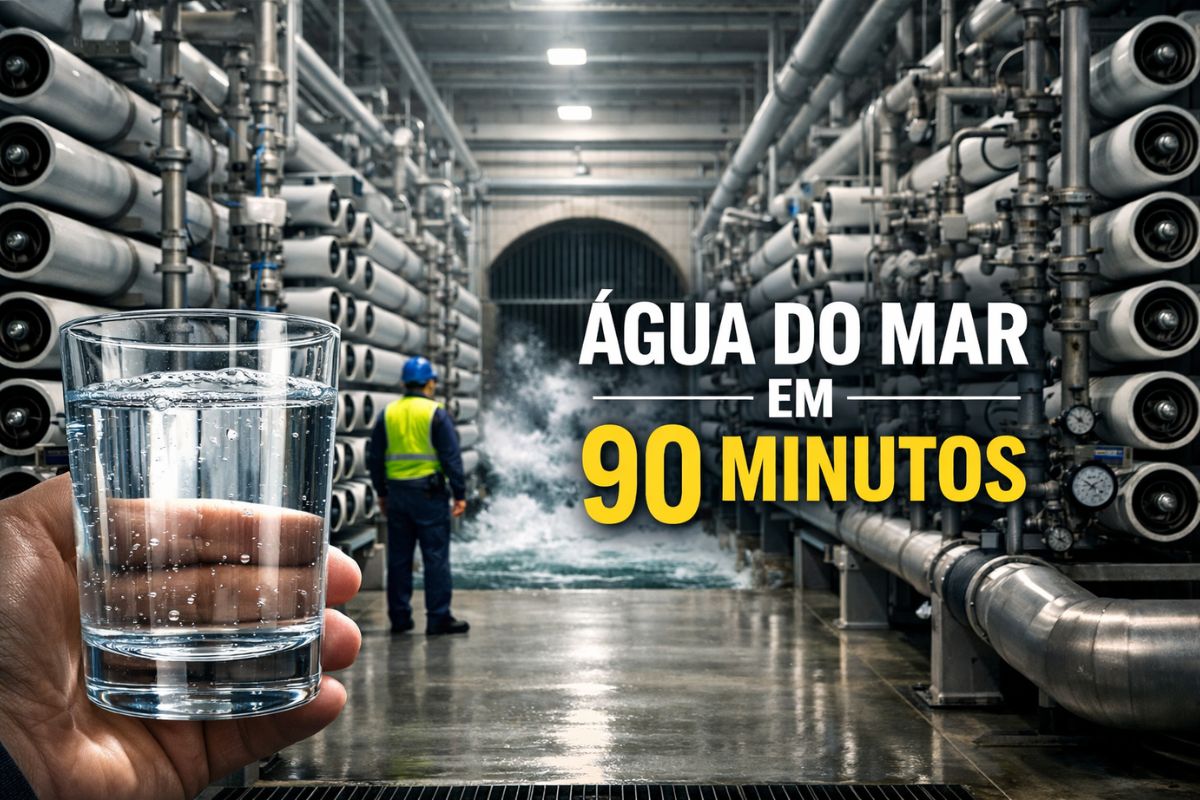


In A Desalination Plant, Salty And Dirty Seawater Passes Through Filters, Tanks, And Reverse Osmosis Membranes, Losing 99.8% Of The Salt, Turns Into Drinking Water In About 90 Minutes, And Helps Ensure Daily Supply For Part Of 300 Million People In Arid And Critical Coastal Regions
Every day, a single desalination plant takes about 90 minutes to transform batches of seawater into drinking water, removing 99.8% of the salt with the help of high-pressure pumps, series of filters, and semi-permeable membranes that only allow water molecules to pass through while retaining almost all other salts and impurities.
Globally, about 20,000 similar plants produce more than 45 billion liters per day and supply drinking water to over 300 million people, especially in regions where rivers and reservoirs cannot meet the demand. The process is energy-intensive, requires strict quality control, and has become a central part of the water strategy for countries surrounded by sea and with limited fresh water available.
How Seawater Enters The Plant Until It Turns Into Drinking Water

The path to drinking water begins in the ocean.
-
A gigantic dam project in the Himalayas could solve one crisis but silently create another for millions of people.
-
Nikola Tesla said that intelligent people tend to have fewer friends, and now science partially confirms this: a study with over 15,000 people showed that for the more intelligent, socializing too much can even reduce life satisfaction.

-
A superyacht worth US$ 17 million is delivered in impeccable condition, sets out to sail, and hits a bridge in the Bahamas just two hours later.

-
Residents of Australia woke up to a sky completely red like blood before the arrival of Cyclone Narelle, which hit the coast with winds of 250 km/h, tearing off roofs and lifting iron dust in a scene they described as apocalyptic.

The intake is done hundreds of meters from the shore, at a point selected to ensure a constant flow and minimize the impact on marine life. A pipe about 63 centimeters in diameter draws approximately 15 million liters per day, the equivalent of over 10,000 liters per minute, or a full bathtub every second.
At the entrance, large metal grates function as sieves, blocking anything over 4 or 5 millimeters in diameter, such as mollusks, jellyfish, crabs, and small fish.
The water travels through underground pipes to the desalination plant, still carrying sediments and suspended particles that need to be removed before the most sensitive stage of the process.
Pre-Treatment: Sand Filters, Chemistry, And Giant Tanks

Before reaching the membranes that separate salt from drinking water, seawater goes through a series of pre-treatments.
First, it passes through sand beds in large tanks.
Gravity forces it through the tiny spaces between the grains, where dirt clings, retaining suspended particles that escaped the initial grates.
Even so, the water still contains microscopic particles.
To remove them, huge paddles mix the water with sodium hypochlorite, which disinfects, and ferric sulfate, which acts as a coagulant.
This coagulant binds to the residues and sand, forming larger flakes that settle to the bottom of the tanks.
A second filtration stage with sand beds agitated by air completes the pre-treatment, further refining the cleaning process.
After these phases, the water is stored in reservoirs of up to half a million liters.
Now visually clean and with much fewer particles, it is ready to face the stage that truly separates the salt from the future drinking water: high-pressure reverse osmosis.
Reverse Osmosis: Heart Of The Transformation Into Drinking Water

The salt dissolves in water because the water molecules attract and stabilize it. Breaking this bond is the major challenge in transforming seawater into drinking water.
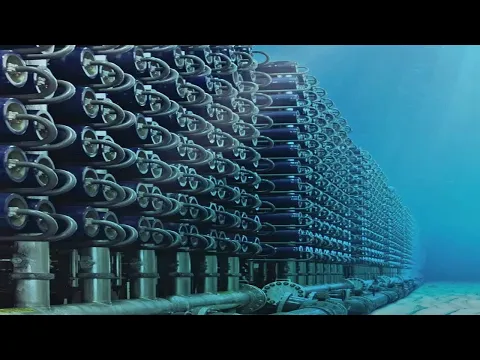
The plant accomplishes this with a system of pumps that gradually increases the pressure to about 60 bar, or 60 times atmospheric pressure at sea level.
Under this extreme pressure, the water enters tubes equipped with semi-permeable membranes wrapped in layers.
These membranes have pores up to 100 times finer than a human hair and only allow water molecules to pass through, retaining salts and other impurities.
Each tube hosts eight membranes, and the entire plant may have around ten thousand membranes in operation, monitored in real-time.
In the center of each module, a collector gathers the water that has passed through the membranes. This flow is the permeate, the basis of the new drinking water.
On the outside, there is the concentrate, a thick brine with a high concentration of salts and other substances.
The final balance is clear: for every two liters of salty water, one liter of fresh water is produced, along with a smaller volume of brine that requires controlled disposal.
What Happens To The Salt, The Residues, And The Concentrated Brine
Not everything that comes out of the plant becomes drinking water. The rejected brine and the solids trapped in previous stages must be treated to reduce environmental impacts.
The concentrated brine is diluted and returned to the sea at calculated points to avoid significantly altering local salinity, preventing harm to marine fauna and flora.
The solid residues, such as particles, sludge, and flakes formed by the coagulant, head to specific chemical treatment tanks.
There, the solids settle at the bottom, part is reused at the beginning of the process, and another part goes through presses that extract the remaining water before disposal in controlled landfills.
Without this management, the desalination process would leave an environmental burden incompatible with the goal of ensuring water in vulnerable regions.
Final Adjustments, Remineralization, And Quality Testing
Even after reverse osmosis, drinking water requires adjustments to reach the tap in optimal conditions.
The near-total removal of salts can alter the pH, making the water slightly too acidic or too basic.
To correct this, operators add acids or bases in precise doses, adjusting the pH to the range recommended by health authorities.
As this water has a very low concentration of essential minerals, such as calcium and magnesium, the plant performs remineralization, reintroducing some of these elements.
This improves taste, rebalances the mineral profile, and provides health benefits.
In the final step, drinking water receives chlorine in controlled dosages, creating an extra barrier against microorganisms that might survive the journey to urban reservoirs and distribution networks.
Before heading to the city, samples undergo extensive testing that analyzes turbidity, dissolved solids, heavy metals, and disinfectant residues.
Automated systems continuously monitor the chemical parameters, ensuring that every liter delivered meets legal standards for human consumption.
Global Scale: 7 Million Liters Per Day Here, 45 Billion On The Planet
The described plant converts about 7 million liters of salty water into drinking water per day, enough to supply a medium-sized city if combined with other sources.
This capacity directly depends on a continuous power supply and the good condition of the membranes and high-pressure pumps, which account for most operational costs.
Worldwide, over 19,000 desalination plants already produce more than 45 billion liters daily, and estimates suggest that approximately 300 million people depend in some way on drinking water from the sea.
The advancement of this technology has transformed water-poor countries with rich coastlines into emblematic cases of adaptation to water scarcity, although the energy and environmental costs remain at the center of the technical debate.
In light of a scenario where giant machines can deliver drinking water in 90 minutes from seawater, do you think desalination should be an absolute priority for investment in dry regions, or should the focus still be on saving and better recovering the fresh water we already have available?







Necessário e ótimo em todos os sentidos.
No futuro creio que dependeremos desses processos para abastecimento em tempos de secas,
e escacez por alto consumo.
Quanto custa uma usina de dessalinizacao?