





 Portuguese
  English
  Spanish
  5 min of reading
  1 comment


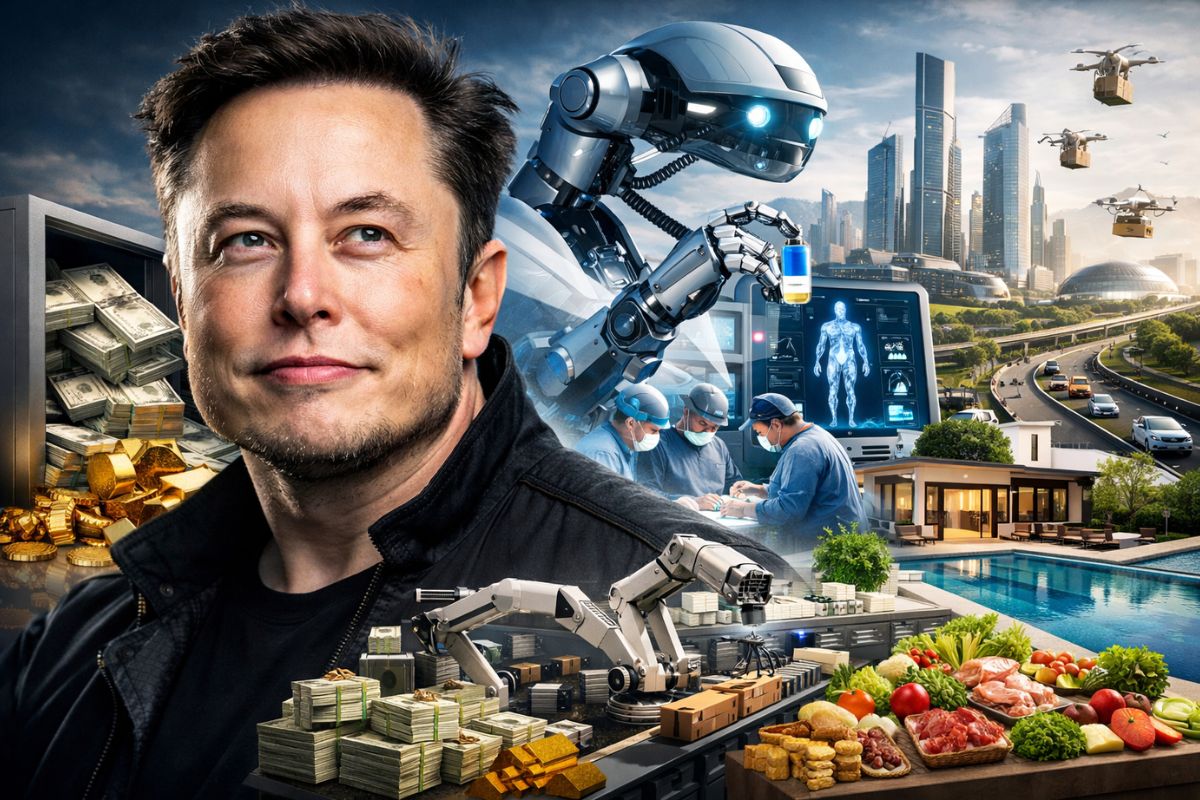


Elon Musk, in a participation on the podcast Moonshots With Peter Diamandis, said that AI will create abundance of resources, goods, and services, making retirement irrelevant and saving money useless. In Brazil, with INSS and private pension, he recommended not saving for decades, as he believes that would not make any difference.
Elon Musk’s statement about the future of retirement resonated in Brazil, where more and more people invest in private retirement funds and also rely on INSS. According to the businessman, the practical recommendation is straightforward: saving money for retirement will cease to make sense.
Presented as a vision of an accelerated future, Elon Musk associated the change with the advancement of AI and the idea of total abundance. The owner of Tesla stated that, in this scenario, anyone will be able to buy whatever they want, with goods and services in abundance, and healthcare for all within five years. In the same vein, he stated that saving now will not make a difference in the near future.
Why Elon Musk Says Retirement Will Become Irrelevant
Elon Musk’s central premise is based on a technological bet: AI, as it advances, would have the capacity to create resource abundance on such a scale that the concept of scarcity would lose its strength.
-
The largest food company on the planet, JBS, has just opened a 4,000 square meter laboratory in Florianópolis to develop customized proteins that modulate muscle mass gain, immune response, and metabolic performance.

-
After nearly 30 bids and competition among industry giants, a Spanish company purchases one of the largest airports in Brazil for almost R$ 3 billion and takes over the management of Galeão in a concession that will last until 2039.

-
The Federal Revenue Service now automatically cross-references everything you declare with data from banks, credit cards, brokerage firms, and insurance companies, and any discrepancy between your income and your expenses triggers an alert in seconds.

-
Amid global tensions, Brazil blocks the United States’ proposal at the WTO and paves the way for a trade crisis and possible retaliations.

In this logic, retirement would cease to be a necessary planning, as goods and services would be available in sufficient volume to meet everyone’s needs.
When speaking of abundance, Elon Musk is not only addressing consumption.
He connects abundance to the functioning of the everyday economy: access to services, availability of products, and reduction of barriers to acquiring what one desires.
The direct consequence, according to his remarks, is that retirement would become a term more historical than practical, as the future would be organized by broad and continuous supply.
The same idea appears in how Elon Musk describes the impact of AI: a technology that not only accelerates processes but also reorganizes priorities.
In this vision, retirement loses its role as protection against lack of income, as abundance would diminish the importance of accumulating money over long periods.
Elon Musk’s Recommendation on Saving Money
The point that caused the most shock was the explicit recommendation.
Elon Musk said not to worry about saving money for retirement projected to be 10 or 20 years away, because it would not make a difference.
The phrase frames the act of saving money as a potentially useless routine in a future of abundance.
By asserting that saving money will stop being important, Elon Musk transforms a common habit into a topic of public debate.
Retirement, in this framing, ceases to be a savings-based goal and starts to depend on the pace of AI.
For those structuring their financial lives based on decades of contributions and money accumulation, the message sounds disruptive.
Even though it is a prediction, the recommendation directly affects present decisions.
Saving money, organizing retirement, and choosing long-term strategies are actions that require trust in the future scenario.
By stating that AI will produce total abundance in a few years, Elon Musk calls that trust into question.
Abundance, Health, and the Five-Year Promise
Among the statements, one of the most objective was the timeframe: Elon Musk said that better medical care than currently available would be accessible to everyone within five years.
In this regard, abundance appears linked to health, as if AI and technology accelerated the ability to provide care on a universal scale.
The idea of healthcare for all, within the same package of abundance, broadens the argument’s reach.
Retirement is often associated with cost of living, medical assistance, and protection against unforeseen events. If healthcare becomes accessible and goods and services cease to be scarce, the role of saving money for retirement loses part of its meaning, according to the logic presented.
At the same time, the five-year timeframe reinforces the provocation. It is not a distant transformation:
Elon Musk describes a near future, with AI and abundance rapidly changing priorities.
It is this temporal framing that tends to enhance the impact of the statement.
The Shock in Brazil Between INSS, Private Pension, and Elon Musk’s Statement
In Brazil, retirement has an institutional component that appears in the debate itself: INSS, cited as a reference for the system that supports a significant part of the income of those who leave the labor market.
At the same time, the growth of private retirement funds shows that many people try to boost future income with money saved over time.
When Elon Musk states that saving money will be useless, the message clashes with this Brazilian scenario.
Retirement, in practice, usually involves long-term calculations, continuous contributions, and expectations of stability.
Elon Musk’s statement, by proposing total abundance generated by AI, suggests that this architecture may become obsolete.
The immediate consequence is the shock: for those in Brazil, where INSS and private pension coexist, the idea that saving today will make no difference provokes a reaction as it disrupts already made decisions.
The effect is stronger when the statement comes from Elon Musk, presented as one of the richest men in the world, with an estimated fortune of over US$ 700 billion.
Concerns Raised About AI, Jobs, and Environmental Impact
Even under an optimistic tone, the very repercussion includes caveats.
Among the mentioned concerns is the risk of AI accelerating the end of many jobs, increasing uncertainty precisely during the period when many people try to save money to secure retirement.
Another criticism cited involves environmental impact: maintaining data centers may require high water usage.
At this point, the promise of abundance comes with physical and environmental costs, which tension the narrative of total abundance within a few years.
By bringing together retirement, money, AI, and abundance in the same forecast, the discussion shifts from being merely technological.
It becomes social and environmental because it replaces a security model based on saving money with a security model based on the ability of AI to deliver goods, services, and health for all.
What Remains for Those Who Save Today
Elon Musk’s statement crosses two layers that rarely appear together: a forecast of total abundance and a practical recommendation to stop saving money with retirement in mind.
In Brazil, where INSS and private pension shape daily choices, the statement becomes a test of realism about what to expect from AI and what financial security means.
As a concrete action, it is worth closely following the debate on AI and its effects on jobs, environmental costs, and access to services, without abandoning long-term decisions merely based on a prediction.
Reviewing retirement strategies calmly, assessing risk and horizon, tends to be more realistic than impulsive decisions.








Se trata de previsão somente duvido que seja ancorado na realidade material.
Começa pelo inúmeros problemas sociais e acesso a serviços, segundo ele a capacidade de gerenciamento da IA garantirá uma explosão de produtividade e recursos gerenciados de forma eficiente.
Nesse sistema que possuímos é impossível mesmo com todas reformas estruturais possíveis não tem possibilidade teórica e nem prática.