





 Portuguese
  English
  Spanish
  5 min of reading
  0 comments


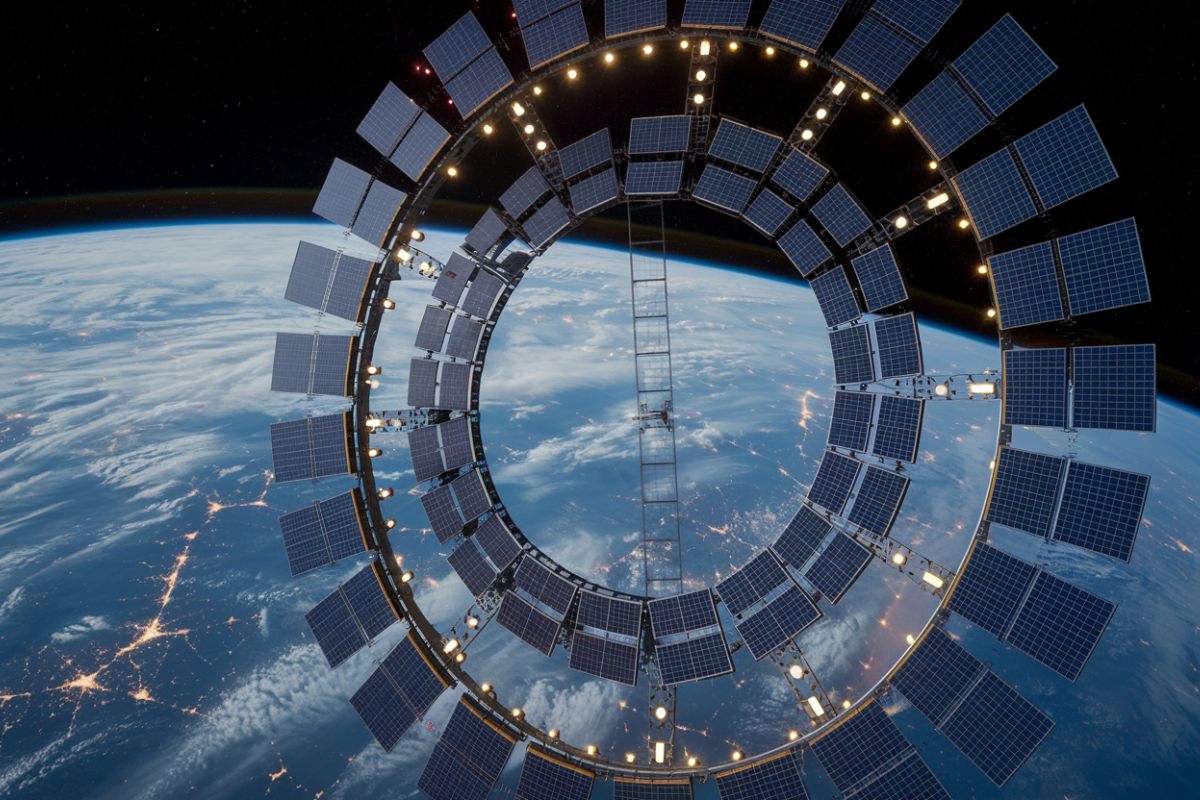
Elon Musk Bets on the Sun to Provide Energy to the U.S. Understand How a Giant Photovoltaic Plant Can Transform Sustainable Energy and the Energy Future
For Elon Musk, the energy demand of the entire U.S. could be met without issues with the help of a gigantic fusion reactor installed in the sky, directly above our heads. The good news, according to the entrepreneur, is that there’s no need for a crazy project or a billion-dollar investment to achieve something like this: we have one that’s been around for billions of years, and we call it the Sun. The CEO of Tesla and SpaceX estimates that a massive photovoltaic plant, approximately 160 x 160 km, would be enough to meet the energy demand of the U.S.
That Musk enjoys catchy headlines and provocative ideas is no surprise, but in this case, he is not the first to suggest a project of XXL size and a futuristic approach to harness solar energy.
The Mother of All Installations
Elon Musk likes impactful phrases, and he made this clear recently during his appearance on ‘The Joe Rogan Experience’, a podcast hosted by commentator and comedian Joe Rogan, who in recent weeks has had a guest list as eclectic as actors Dwayne Johnson “The Rock” and Whitney Cummings, former CIA agent Michael Baker, martial arts expert Tim Kennedy, or writer Elliott West. Musk appeared on the podcast on October 31 and, among other things, talked about the potential of solar energy.
-
He started running at 66 years old, broke records at 82, and is now a subject of study for having a metabolic age comparable to that of a 20-year-old, in a case that is intriguing scientists and inspiring the world.

-
With a cost per shot close to zero, the DragonFire laser could change naval warfare in 2027 and provide British ships with nearly unlimited defense against drones.

-
A British startup creates tires that generate electricity in electric vehicles when passing over potholes, speed bumps, and cracks.

-
Oldest tree on the planet reappears after 130 years of searches: Wattieza, 385 million years old, was 10 meters tall and had no leaves or seeds; Gilboa fossils in New York solved the mystery in 2007.


“Actually, it would be possible to power all of the United States with a solar area of 100 miles by 100 miles,” the mogul explained in statements recorded by Money Wise. Converted to our metric system, this would equate to a facility of about 160 x 160 kilometers. Musk’s proposal is so outrageous that upon hearing it, Rogan asked him to explain further: “So you could pick a dead zone, cover it with solar panels, and power the whole country?”
Solar Panels, Batteries, and a Giant Solar Energy Reactor
“Absolutely. We need batteries, but yes,” Musk replied, who believes that bringing such an idea to practice would not be difficult and sees as perfectly “viable” to provide energy for the entire country with the help of the Sun: “This thing just works. We have a gigantic fusion reactor in the sky.” His bet actually goes beyond words.
Investing in the Solar Energy Industry
In 2016, Tesla acquired SolarCity, a company dedicated to marketing solar power generation systems, in a deal valued at about $2.6 billion. “Tesla is preparing to commercially launch its Powerwall and Powerpack energy storage products on a large scale,” Musk’s company explained at the time, shortly after launching its own energy division: Tesla Energy Operations.
Musk’s bet on photovoltaics is also not unique. The Solar Energy Industries Association and Wood Mackenzie recently estimated that this year the U.S. solar industry would add 32 GW of production capacity, a 53% increase compared to 2022, and that by 2028, the country’s operational capacity would reach 375 GW. Growth forecasts are also considerable in Europe.
The Issue of Megaprojects
Musk is not the first to suggest a project of XXL size and futuristic philosophy to elevate the utilization of photovoltaic energy to a new level. In fact, there are already concrete initiatives that go far beyond the mogul’s statement on ‘The Joe Rogan Experience’. One of them is led by the European Space Agency (ESA) itself.
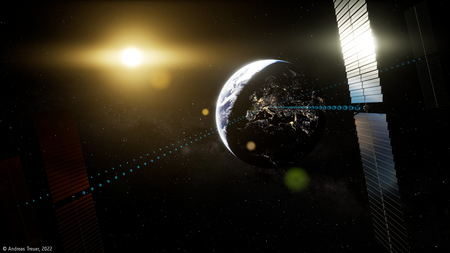
For some time, the intergovernmental agency has been nurturing the idea of harnessing SBSP, an abbreviation for “Space-Based Solar Power,” a strategy that would involve capturing solar energy with the help of enormous satellites in geostationary orbit, which would then convert it into low-density microwaves and transmit it to receiving stations located on Earth.
Achieving something like this would require facing “prohibitive challenges,” such as deploying enormous receiving antennas, assembling large structures in space, or studying the effects of low-power microwaves. For now, the ESA has already launched the SOLARIS initiative to assess its feasibility.
In Focus for Other Agencies
The ESA is not the only one dedicating time to analyze the possibilities of SBSP. Its Japanese counterpart, JAXA, published a report on its advantages and challenges, and even proposed solutions. In the 1990s, the predecessor of JAXA participated in a conceptual design, SPS2000, of 10,000 kW, and in the first decade of the 21st century, the space agency and the Japanese government worked on another SSPS concept of one million kilowatts.
China and NASA have also considered this possibility. Last year, Space News reported that the American agency had begun a study to evaluate the possibilities of SPS. “As technology evolves, the feasibility of the system changes over time,” explained Nilokolai Joseph from NASA’s Office of Technology, Policy, and Strategy. With the new report, the agency wanted to “assess how much it should support SPS.” Recently, a study from the Universities of Surrey and Swansea concluded that it is feasible to create lightweight and low-cost panels to generate energy in space.
Large Installations on Land
Not all solar megaprojects are focused in space. Here on Earth, gigantic solar farms with panels have been created, such as the deployment that China is pushing in Inner Mongolia, which includes a single facility: 196,000 panels distributed over an area of 1.4 million square meters, making it the largest facility of its kind in a desert. Tesla itself has participated in large solar projects.
… And in Theoretical Studies
If there is an installation that makes all solar farms built to date look small, or even that enormous strip of 160×160 kilometers suggested by Musk to power the U.S., it is the Dyson Sphere, an idea proposed in the 1960s by physicist Freeman Dyson. His proposal: to build a structure capable of surrounding the Sun.
Dyson believed that to continue evolving, there would come a time when a civilization would need to drastically improve its energy collection. And how to do that? With an installation capable of covering its star, in our case the Sun, with a “mesh” covered with panels or other technology that captures its potential.







Seja o primeiro a reagir!