





 Portuguese
  English
  Spanish
  4 min of reading
  0 comments


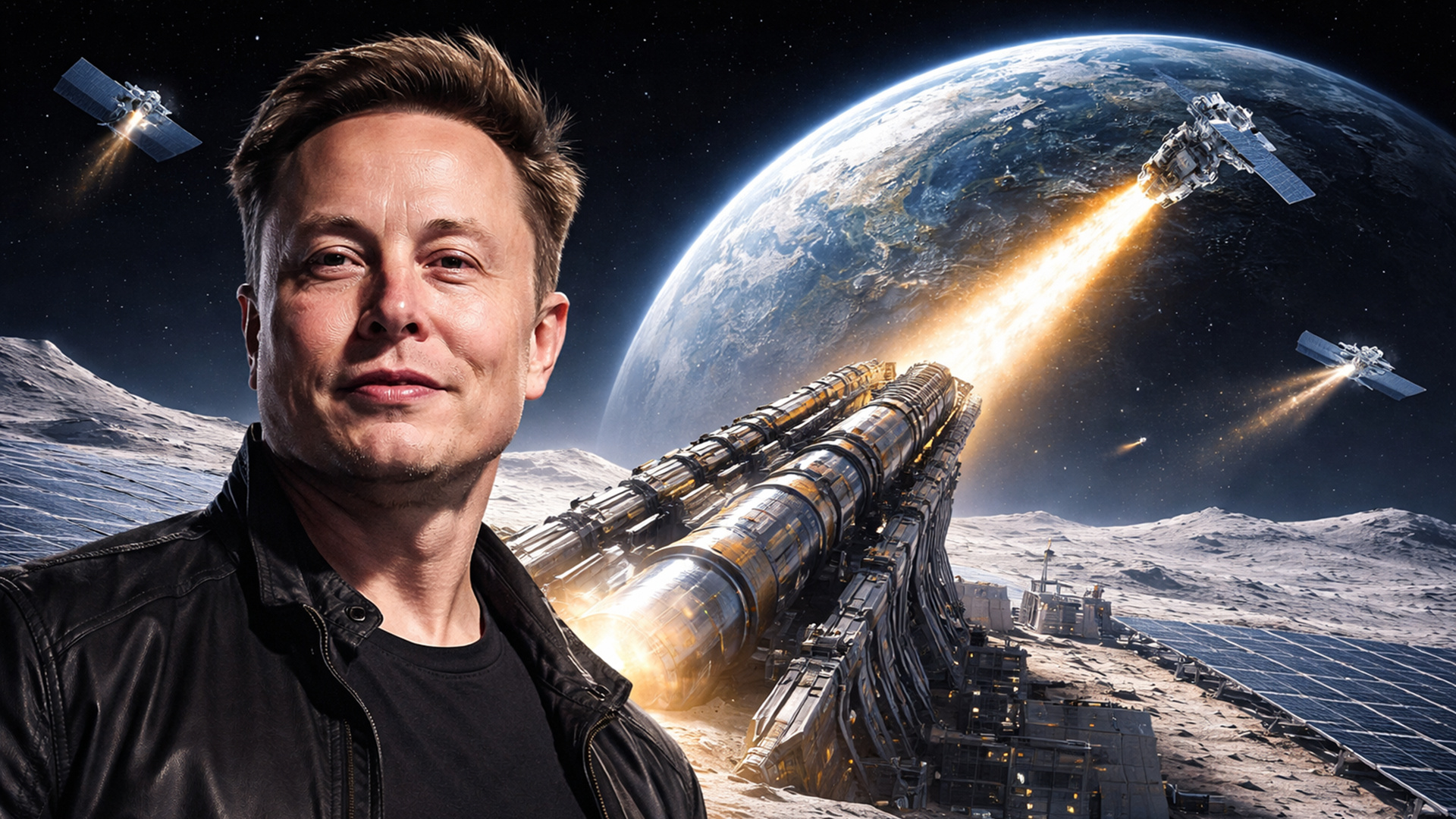
Elon Musk presented the TERAFAB Project with the proposal to use electromagnetic propellers on the Moon to launch artificial intelligence satellites, transfer part of the energy infrastructure to space, and try to break the terrestrial limit of expansion of data centers
Elon Musk presented a proposal to transfer part of the energy-intensive infrastructure of artificial intelligence to the Moon, using electromagnetic mass drivers to launch satellites from the lunar surface.
The initiative, part of the TERAFAB Project, aims to overcome what he called the “terawatt ceiling” of terrestrial computing and pave the way for an intelligence scale at the petawatt level.
The proposal was revealed by Musk during a presentation held over the weekend at Giga Texas. According to the plan, the Moon would host an industrial base focused on the production and sending of orbital infrastructure for AI, taking advantage of local conditions considered favorable for this type of operation.
-
Something is happening around the Earth: Inside the huge explosion of fireballs in 2026

-
A hot air bubble coming from Argentina expands over Brazil, causing thermometers to exceed 38 degrees with a thermal sensation of 40 degrees in late March, affecting 6 states at once.

-
The radish leaf that almost everyone throws away has more polyphenols, flavonoids, and fiber than the consumed root, and a 2025 study showed that the leaf contains compounds that protect the intestine, combat inflammation, and may inhibit the growth of cancer cells.

-
A planet that seemed to defy the laws of physics has intrigued scientists for decades, until the James Webb revealed what is really affecting Saturn’s rotation.

TERAFAB Project targets AI infrastructure on the Moon
Elon Musk’s plan is based on the assessment that Earth faces space and energy limitations to sustain the expansion of large artificial intelligence projects. The proposal is to shift this demand to the lunar surface, exploring resources and conditions that, in the presented view, would allow for a computational capacity on a scale much higher than what is currently available.
Among the highlighted factors are the lunar vacuum, low gravity, and the use of solar energy. In the presentation, it was stated that solar panels in space are about five times more efficient than on Earth, where clouds and the dense atmosphere reduce the efficiency of energy capture.
Instead of relying on the increased use of rockets, the plan envisions the construction of a large-scale electromagnetic track.
This structure would be used to launch satellites equipped with artificial intelligence into space using solar energy, without resorting to chemical propellants.
Mass drivers and launches without chemical fuel
The electromagnetic tracks envisioned for the project could extend for dozens of kilometers. The goal would be to use magnetic fields to accelerate the satellites to lunar escape velocity, turning the Moon’s surface into a launch platform for a distributed orbital network.
According to the proposed model, this would eliminate the need for expensive and volatile chemical fuels. It would also dispense with discarded propulsion stages, which are pointed out in the plan as elements that pollute Earth’s oceans.
Another front mentioned by Musk involves using SpaceX’s Starship to transport the initial hardware necessary for deploying the structure. From this base, the system could evolve into an orbital network capable of providing a thousand times more energy than current systems, according to the presented projection.
Lunar factory and technical options under study
The announced vision also includes the creation of a lunar factory operated by robotics. This facility would manufacture solar-powered artificial intelligence satellites, which would then be sent to a distributed orbital network via electromagnetic propellers.
Two main models are being considered for this stage. One of them is the electromagnetic cannon, described as a system that uses a single powerful burst of force to propel the payload.
The other model under analysis is the coil gun, which employs a sequence of timed magnets to produce a constant and controlled acceleration. Among the two alternatives, this second option has been pointed out as the preferred choice to protect sensitive artificial intelligence payloads during launch.
Change of priority and challenges of the plan
The proposal for the lunar mass driver was presented as a central piece of a broader strategic shift announced by SpaceX in February 2026. At that time, the company began prioritizing a “self-sustaining” lunar city instead of the immediate colonization of Mars.
Although Mars continues to be treated as the guarantee of humanity’s long-term survival, the Moon has been described as the immediate industrial priority.
One of the logistical arguments cited is the frequency of launch windows, which would occur every 10 days for the Moon, compared to a wait of 26 months for Mars.
The concept of a magnetic space weapon, however, is not new. The text recalls that this idea has existed since Edward Fitch Northrup theorized it in 1937, but emphasizes that it remains purely theoretical and has yet to move from the drawing board to the lunar surface.
Critics have already pointed out the scale of the calculations involved in the proposal. According to these assessments, launching more than a million tons of material, necessary to achieve a petawatt of power, would require about 135 Starship launches per day.
Despite the challenges pointed out, Elon Musk presented the plan as an attempt to push computing to its physical limits. “We will take physics to the limit in computing and do amazing and crazy things,” said the entrepreneur.
At another moment in the presentation, Musk also stated: “I want to live long enough to see the mass driver on the Moon.” The proposal, while ambitious and still theoretical, was presented as part of a strategy to shift the energy expansion of artificial intelligence off Earth and reduce competition between data centers and cities for terrestrial energy consumption.
With information from interestingengineering.






Seja o primeiro a reagir!