





 Portuguese
  English
  Spanish
  4 min of reading
  1 comment


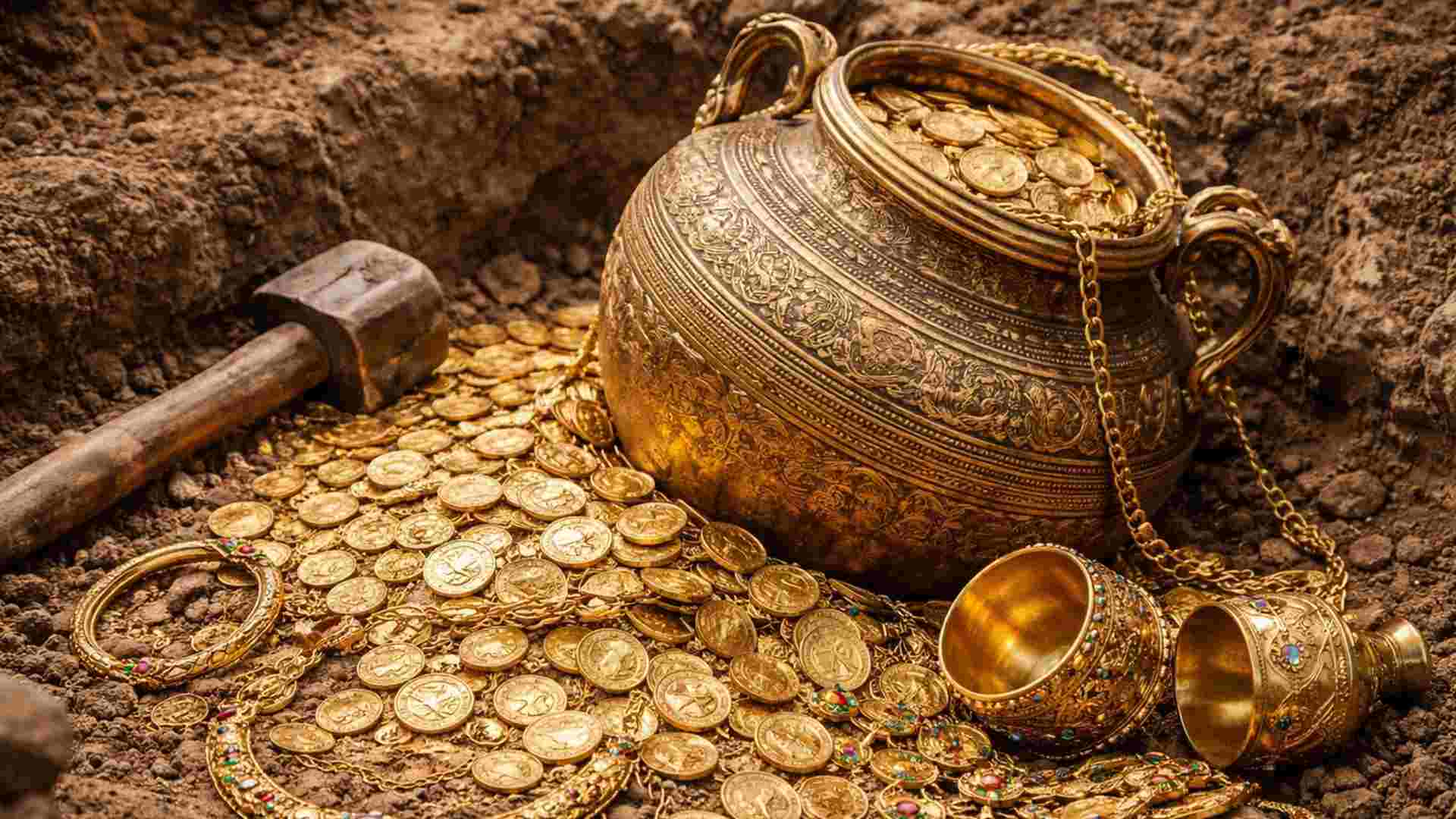


Discovered By Chance In An Agricultural Field In Hoxne, In Eastern England, The Roman Treasure With More Than 15 Thousand Coins, Jewels, And Utensils Reveals Patterns Of Monetary Circulation, Practices Of Concealment And Economic Instability In Britain Between The 4th And 5th Centuries AD
In November 1992, the search for a lost hammer in Hoxne, Suffolk, in the United Kingdom, led to the accidental discovery of a Roman treasure valued at £1.75 million, revealing one of the most important collections of gold and silver from the late Roman period in Britain.
Casual Discovery And Communication To The Authorities
The episode began when farmer Peter Whatling lost a hammer on his farmland and asked a friend for help in locating it. Eric Lawes, a retired gardener and amateur detectorist, offered to search for the object in the field using a metal detector.
On November 16, 1992, during the search, Lawes found several buried metal objects, including ancient coins and spoons. Realizing the historical potential of the finds, he halted the digging and immediately informed the local police and the responsible archaeological service.
-
He started running at 66 years old, broke records at 82, and is now a subject of study for having a metabolic age comparable to that of a 20-year-old, in a case that is intriguing scientists and inspiring the world.

-
Oldest tree on the planet reappears after 130 years of searches: Wattieza, 385 million years old, was 10 meters tall and had no leaves or seeds; Gilboa fossils in New York solved the mystery in 2007.

-
A 48-square-meter house assembled in hours with 4,000 bricks made of recycled plastic that does not absorb moisture, has natural thermal insulation, and costs less than 90,000 reais in a complete kit.

-
Luciano Hang revealed that Havan’s air fleet has already accumulated more than 20,000 landings, 10,000 flight hours, and 6 million kilometers traveled, and he says that without the planes, the company would never have grown so quickly.


This decision allowed professional archaeologists to take over the excavation and recording work. By not indiscriminately removing the objects from the site, it was possible to accurately document the position and context of each artifact found underground.
Archaeological Importance Of The Hoxne Treasure
The discovery became known as the Hoxne Treasure and is now considered one of the most significant collections of precious metals from the late Roman period ever found in Britain. In monetary terms, it ranks fifth among the ten largest treasures of gold and silver dated between the 2nd and 7th centuries AD.
The archaeological work revealed a collection composed of 15,233 Roman coins, as well as silver vessels, gold jewelry, numerous spoons, and personal hygiene items, the latter being of lesser economic value but relevant for the historical interpretation of the collection.
The diversity and quantity of the items provided researchers with a detailed overview of practices of accumulation, monetary circulation, and the use of luxury objects at the end of Roman presence in Britain.
Structure Of The Chest And Preserved Materials
During the excavation, remains of wood and other organic materials associated with the collection were also identified. These traces allowed researchers to determine that the objects were stored in a wooden chest, likely made of oak, with compartments or internal subdivisions.
The archaeologists concluded that the chest was filled with straw and fabric, used as protection for the metal objects. The preservation of these organic materials is considered unusual and contributed to a more accurate understanding of how the treasure was stored.
Among the individual items, a decorative handle made of silver and niello, sculpted in the shape of a tigress, stood out, highlighting the level of artistic sophistication present in the collection.
Dating, Historical Context And Uncertainties
The analysis of the coins indicated that the treasure was deliberately buried at some point in the 5th century AD. Some coins could be dated after 407 or 408 AD, while most belong to earlier decades, providing data on the period of circulation of Roman currency.
This information helped archaeologists understand how long Roman coins continued to be used in the region after the weakening of imperial administration. Despite this, the exact reason for the burial of the treasure remains unknown.
The names of the original owners and the reasons for hiding the objects could not be determined. The hypotheses cited in studies include unstable conditions at the end of the 4th and beginning of the 5th centuries, changes in economic climate, or even the possibility that the collection represents spoils from a robbery, with no definitive conclusion.
Reward And Destination Of The Treasure
In 1993, the collection was officially declared a valuable find, characterized as items purposely deposited and not recovered by their owners. According to current legislation, the treasure was handed over to the British Crown.
Subsequently, the Crown sold the collection to museums at market value. The amount raised was passed on to the discoverer, Eric Lawes, who shared the sum with the landowner where the discovery occurred.
Together, Lawes and Whatling received £1.75 million, concluding an episode that began with the search for a simple lost hammer and resulted in one of the most significant archaeological finds of the late Roman period in Britain.









Did he find his hammer?