





 Portuguese
  English
  Spanish
 5 min of reading
  0 comments


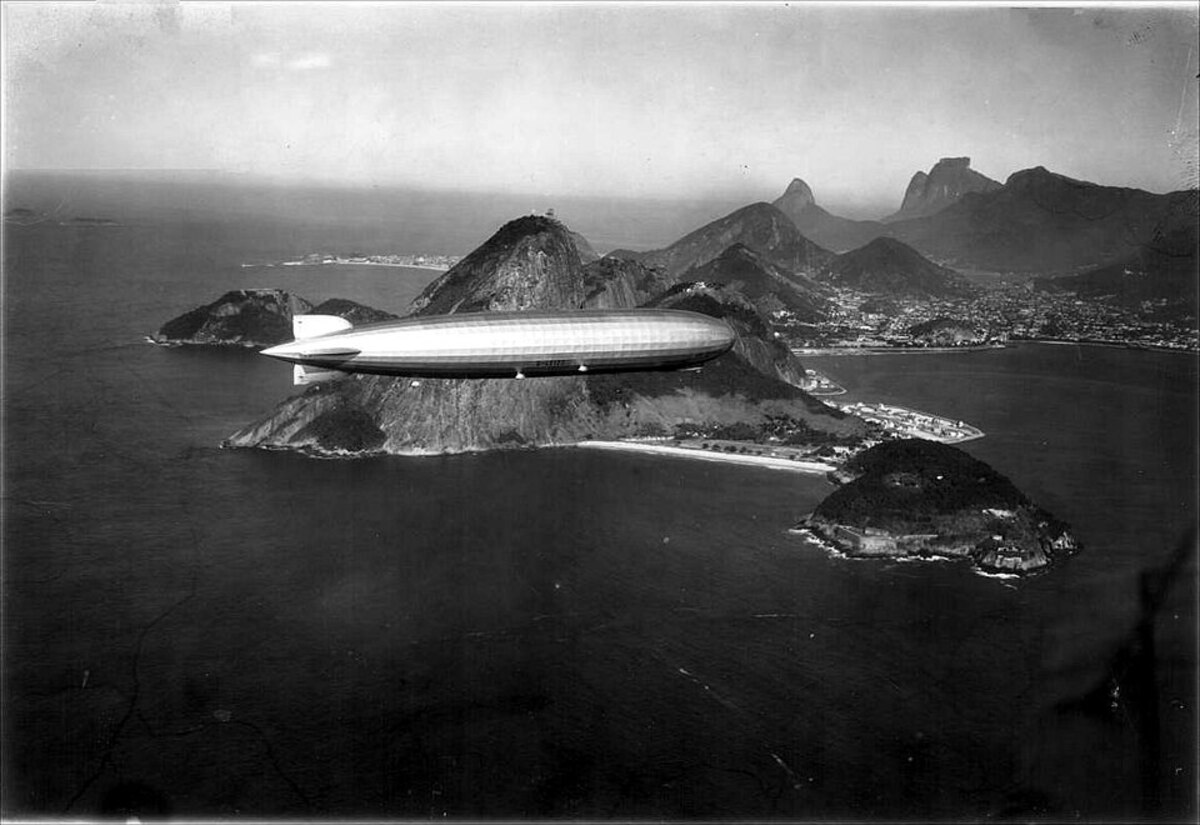
In 1930, The Graf Zeppelin Flew Over Rio and Marked the Beginning of International Commercial Aviation in Brazil
The Sunday had not yet fully brightened, but Rio de Janeiro was already in celebration. An eager crowd took to the city streets to witness a unique spectacle: the flight of the Graf Zeppelin over Guanabara Bay.
It was May 25, 1930. The clock struck 6:30 AM when the aluminum giant appeared in the Carioca sky and continued on to land at Campo dos Afonsos in Santa Cruz. With this, Brazil officially entered the era of international commercial aviation.
The Beginning of a New Era in Brazilian Skies
The arrival of the Graf Zeppelin was more than just an event. It was a milestone. The German airship, with its impressive 236 meters in length, inaugurated the first passenger route between Brazil and Europe.
-
In the United States, a valley 86 meters below sea level has reached 56.7°C and remains the place with the highest air temperature ever recorded on Earth, a direct result of a terrain that traps heat between high mountains in the midst of the desert.

-
Goodbye clothes with odors from use: Samsung’s device uses high-temperature steam, eliminating up to 99.9% of bacteria, removing dust mites, and neutralizing odors directly in the wardrobe without the need for washing.

-
Embraer arrives in Mexico with 7 new E190-E2s in 2026, after 5 jets have already been delivered, while Mexicana surpasses 1 million passengers, plans a fleet of 20 aircraft, and expands strategic routes across the country.

-
China is not joking around and is secretly expanding its nuclear weapons infrastructure: a giant dome the size of 13 city blocks, 600 warheads, destroyed villages, and a modernized military network in record time in China, says CNN.


The impact was immediate. The press celebrated the news as a symbol of progress. For many, modernity had finally landed here.
According to Charles Narloch, a professor at Unirio and researcher at the Museum of Astronomy and Related Sciences, there were no regular commercial flights for international passengers. The Zeppelin came to fill that gap.
Already famous for having circumnavigated the globe in 1929, Captain Hugo Eckener was a celebrity. The Italian newspaper “Corriere della Sera” even called him the most famous man on the planet.
The Rise of Airships and Their Peak
Airships were not new to the world. Since the 19th century, there had been lighter-than-air aircraft. The very Santos Dumont developed airships before inventing the airplane.
During World War I, they were used as bombers. The Germans, for example, relied on the Zeppelins created by Ferdinand von Zeppelin.
After the conflict, airships took to the skies as a luxury means of transport. The Graf Zeppelin debuted in 1928 and, a year later, was already circling the globe.
The journey took 21 days, with a speed not exceeding 110 km/h, and only those with a lot of money could board. There were 20 passengers and 36 crew members. The price? Something like US$ 8,000 in today’s values, one way.
Luxury at Altitude and Impressive Structure
The structure was impressive. The duralumin hull housed 60 hydrogen balloons. Five 12-cylinder engines ensured propulsion. Inside, the comfort: suites, dining, and living rooms. A true flying hotel.
The journey to Brazil began on May 18 in Germany. In three days, the Zeppelin crossed the Atlantic and landed in Recife, where a tower had been built to welcome it. The arrival was celebrated with stands and distinguished guests. The party was just beginning.
Expectation in Rio de Janeiro
Meanwhile, in Rio, anticipation was rising. No one knew the exact time of arrival. Many spent the night on the street, eyes turned to the sky. Newspapers tried to discover the exact time.
The anticipation was so great that even trains between São Paulo and Rio were sold out. The poor road saw the highest volume of cars ever, according to Narloch.
Curious stories also emerged. The newspaper O GLOBO reported that a Portuguese man named José Pinheiro fell asleep at Cais do Mercado Novo while waiting for the Zeppelin and fell into Guanabara Bay. Fortunately, he was rescued alive.
Before landing, the airship flew over a ship carrying Júlio Prestes to the United States. He had been elected President of Brazil, but would not take office. The 1930 Revolution would change the course of the country, placing Getúlio Vargas in power.
The Crowd Watches the Aerial Spectacle
Thousands of people awaited the Graf Zeppelin at high points like Santa Teresa and the hills of São Januário and da Viúva. When the airship appeared, the city erupted in cheers. Shouts, applause, children running. The “flying cigar” was real.
The Zeppelin traveled along the coastline to Santa Cruz, where Campo dos Afonsos was prepared for landing. It was a true show.
Ropes were thrown, and about 150 men pulled the airship down to the ground. Some climbed the ropes, the so-called “spiders.” Only when the 67-ton giant was fully secured did the passengers disembark.
Organization and Reception at Campo dos Afonsos
The event was organized with great fanfare. The public was divided into first, second, and “general” seating. Authorities such as Mayor Prado Júnior and American Ambassador Edwin Morgan were present. Security involved about 2,000 men from various agencies.
For Professor Narloch, the presence of airships helped change Brazil’s image abroad. From a country seen as exotic and backward, it began to draw the attention of the international press. The impact was so great that he compared the mobilization to that of a World Cup.
The End of the Era of Airships
For seven years, the Graf Zeppelin made 64 trips to Brazil. In 1933, with Hitler’s rise, airships began to fly with the Nazi swastika. In 1936, the hangar for the Zeppelins was inaugurated in Santa Cruz. The structure is still there, well preserved, but had a short life.
The end of the era of airships came in 1937, with the tragedy of the Hindenburg, which exploded while attempting to land in the United States, killing 36 people. From then on, airships lost ground in global aviation.
Memory and Inspiration to This Day
The memory, however, remained alive. From Recife to Rio, the dream of a modern future was carried in the air by the Zeppelin.
Today, companies are studying new airships with helium gas, which is less flammable. But everything is still in the testing phase. What remains is the memory of that Sunday when Rio’s sky welcomed one of the largest aircraft ever built.
With information from O Globo.








Seja o primeiro a reagir!