





 Portuguese
  English
  Spanish
  3 min of reading
  18 comments


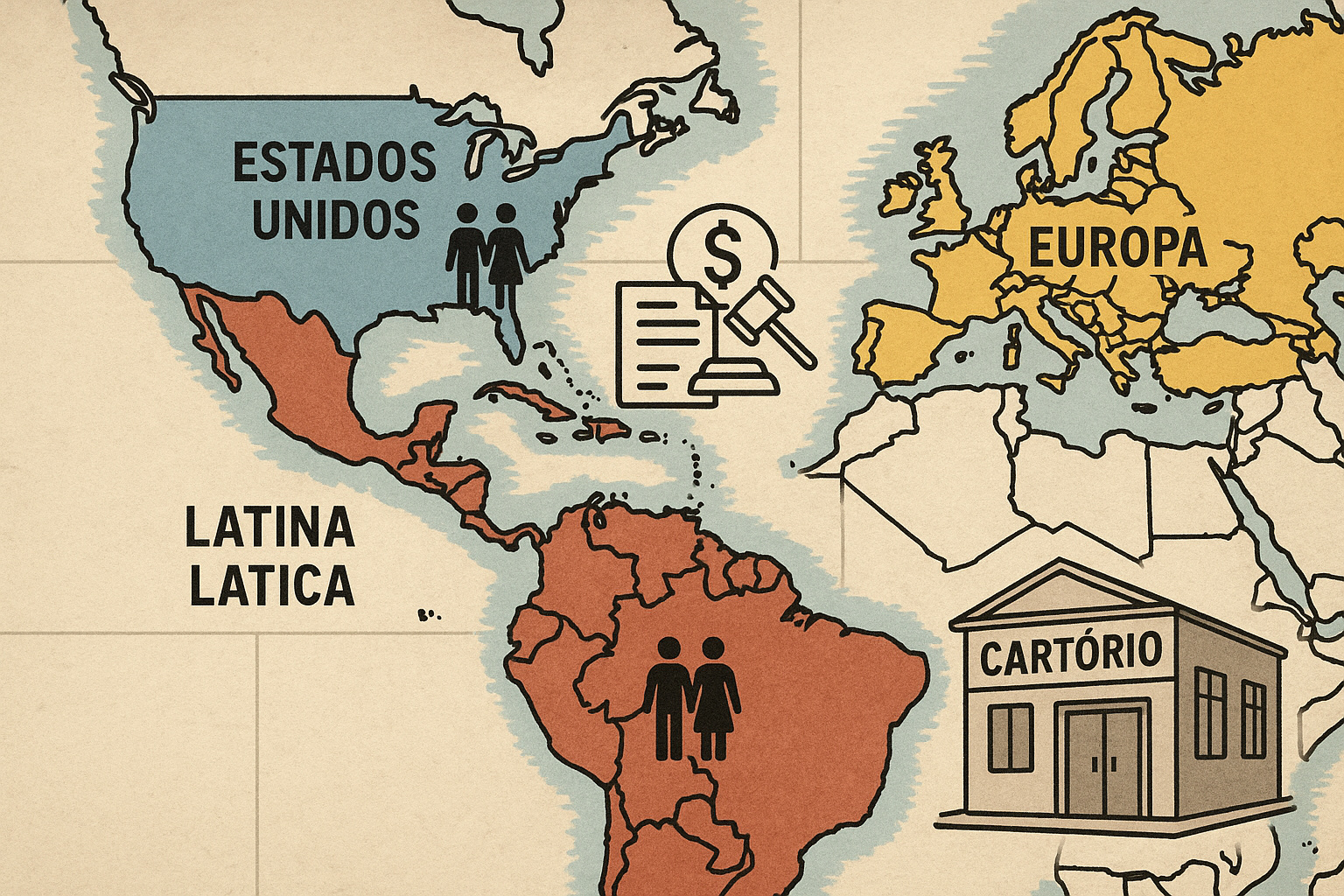


Succession Systems in Latin America, Europe, and the United States Reveal Different Levels of Protection for the Surviving Spouse, Bringing to Light the Debate on the Future of Brazilian Legislation Amidst Bill No. 4/2025
Brazil is currently discussing a possible change to the Civil Code that could remove the spouse from the list of necessary heirs. The proposal is in the Bill No. 4/2025, under review in the Senate, and is already causing controversy. While the topic divides opinions in the country, international experiences show how different societies handle succession between husband and wife.
Latin America Maintains Strong Protection
In the countries of Latin America, protecting the spouse is a common rule. In Argentina, the widower or widow has the right to a share of the inheritance in competition with the children, similar to what happens in Brazil today. In Chile, the spouse is also a necessary heir, positioned alongside direct descendants. In Uruguay, in addition to succession, there is additional protection for older spouses, granting lifetime usufruct of part of the assets.
Mexico adopts a similar model but conditions the spouse’s participation on the marriage regime. In partial or total community of property, there is a direct division of assets; in more restrictive regimes, the spouse may receive only part of the inheritance, always preserving the minimum necessary for support. These examples show that regionally, Brazil is not isolated in including the spouse as a necessary heir.
-
Larger than entire cities in Brazil: BYD is building a 4.6 km² complex in Bahia with a capacity for 600,000 vehicles per year, but the discovery of 163 workers in conditions analogous to slavery has shaken the entire project.

-
With an investment of R$ 612 million, a capacity to process 1.2 million liters of milk per day, Piracanjuba inaugurates a mega cheese factory that increases national production, reduces dependence on imports, and repositions Brazil on the global dairy map.

-
Brazilian city gains industrial hub for 85 companies that is equivalent to 55 football fields.

-
Peugeot and Citroën factory in Argentina cuts production by half and opens a layoff program for more than 2,000 employees after Brazil drastically reduced purchases of Argentine vehicles.


Europe Brings Diverse Models
In Europe, the situation varies greatly. In Portugal, the surviving spouse has the right to compete with descendants or ascendants and cannot be completely excluded from the inheritance, maintaining strong protection. In Spain, the model is similar but favors the usufruct of part of the inheritance in favor of the spouse, ensuring security without necessarily transferring full ownership of the assets.
In countries like France and Germany, there are more complex combinations. The spouse cannot be left completely unprotected, but children take priority in succession. Often, the husband or wife receives usufruct of assets, such as the family home, instead of total inheritance. This system seeks to balance family interests with the preservation of the estate for descendants.
United States Prioritize Autonomy
In the United States, there is no figure of necessary heir as in Brazil. The system is based on broad testamentary autonomy. However, in states that adopt the community property regime (such as California and Texas), half of the assets acquired during the marriage automatically belong to the surviving spouse. Outside of this, there are minimum guarantees, known as elective shares, which ensure a portion of the estate to the husband or wife, even if the deceased left a will excluding the partner.
This logic shows that protection does not come through mandatory inheritance but rather through prior division of assets and minimal rights. For critics of the Brazilian model, this could be a way to give families more freedom in planning succession.
Connection with Brazil
The information was originally published by Campo Grande News, which highlighted the popular reaction against the exclusion of the spouse from mandatory inheritance. The debate in the National Congress occurs precisely in a context where other countries have already relaxed rules but maintained some form of protection, whether through usufruct, sharing, or minimum rights guaranteed by law.
The Bill No. 4/2025 is still under review in the Senate and, if approved, will represent one of the most significant changes in Brazilian succession law since the enactment of the Civil Code in 2002. Until then, international comparisons help to understand what is at stake and how different cultures address the issue.
What do you think? Should Brazil follow models like that of the United States, which prioritize family autonomy, or do you prefer to maintain traditional protection for the spouse, as seen in Portugal and Argentina, ensuring mandatory inheritance for the surviving partner?








“(…) reação popular contrária à exclusão do cônjuge da herança obrigatória (…)? Onde?
Quero expressar minha opinião favorável ao projeto. Na minha família, irmãos, cunhados, sobrinhos e seus cônjuges, 100% das pessoas são favoráveis ao projeto,
As pessoas honestas não ver a hora da aprovação. Nao faz sentido o cônjuge herdeiro necessário de bens particulares de antes de se conhecerem inclusive bens que junto com o ex cônjuge. É um golpe depois de 2002 casamento virou um roubo legalizado. So estimula casamento para roubar patrimônio alheio . E urgente a aprovação
Perfeitamente! Patrimônios herdados pela pessoa e construídos antes do casamento, as vezes com ex-cônjuge, são herdados quase que inteiramente para um cônjuge do segundo casamento que chegou com o patrimônio construído e sem nenhuma contribuição. Esta reforma se trata de justiça.
Essas mudanças de tirar algo que pertencem aos verdadeiros donos, proprietários que conquistaram com seu trabalho visando os bens, móveis e imóveis para os seus descendentes, dá margem ao poder de comunista usufruir para uma ****pula de elite máximo supremo, levando todos os familiares e os demais do povo para ao desalento, pobreza, fome e miséria.