





 Portuguese
  English
  Spanish
  5 min of reading
  0 comments


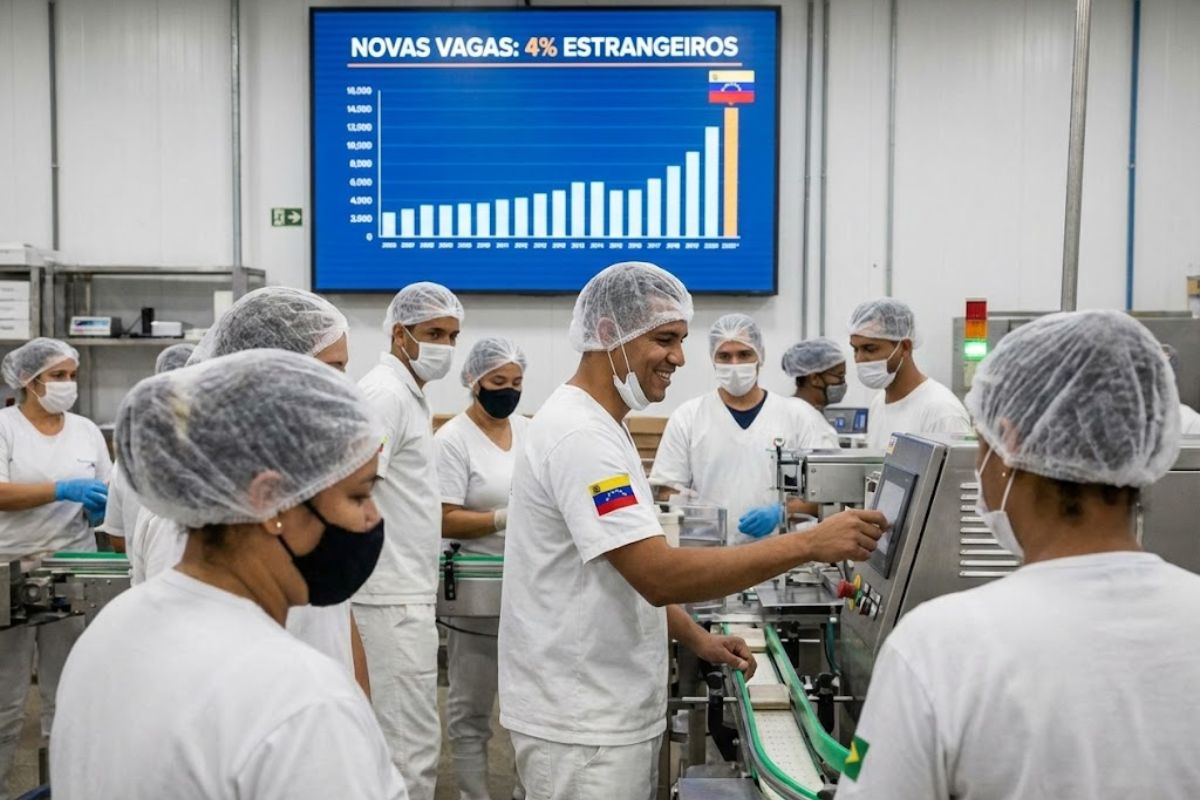
With Historic Low Unemployment and Labor Shortage, the Brazilian Formal Job Market Begins to Welcome Immigrants in Mass, Pulling Venezuelans into Factories and Essential Services and Exposing Challenges of Qualification, Social Integration, and Labor Protection Across the Country and in Migration Policy.
Amid the rise of Latin American immigration between 2020 and 2025 and the continuous decline in the unemployment rate, foreigners already account for 4% of new formal job contracts in the Brazilian labor market, according to Caged data. Just between January and October 2025, the net formal job creation for people of other nationalities reached 73,400, within a total of 1.8 million new positions created in the period.
In the same timeframe, almost half of the foreign hires are Venezuelans, who make up 47.8% of the admissions. Haitians account for 8.2%, Argentinians for 4.8%, and Paraguayans for 4.3%, creating a new map of the formal workforce in the country and reinforcing Brazil as a regional attraction amid economic and humanitarian crises in the countries of origin.
Explosion of Hirings in Five Years

Between 2020 and 2025, the number of foreigners hired with formal contracts surged by nearly 200%, according to recent Caged data.
-
Future profession with immediate earnings: Specialist reveals how a solar energy technician earns R$ 8,000 per month by taking advantage of the explosion in demand across the entire country.

-
Work from 8:30 AM to 5:30 PM with a 1-hour break at Sicredi as a Customer Service Assistant and receive a salary + benefits such as life insurance, dental plan, partnerships, Gympass, and much more in job openings across various states.

-
Subsea7 has job openings: the company has offshore and onshore positions available in 2026 for operators, pilots, supervisors, engineers, and much more.

-
Unimed is hiring candidates with and without experience! More than 10 job openings for Assistants, Analysts, Kitchen Assistants, and much more!


In 2020, the year the market eliminated jobs due to the pandemic, there were 24,800 hires of people from other nationalities.
In 2021, the volume dropped to just over 5,000, equivalent to 0.19% of the total job balance.
Starting in 2022, the trend reversed.
The number of foreign hires rose to 35,900 in 2022, climbed to 47,300 in 2023, reached 71,100 in 2024, and has already surpassed that level in just ten months of 2025, maintaining a share of approximately 4% of new formal job openings.
The trajectory indicates consolidation of immigrants’ presence in the hiring flow, rather than just a temporary spike.
Unemployment at Historic Low and Labor Shortage
The increase in foreign participation occurs alongside the rapid decline in unemployment. In 2021, the unemployment rate was at 12.1%.
In 2022, it dropped to 8.3%; in 2023, to 7.6%; and in 2024, to 6.2%. In the quarter ending in October 2025, it reached 5.4%, the lowest level since IBGE’s series began in 2012.
This heated environment helps explain the formal job market’s openness to immigrants.
With fewer available workers and more vacancies open, companies are expanding their recruitment beyond traditional borders, especially in roles that are harder to fill.
Employee turnover is also at a record high: 36.1% of formal workers changed jobs in the last 12 months until October, compared to less than 25% pre-pandemic.
Sectors That Hire Foreigners the Most
Foreigners are concentrated in roles that are hard to fill for Brazilian companies.
The production line feeder position leads, with a net positive of 13,800 immigrant hires by October 2025.
Following are roles such as cleaners, with around 5,300 hires, butchers, with 4,700, and construction laborers, with 4,100.
A survey by Fiesp shows that 20.5% of São Paulo industries that sought new employees between early 2024 and March were unable to hire.
The combination of open vacancies, relatively low entry wages, and low attractiveness for local workers pushes companies to turn to immigrants to maintain operations, especially in labor-intensive activities with high turnover.
Venezuela, Haiti and Neighbors: Who is Coming to Brazil
Census 2022 data from IBGE indicates that the Venezuelan influx reached unprecedented dimensions in just over a decade, with an increase from 2,900 to 271,500 Venezuelans arriving in the country between 2010 and 2022, amid the worsening economic and political crisis under Nicolás Maduro’s government.
They now form the main national group among the foreign hires.
Humanitarian crises in other countries also explain the new composition of the Brazilian formal job market.
In the case of Haitians, the number of individuals who arrived in Brazil grew by 106,294% in 12 years until 2022, increasing from 54 to 57,453, according to IBGE.
Argentinians and Paraguayans complete the list of the main nationalities, driven by economic instability and the perception of greater relative stability in Brazil.
Adaptation and Requalification Stories
The statistical trajectory translates into individual stories of new beginnings.
The Venezuelan Maria Hernandez, 32, a graduate in electrical engineering and a former physics teacher in her country, arrived in Brazil in 2019 with her family seeking stable income.
Without immediate recognition of her qualifications, she started in cleaning jobs until she secured a formal position as a bilingual customer service analyst and later, as a training analyst at a multinational customer service company.
Venezuelan Julio César, 27, passed through Erechim in Rio Grande do Sul, where he worked for two years at a bus company, and through Cascavel in Paraná, working in a chicken processing plant, before taking a formal position as a housekeeper at an international hotel chain.
The challenges of adaptation include language and understanding basic routines, but they are mitigated by the stability of a job with a formal contract, which was non-existent in their previous experience in Venezuela.
Regional Concentration and Pressure on Public Policies
Caged data shows that most formally hired Venezuelans are concentrated in the South region.
Between January and October 2025, 25,900 found jobs with formal contracts in the region, notably in Santa Catarina, which accounts for 10,800 hires, followed by Paraná with 9,300, and Rio Grande do Sul with 5,600.
This distribution reinforces the role of industrialized regions and those with a strong service sector in absorbing foreign labor.
At the same time, it increases the challenge of coordinating policies for reception, professional qualification, Portuguese language teaching, and combating informality, to prevent part of this group from migrating to precarious activities or being left out of social protection.
Future Challenges for the Brazilian Formal Job Market
The increase in immigrant participation in hiring raises a medium and long-term agenda.
On one hand, foreigners help fill gaps in sectors with labor shortages, preventing loss of production and job closures.
On the other hand, they require a revision of integration policies, validation of diplomas, combating discriminatory practices, and strengthening labor inspections.
According to specialists, the Brazilian formal job market is likely to permanently coexist with a greater presence of foreigners if unemployment remains low and Latin American immigration remains high, making the establishment of clear and stable rules even more important for local workers and immigrants.
Do you currently work with foreign colleagues or are you considering migrating to another region or country in search of formal employment? How does this shift in the job market impact your professional reality today?










Seja o primeiro a reagir!