





 Portuguese
  English
  Spanish
  10 min of reading
  0 comments


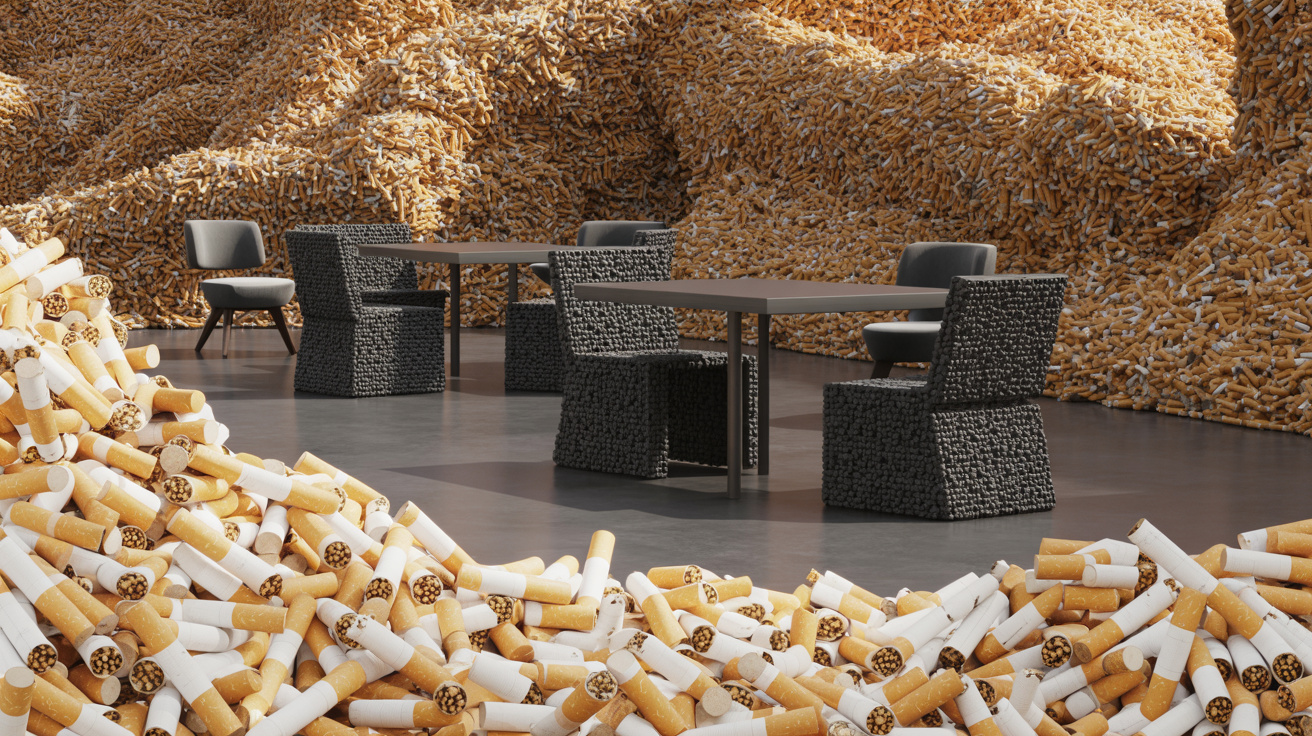
Cigarette Butts Dominate Urban Waste in Europe: 4.5 Trillion Are Discarded Each Year and Can Contaminate Up to 8 Liters of Water Each. See How Companies in the Netherlands and France Recycle Filters and Transform Toxic Plastic into Sustainable Urban Furniture.
In the canals of Amsterdam and on the sidewalks of Leiden, urban collectors identify cigarette butts as the most difficult and time-consuming waste to collect. Globally, 4.5 trillion butts are discarded into the environment each year, making them the most abundant item in beach cleanup campaigns in Europe and around the world. Each butt is made of cellulose acetate, a non-biodegradable plastic that takes up to 10 years to decompose, releasing arsenic, lead, nicotine, and more than 7,000 toxic chemicals that contaminate 8 liters of water per unit. In the Netherlands, pioneering companies like Peukenzee and initiatives across Europe have developed processes to collect and recycle these butts, turning them into hard boards, transport pallets, park benches, and coatings for urban furniture.
The French company MéGo! is the first European company in the sector to extract cellulose from the filters and transform it into sheets that become tablet stands and street furniture, while the remaining tobacco and ashes are composted.
Cigarette Butts: The Most Discarded Item on the Planet
Cigarette butts have earned an ignoble title: they are officially the most abundant item in cleanup operations around the world. According to data from the International Coastal Cleanup, Ghana leads the statistics with 3.5 million butts collected on beaches, followed by Canada with 167,811 and Chile with 73,405 units.
-
He started running at 66 years old, broke records at 82, and is now a subject of study for having a metabolic age comparable to that of a 20-year-old, in a case that is intriguing scientists and inspiring the world.

-
Oldest tree on the planet reappears after 130 years of searches: Wattieza, 385 million years old, was 10 meters tall and had no leaves or seeds; Gilboa fossils in New York solved the mystery in 2007.

-
A 48-square-meter house assembled in hours with 4,000 bricks made of recycled plastic that does not absorb moisture, has natural thermal insulation, and costs less than 90,000 reais in a complete kit.

-
Luciano Hang revealed that Havan’s air fleet has already accumulated more than 20,000 landings, 10,000 flight hours, and 6 million kilometers traveled, and he says that without the planes, the company would never have grown so quickly.


In Europe, citizen science campaigns have collected nearly 700,000 items of waste, with cigarette butts being the most individually found item on beaches.

Global numbers are even more alarming. Of the 5.7 trillion cigarettes produced worldwide in 2016, studies show that between 55% and 75% are improperly discarded into the environment. This means that between 0.3 and 0.8 million metric tons of plastic from cigarette filters are released into the environment each year. Just in California, smokers buy more than 12 billion cigarettes annually.
Butts are everywhere: on sidewalks, in storm drains, on beaches, in parks, floating in canals. A study at the University of Victoria in Canada collected 8,000 butts from the campus ground between December 2019 and February 2020 just to document the extent of the problem. In urban areas of Brazil, cigarette butts accounted for 91.5% of the miscellaneous waste category collected in cleanup operations.
What Makes Butts So Problematic
Many people incorrectly believe that cigarette filters are made of paper or cotton. In fact, they are made of cellulose acetate, a type of modified plastic based on biopolymer. This material does not biodegrade due to additives in the plastic and its physical and chemical characteristics.
A butt abandoned on the ground can take 2 to 10 years to decompose, breaking down into microplastics that infiltrate the soil and end up in the water.
Before degrading, each butt acts as a toxic sponge. During the act of smoking, the filter absorbs more than 7,000 chemicals present in tobacco smoke, including nicotine, arsenic, lead, cadmium, chromium, polycyclic aromatic hydrocarbons, and volatile organic compounds. At least 70 of these substances are recognized as carcinogenic.
What Happens When a Cigarette Butt Is Discarded on the Street
When a butt is discarded in the environment, these toxins begin to leach out. Research shows that a single cigarette butt can contaminate up to 8 liters of groundwater or surface water. Studies in aquatic environments demonstrate that the leachate from cigarette butts negatively affects the survival and behavior of freshwater invertebrates.
Fish and birds confuse butts with food and ingest them, resulting in poisoning or intestinal blockages.
The impact on soil and plants is equally grave. Research shows that exposure to butts hampers the germination and growth of plants. It takes no more than 1 butt per square meter to elevate nicotine levels in agricultural crops such as fruits, teas, spices, and medicinal plants to more than 20 times the maximum residue level of 0.01 mg of nicotine per kg that was established in the ban on insecticides containing nicotine in the European Union in 2009.
The Recycling Industry of Butts
In light of this catastrophic scenario, companies specializing in recycling cigarette butts and turning them into new products have emerged. TerraCycle, an American company with global operations, is a pioneer in the field.
Since 2012, TerraCycle has established direct partnerships with the tobacco industry, including subsidiaries of large groups like Santa Fe Natural Tobacco Company (owned by Reynolds American, which in turn is owned by British American Tobacco) to fund butt recovery systems.
The process developed by TerraCycle works as follows: first, the collected butts go through sorting and cleaning. Next, the cellulose acetate material is extracted from the filters. This acetate is then recycled into usable forms such as plastic pellets that serve as raw material for manufacturers.
The organic residual components, such as ashes, tobacco, and paper, are separated and composted. With the plastic pellets, the company produces transport pallets, plastic storage containers, park benches, and other usable items.
Since 2009, the Reynolds organization has invested over US$ 15 million in education, prevention, cleanup, and butt recycling through partnerships with Keep America Beautiful and TerraCycle. In 2023, Santa Fe Natural Tobacco Company funded the installation of 447 cigarette collection receptacles for recycling with TerraCycle solely in the United States.
MéGo!
In France, the company MéGo! (a play on the French word “mégot,” slang for cigarette butts) was the first company in Europe and possibly the world to develop a complete process for recycling butts into furniture and objects. MéGo! has developed an advanced method to recover cellulose from cigarette filters.

This cellulose is then transformed into sheets that can be used to create urban furniture or household objects, such as computer tablet stands.
The remaining tobacco and ashes are composted until usable, and the company is even exploring the possibility of breaking down toxic waste with fungi for composting purposes.
Dutch Initiatives Against Butts
In the Netherlands, the issue of cigarette butts is taken very seriously. Urban waste collectors in cities like Leiden report that collecting butts is the main problem in public cleaning and the most time-consuming task.
A collector named Spencer, who works cleaning canals and collecting butts, uses specialized devices of various types so he doesn’t have to bend over all the time. He notes that cigarette butts are the hardest waste to collect.
The company Peukenzee, founded by two Dutch students, was created specifically to address the recycling of cigarettes in the Netherlands. They and their growing team conduct research on the most economical and ecological way to recycle cigarette butts. For their research, they need large quantities of cigarette filters.
Leiden University implemented an awareness campaign on May 30, 2022, placing special receptacles in seven university buildings to collect the butts that people threw on the ground.
The university wanted to show how many butts were being removed from the environment. At the end of the campaign, all the contents of the receptacles were donated to Peukenzee to support their research on recycling cigarette filters.
In July 2021, eleven environmental organizations organized a massive collection of discarded cigarette butts throughout the Netherlands, ending on Saturday, July 10. The campaign “plastic peukmeuk” invited people in 60 different locations to start collecting butts at 11:30 a.m. and post photos of their work by 3 p.m. on a special app called Litterati.
The activists, who walked from Amsterdam’s central station to Dam Square, used the collected cigarette butts to create a giant artwork inspired by their hashtag #nofilterplease.
Creative Recycling Applications
In addition to urban furniture, researchers around the world have discovered surprising uses for recycled cigarette butts. In Australia, the Royal Melbourne Institute of Technology (RMIT) demonstrated that fired clay bricks containing only 1% of recycled cigarette butt content have the same strength as regular bricks but require less energy for production.
Researchers in China discovered that an extract derived from soaking old cigarette filters in water reduces rust on steel by more than 90%. In Vancouver, Canada, a citywide campaign is underway to collect discarded cigarette filters and recycle them into transport pallets as well as other industrial products.
Cigarette Butt Paper?
In the Brazilian city of Votorantim, people are making paper from cigarette butts. Every week, about 60 kg of butts are collected and sent to a recycling center. There, the butts are separated from their toxic chemicals by heating them to 100°C for 5 hours.
The mixture is then screened and washed, leaving behind a cellulose material that is eventually used as raw material for paper. Only 35 butts are needed to produce a single A4 sheet. The resulting papers are then used for educational purposes in regional schools.
Indian interior designer Sachi Tungare transforms this waste material into beautiful and useful objects. The soft cotton-like texture found in cigarette butts can be used to create new clothing through recycling.
Some companies are even experimenting with creating cotton swab stems from the cotton structure found in collected cigarette butts.
The Limits and Challenges of Recycling
Despite these advances, experts warn that butt recycling faces significant technical, environmental, and economic limitations. The European Union has classified cigarette filters among the products covered by the Single-Use Plastics Directive due to their significant contribution to pollution and their very low recycling potential.
Unlike homogeneous plastics such as PET bottles, filters are made of a non-biodegradable plastic and are contaminated with toxic substances absorbed during product use. Additionally, the opacity of the processes applied by certain specialized structures, particularly in private recycling initiatives for cigarette butts, limits the possibility of rigorous assessment.
Projects led by companies like TerraCycle, Ecomégot, or EconCare are generally not the subject of peer-reviewed scientific publications.
The traceability of recycling waste, its exact composition, its destination, and its impact on health remain poorly documented. There are legitimate concerns about whether the recycling process truly neutralizes toxins or merely redistributes them into new products.
The scale of the problem is also discouraging. Recycling will never keep pace with the production of single-use plastics like cigarettes. Even with all the combined recycling programs, the amount of butts processed is a tiny fraction of the trillions discarded annually.
Alternative Solutions Beyond Recycling
Recognizing the limitations of recycling, various jurisdictions are exploring other approaches. Politicians in several places have introduced bills in legislatures to ban single-use cigarette filters, but these bills tend to die before becoming law. The tobacco industry strongly opposes these bans.
New Zealand has adopted a more radical strategy: lawmakers have passed legislation that will prohibit anyone born after 2008 from legally buying tobacco products. Though the term “legally” is operative, the idea is to drastically reduce the number of smokers over time.
Another approach is to make it easier for smokers not to throw butts on the ground. The Surfrider Foundation on Vancouver Island, British Columbia, tried to distribute free pocket ashtrays, but the program failed for a tragically comical reason: smokers said the smell was too bad. “I mean, it’s disgusting,” explained Lynn Wharram, president of the foundation’s chapter.
A more successful strategy involved placing 20 cigarette disposal containers in obvious locations downtown Victoria, outside bars, event spaces, and bus stops. This strategy interrupts the flow of butts from the streets and storm drains to the sea. However, a dilemma arises: places like public beaches and parks, where children play and people enjoy fresh air, are often off-limits to smokers. “Parks don’t want us to put receptacles there because they don’t want to promote smoking,” Wharram said.
An Uncomfortable Truth About Filters
A little-known but crucial fact is that cigarette filters do not have an overall positive effect on health. Filters were added to cigarettes in the 1950s when it became increasingly clear that smoking causes lung cancer and other serious diseases. They reduce tar and nicotine inhalation as measured by machines, which is why nearly 99% of smokers use filtered cigarettes.
However, the reduction measured by machines does not necessarily translate to real exposure reduction for human smokers, who adapt their behavior by smoking more intensely or blocking the filter’s ventilation holes. Filters created a false sense of security that allowed the tobacco industry to continue selling a deadly product while appearing to care about health.
Now, decades later, we are left with trillions of pieces of toxic plastic scattered across the planet, with no viable solution for dealing with them.
The Waste That Reveals Our Relationship with Consumption
Cigarette butts are more than just waste. They are a visible marker of our dysfunctional relationship with single-use products, our inability to hold manufacturers accountable for the waste their products create, and our tendency to treat the environment as an infinite dump.
The good news is that recycling initiatives are turning an environmental problem into raw material.

Every collected butt is one that doesn’t contaminate water, doesn’t poison wildlife, and doesn’t decompose into microplastics. Companies like Peukenzee in the Netherlands, MéGo! in France, and TerraCycle globally are proving that it is technically possible to give a second life to this waste.
The bad news is that this will never be enough. The real solution will not come from better recycling, but from smoking less and ideally eliminating plastic filters from cigarettes altogether. Until then, every butt collected from the street and transformed into a park bench is a small victory in a much larger war against plastic pollution.








-

-

-

-

-

-

33 pessoas reagiram a isso.